Êxodo 3
Wycliffe Bible · Toque num versículo para ver as referências cruzadas.
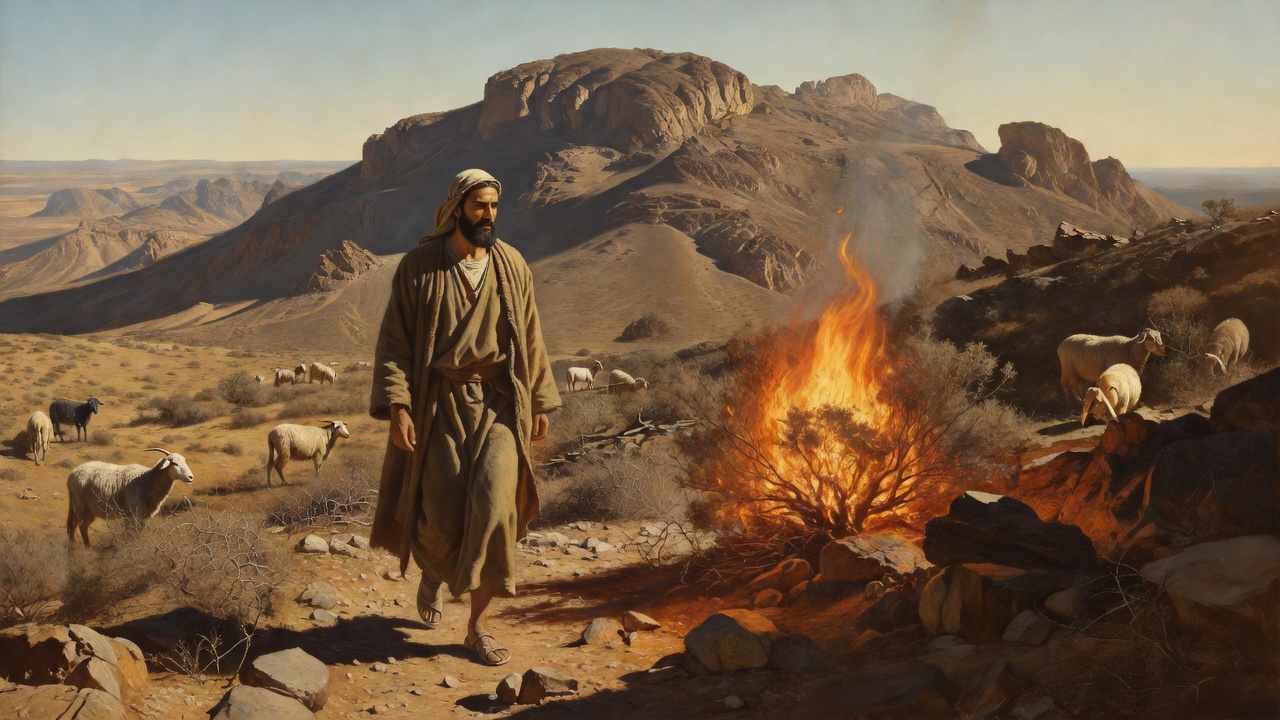
Moses at the Burning Bush
1Forsothe Moises kepte the scheep of Jetro, `his wyues fadir, preest of Madian; and whanne he hadde dryue the floc to the ynnere partis of deseert, he cam to Oreb, the hil of God. 2Forsothe the Lord apperide to hym in the flawme of fier fro the myddis of the buysch, and he seiy that the buysch brente, and was not forbrent. 3Therfor Moyses seide, Y schal go and schal se this greet siyt, whi the buysch is not forbrent. 4Sotheli the Lord seiy that Moises yede to se, and he clepide Moises fro the myddis of the buysch, and seide, Moyses! Moises! Which answeride, Y am present. 5And the Lord seide, Neiye thou not hidur, but vnbynde thou the scho of thi feet, for the place in which thou stondist is hooli lond. 6And the Lord seide, Y am God of thi fadir, God of Abraham, and God of Isaac, and God of Jacob. Moises hidde his face, for he durste not biholde ayens God. 7To whom the Lord seide, Y seiy the affliccion of my puple in Egipt, and Y herde the cry therof, for the hardnesse of hem that ben souereyns of werkis. 8And Y knew the sorewe of the puple, and Y cam down to delyuere it fro the hondis of Egipcians, and lede out of that lond in to a good lond and brood, into a lond that flowith with milk and hony, to the places of Cananey, and of Ethei, of Amorrey, and of Feresei, of Euey, and of Jebusei. 9Therfor the cry of the sones of Israel cam to me, and Y seiy the turment of hem, bi which thei ben oppressid of Egipcians. 10But come thou, I schal sende thee to Farao, that thou lede out my puple, the sones of Israel, fro Egipt. 11And Moises seide to hym, Who am Y, that Y go to Farao, and lede out the sones of Israel fro Egipt? 12And the Lord seide to Moises, Y schal be with thee, and thou schalt haue this signe, that Y haue sent thee, whanne thou hast led out my puple fro Egipt, thou schalt offre to God on this hil. 13Moises seide to God, Lo! Y schal go to the sones of Israel, and Y schal seie to hem, God of youre fadris sente me to you; if thei schulen seie to me, what is his name, what schal Y seie to hem? 14The Lord seide to Moises, Y am that am. The Lord seide, Thus thou schalt seie to the sones of Israel, He that is sente me to you. 15And eft God seide to Moises, Thou schalt seie these thingis to the sones of Israel, The Lord God of youre fadris, God of Abraham, and God of Isaac, and God of Jacob, sente me to you; this name is to me with outen ende, and this is my memorial in generacioun and in to generacioun. 16Go thou, gadere thou the eldere men, that is, iugis, of Israel, and thou schalt seie to hem, The Lord God of youre fadris apperide to me, God of Abraham, and God of Ysaac, and God of Jacob, and seide, Y visitynge haue visitid you, and Y seiy alle thingis that bifelden to you in Egipt; 17and Y seide, that Y lede out you fro the affliccioun of Egipt in to the lond of Cananey, and of Ethei, and of Amorrei, and of Ferezei and of Euei, and of Jebusei, to the lond flowynge with mylk and hony. 18And thei schulen here thi vois; and thou schalt entre, and the eldere men of Israel to the kyng of Egipt, and thou schalt seie to hym, The Lord God of Ebrews clepide vs; we schulen go the weie of thre daies in to wildirnesse, that we offre to oure Lord God. 19But Y woot, that the kyng of Egipt schal not delyuere you that ye go, but bi strong hond; 20for Y schal holde forthe myn hond, and I schal smyte Egipt in alle my marueils, whiche Y schal do in the myddis of hem; aftir these thingis he schal delyuere you. 21And Y schal yyue grace to this puple bifore Egipcians, and whanne ye schulen go out, ye schulen not go out voide; 22but a womman schal axe of hir neiyboresse and of her hoosteesse siluerne vesselis, and goldun, and clothis, and ye schulen putte tho on youre sones and douytris, and ye schulen make nakid Egipt.
Você sabia?
O chamado de Moisés na sarça ardente
- Moisés está pastoreando em Midiã quando este capítulo começa. Os midianitas eram uma tribo árabe nômade, descendente de Midiã, o quarto filho de Abraão com Quetura, cujo nome se explica como contenda. Viviam sobretudo no deserto ao norte da Arábia, e a península do Sinai era pasto para seus rebanhos; foi ali, depois de fugir do Egito, que Moisés se tornou servo e, em seguida, genro do sacerdote.Fontes: o próprio texto bíblico · Midian · Midian
- Seu sogro é Jetro, chamado sacerdote de Midiã. O Dicionário Bíblico de Easton (1897) identifica esse sacerdote com Raguel e diz que, se os dois nomes pertencem ao mesmo homem, Raguel pode ser considerado seu nome pessoal e Jetro, que significa excelência, um título oficial.Fontes: o próprio texto bíblico · Jethro
- Moisés conduz o rebanho até Horebe, o monte de Deus. O nome é explicado como deserto, ou monte, do chão ressecado, um termo geral para toda a cordilheira da qual o Sinai era um dos cumes; o Dicionário Bíblico de Easton (1897) dá à cordilheira o nome moderno de Jebel Musa e a descreve como um enorme bloco de cerca de duas milhas de comprimento por cerca de uma milha de largura, com uma planície muito ampla chamada Er Rahah na extremidade nordeste, onde os israelitas depois acamparam por quase um ano.Fontes: o próprio texto bíblico · Horeb
Notas escritas com auxílio de IA a partir de fontes abertas (Theographic Bible Metadata, CC BY-SA 4.0; Easton’s Bible Dictionary, domínio público) e revisadas antes de publicar.
Lugares deste capítulo
- Midian · 28.495, 35.012 · versículo 1
- Mount Horeb · Hoje: Jebel Musa · 28.540, 33.973 · versículo 1
- Egypt · 30.129, 31.308 · versículos 7, 8, 10, 11, 12, 16, 17, 18, 19, 20, 22
Só aparecem lugares com identificação de alta confiança (90% ou mais segundo as fontes acadêmicas reunidas pelo OpenBible). Mapa da época: DARE (Digital Atlas of the Roman Empire), CC BY 4.0; mapa atual: © colaboradores do OpenStreetMap; lugares: OpenBible.info (CC BY 4.0).
Créditos e licença desta tradução
Wycliffe Bible
This is the Pentateuch and Gospels from The Holy Bible, containing the Old and New Testaments, with the apocryphal books, in the earliest English version made from the latin Vulgate by John Wycliffe and his followers. c.1395
Public Domain
Language: Middle English (English)
Dialect: Middle
Translation by: John Wycliffe
2016-11-08
Títulos de seção adaptados da Berean Standard Bible (domínio público); não fazem parte do texto bíblico desta tradução.
Fonte: http://ebible.org/engWycliffe/ · eBible.org