Exodus 3
Wycliffe Bible · Tap a verse to see its cross-references.
Moses at the Burning Bush
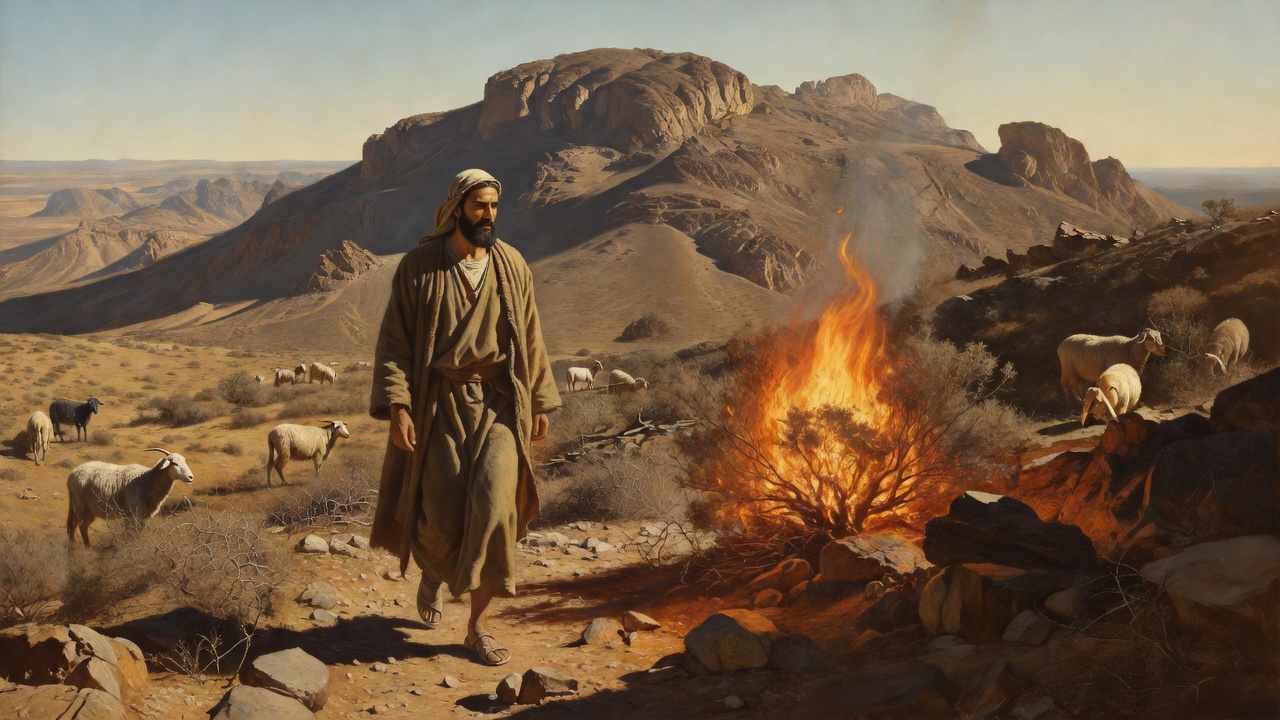
1Forsothe Moises kepte the scheep of Jetro, `his wyues fadir, preest of Madian; and whanne he hadde dryue the floc to the ynnere partis of deseert, he cam to Oreb, the hil of God. 2Forsothe the Lord apperide to hym in the flawme of fier fro the myddis of the buysch, and he seiy that the buysch brente, and was not forbrent. 3Therfor Moyses seide, Y schal go and schal se this greet siyt, whi the buysch is not forbrent. 4Sotheli the Lord seiy that Moises yede to se, and he clepide Moises fro the myddis of the buysch, and seide, Moyses! Moises! Which answeride, Y am present. 5And the Lord seide, Neiye thou not hidur, but vnbynde thou the scho of thi feet, for the place in which thou stondist is hooli lond. 6And the Lord seide, Y am God of thi fadir, God of Abraham, and God of Isaac, and God of Jacob. Moises hidde his face, for he durste not biholde ayens God. 7To whom the Lord seide, Y seiy the affliccion of my puple in Egipt, and Y herde the cry therof, for the hardnesse of hem that ben souereyns of werkis. 8And Y knew the sorewe of the puple, and Y cam down to delyuere it fro the hondis of Egipcians, and lede out of that lond in to a good lond and brood, into a lond that flowith with milk and hony, to the places of Cananey, and of Ethei, of Amorrey, and of Feresei, of Euey, and of Jebusei. 9Therfor the cry of the sones of Israel cam to me, and Y seiy the turment of hem, bi which thei ben oppressid of Egipcians. 10But come thou, I schal sende thee to Farao, that thou lede out my puple, the sones of Israel, fro Egipt. 11And Moises seide to hym, Who am Y, that Y go to Farao, and lede out the sones of Israel fro Egipt? 12And the Lord seide to Moises, Y schal be with thee, and thou schalt haue this signe, that Y haue sent thee, whanne thou hast led out my puple fro Egipt, thou schalt offre to God on this hil. 13Moises seide to God, Lo! Y schal go to the sones of Israel, and Y schal seie to hem, God of youre fadris sente me to you; if thei schulen seie to me, what is his name, what schal Y seie to hem? 14The Lord seide to Moises, Y am that am. The Lord seide, Thus thou schalt seie to the sones of Israel, He that is sente me to you. 15And eft God seide to Moises, Thou schalt seie these thingis to the sones of Israel, The Lord God of youre fadris, God of Abraham, and God of Isaac, and God of Jacob, sente me to you; this name is to me with outen ende, and this is my memorial in generacioun and in to generacioun. 16Go thou, gadere thou the eldere men, that is, iugis, of Israel, and thou schalt seie to hem, The Lord God of youre fadris apperide to me, God of Abraham, and God of Ysaac, and God of Jacob, and seide, Y visitynge haue visitid you, and Y seiy alle thingis that bifelden to you in Egipt; 17and Y seide, that Y lede out you fro the affliccioun of Egipt in to the lond of Cananey, and of Ethei, and of Amorrei, and of Ferezei and of Euei, and of Jebusei, to the lond flowynge with mylk and hony. 18And thei schulen here thi vois; and thou schalt entre, and the eldere men of Israel to the kyng of Egipt, and thou schalt seie to hym, The Lord God of Ebrews clepide vs; we schulen go the weie of thre daies in to wildirnesse, that we offre to oure Lord God. 19But Y woot, that the kyng of Egipt schal not delyuere you that ye go, but bi strong hond; 20for Y schal holde forthe myn hond, and I schal smyte Egipt in alle my marueils, whiche Y schal do in the myddis of hem; aftir these thingis he schal delyuere you. 21And Y schal yyue grace to this puple bifore Egipcians, and whanne ye schulen go out, ye schulen not go out voide; 22but a womman schal axe of hir neiyboresse and of her hoosteesse siluerne vesselis, and goldun, and clothis, and ye schulen putte tho on youre sones and douytris, and ye schulen make nakid Egipt.
Did you know?
The Call of Moses at the Burning Bush
- Moses is shepherding in Midian when this chapter begins. The Midianites were a nomadic Arabian tribe descended from Midian, Abraham's fourth son by Keturah, whose name is explained as strife. They lived chiefly in the desert north of Arabia, and the Sinai peninsula was grazing land for their flocks; it was there, after fleeing Egypt, that Moses became a servant and then the priest's son-in-law.Sources: the Bible text itself · Midian · Midian
- His father-in-law is Jethro, called the priest of Midian. Easton's Bible Dictionary (1897) equates that priest with Raguel and says that, if the two names belong to one man, Raguel may be regarded as his personal name and Jethro, meaning excellency, as an official title.Sources: the Bible text itself · Jethro
- Moses leads the flock to Horeb, the mountain of God. The name is explained as desert, or mountain, of the dried-up ground, a general term for the whole range of which Sinai was one summit; Easton's Bible Dictionary (1897) gives the modern name of the range as Jebel Musa and describes a huge block about two miles long and about one mile wide, with a very spacious plain called Er Rahah at its north-east end, where the Israelites later camped for nearly a year.Sources: the Bible text itself · Horeb
Notes written with AI assistance from open sources (Theographic Bible Metadata, CC BY-SA 4.0; Easton’s Bible Dictionary, public domain) and reviewed before publishing.
Places in this chapter
- Midian · 28.495, 35.012 · verse 1
- Mount Horeb · Today: Jebel Musa · 28.540, 33.973 · verse 1
- Egypt · 30.129, 31.308 · verses 7, 8, 10, 11, 12, 16, 17, 18, 19, 20, 22
Only places identified with high confidence are shown (90% or more according to the scholarly sources compiled by OpenBible). Period map: DARE (Digital Atlas of the Roman Empire), CC BY 4.0; modern map: © OpenStreetMap contributors; places: OpenBible.info (CC BY 4.0).
Credits and license for this translation
Wycliffe Bible
This is the Pentateuch and Gospels from The Holy Bible, containing the Old and New Testaments, with the apocryphal books, in the earliest English version made from the latin Vulgate by John Wycliffe and his followers. c.1395
Public Domain
Language: Middle English (English)
Dialect: Middle
Translation by: John Wycliffe
2016-11-08
Section headings adapted from the Berean Standard Bible (public domain); they are not part of this translation’s text.
Source: http://ebible.org/engWycliffe/ · eBible.org