Êxodo 2
Wycliffe Bible · Toque num versículo para ver as referências cruzadas.
The Birth and Adoption of Moses
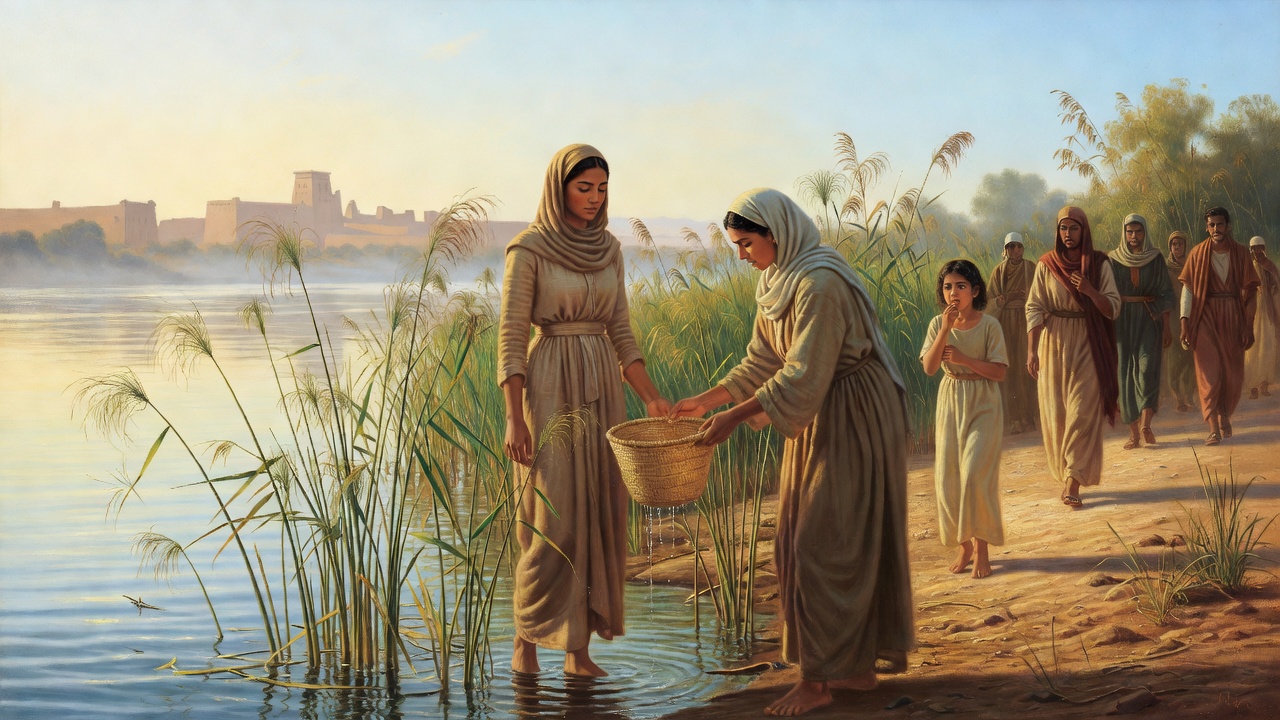
1Aftir these thingis a man of `the hows of Leuy yede out, and took a wijf of his kyn, 2which conseyuede, and childide a sone. And sche seiy hym wel farynge, and hidde him bi thre monethis. 3And whanne sche myyte not hele, thanne sche took a `leep of segge, and bawmede it with tar and pitch, and puttide the yong child with ynne, and puttide hym forth in a `place of spier of the brenke of the flood, 4the while his sistir stood afer, and bihelde the bifalling of the thing. 5Lo! forsothe the douytir of Farao cam doun to be waischun in the flood, and hir damysels walkiden bi the brenke of the flood. And whanne sche hadde seyn a leep in the `place of spier, sche sente oon of hir seruauntessis, 6and sche openyde the leep brouyt to hir, and seiy a litil child wepynge ther ynne. And sche hadde mercy on the child, and seide, It is of the yonge children of Ebrews. 7To whom the `sister of the child seide, Wolt thou that Y go, and clepe to thee an Ebrew womman, that may nurische the yong child? 8She answeride, Go thou. The damysel yede, and clepide the `modir of the child. 9To whom `the douytir of Farao spak, and seide, Take thou this child, and nurische to me; Y schal yyue to thee thi mede. The womman took, and nurischide the child, and bitook hym woxun to `the douytir of Farao, 10whom sche purchaside `in to the place of sone; and sche clepide his name Moises, and seide, For Y took hym fro the watir.
The Rejection and Flight of Moses
11In tho daies, aftir that Moises encreesside, he yede out to hise britheren, and seiy the turment of hem, and a man Egipcian smytynge `oon of Ebrews, hise britheren. 12And whanne he hadde biholdun hidur and thidir, and hadde seyn, that no man was present, he killide the Egipcian, and hidde in soond. 13And he yede out in another dai, and seiy tweyne Ebrews chidynge, and he seide to hym that dide wrong, Whi smytist thou thi brother? 14Which answeride, Who ordeynede thee prince, ether iuge on vs? Whether thou wolt sle me, as thou killidist yisterdai the Egipcian? Moises dredde, and seide, Hou is this word maad opun? 15And Farao herde this word, and souyte to sle Moyses, which fledde fro his siyt, and dwellide in the lond of Madian, and sat bisidis a pit. 16Forsothe seuene douytris weren to the preest of Madian, that camen to drawe watir; and whanne the trouyis weren fillid, thei coueitiden to watere `the flockis of her fadir. 17Scheepherdis camen aboue, and dreuen hem awei; and Moises roos, and defendide the dameselis; and he watride `the scheep of hem. 18And whanne thei hadden turned ayen to Jetro, her fadir, he seide to hem, Whi camen ye swiftliere than ye weren wont? 19Thei answeriden, A man of Egipt delyuerede vs fro the hond of scheepherdis; ferthermore and he drow watir with vs, and yaf drynk to the scheep. 20And he seide, Where is that man? whi leften ye the man? clepe ye hym, that he ete breed. 21Therfor Moises swoor, that he wolde dwelle with Jetro; and he took a wijf, Sefora, `the douyter of Jetro. 22And sche childide a sone to hym, whom he clepide Gersan, and seide, Y was a comelyng in an alyen lond. Forsothe sche childide an othir sone, whom he clepide Eliezer, and seide, For God of my fadir is myn helpere, and delyuerede me fro the hond of Farao.
God Hears the Cry of the Israelites
23Forsothe aftir myche tyme the kyng of Egipt diede, and the sones of Israel inwardli weiliden for werkis, and crieden, and the cry of hem for werkis stiede to God. 24And he herde the weilyng of hem, and he hadde mynde of the boond of pees, which he hadde maad with Abraham, Ysaac, and Jacob; and he bihelde the sones of Israel, 25and knewe hem.
Você sabia?
O nascimento e a fuga de Moisés
- A filha do faraó deu ao menino o nome de Moisés e explicou que o havia tirado da água. O Dicionário Bíblico de Easton (1897) liga o nome dele a “tirado”, ou à palavra egípcia mesu, “filho” — o elemento a partir do qual o dicionário também explica Ramsés como “filho real”.Fontes: o próprio texto bíblico · Moses
- Em Êxodo 2, uma filha de Levi esconde o filho por três meses, e a filha do faraó, ao achá-lo entre os juncos do Nilo, reconhece uma criança hebreia. O Dicionário Bíblico de Easton (1897) liga a aflição dos israelitas ao “novo rei que não conhecera a José”, por muito tempo tido como Aahmes I, chamado Amosis por Josefo, embora o dicionário, citando descobertas então recentes, o identifique como Seti. O sofrimento deles, diz a obra, começou depois que os hicsos, senhores do Egito por cerca de cinco séculos, foram expulsos e a antiga dinastia foi restaurada.Fontes: o próprio texto bíblico · Pharaoh
- Depois que o faraó procurou matá-lo, Moisés fugiu para Midiã e sentou-se junto a um poço; mais tarde casou-se com Zípora, uma das sete filhas do sacerdote de Midiã. Os midianitas eram árabes nômades, descendentes de Midiã, o quarto filho de Abraão com Quetura, e pastoreavam seus rebanhos na península do Sinai e no deserto ao norte da península Arábica. Neste capítulo o sacerdote se chama Reuel, a quem o Dicionário Bíblico de Easton (1897) chama Raguel, considerando essa forma seu nome pessoal e Jetro — “excelência” — um título oficial, caso os dois sejam identificados.Fontes: o próprio texto bíblico · Midian · Midian · Jethro
Notas escritas com auxílio de IA a partir de fontes abertas (Theographic Bible Metadata, CC BY-SA 4.0; Easton’s Bible Dictionary, domínio público) e revisadas antes de publicar.
Lugares deste capítulo
- Nile · Hoje: Nile River · 31.465, 30.367 · versículos 3, 5
- Midian · 28.495, 35.012 · versículos 15, 16
- Egypt · 30.129, 31.308 · versículo 23
Só aparecem lugares com identificação de alta confiança (90% ou mais segundo as fontes acadêmicas reunidas pelo OpenBible). Mapa da época: DARE (Digital Atlas of the Roman Empire), CC BY 4.0; mapa atual: © colaboradores do OpenStreetMap; lugares: OpenBible.info (CC BY 4.0).
Créditos e licença desta tradução
Wycliffe Bible
This is the Pentateuch and Gospels from The Holy Bible, containing the Old and New Testaments, with the apocryphal books, in the earliest English version made from the latin Vulgate by John Wycliffe and his followers. c.1395
Public Domain
Language: Middle English (English)
Dialect: Middle
Translation by: John Wycliffe
2016-11-08
Títulos de seção adaptados da Berean Standard Bible (domínio público); não fazem parte do texto bíblico desta tradução.
Fonte: http://ebible.org/engWycliffe/ · eBible.org