Êxodo 4
Wycliffe Bible · Toque num versículo para ver as referências cruzadas.
Moses’ Staff
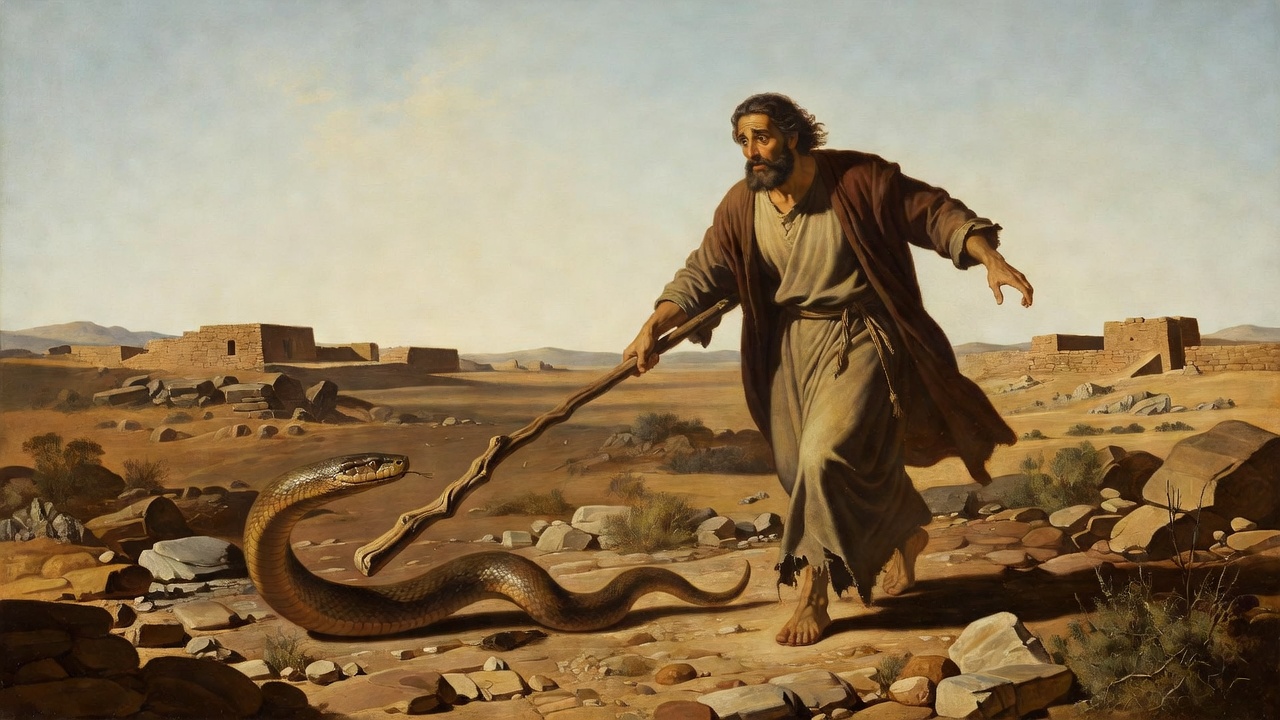
1Moyses answeride, and seide, The comyns schulen not bileue to me, nether thei schulen here my vois; but thei schulen seie, The Lord apperide not to thee. 2Therfor the Lord seide to hym, What is this that thou holdist in thin hond? Moises answeride, A yerde. 3And the Lord seide, Caste it forth into erthe; and he castide forth, and it was turned in to a serpent, so that Moises fledde. 4And the Lord seide, Holde forth thin hond, and take the tail therof; he stretchide forth, and helde, and it was turned in to a yerde. 5And the Lord seide, That thei bileue, that the Lord God of thi fadris apperide to thee, God of Abraham, and God of Isaac, and God of Jacob.
Moses’ Hand
6And the Lord seide eft, Putte thin hond in to thi bosum; and whanne he hadde put it in to the bosum, he brouyte forth it leprouse, at the licnesse of snow. 7The Lord seide, Withdrawe thin hond in to thi bosum; he withdrow, and brouyte forth eft, and it was lijc the tother fleisch. 8The Lord seide, If thei schulen not bileue to thee, nether schulen here the word of the formere signe, thei schulen bileue to the word of the signe suynge; 9that if thei bileuen not sotheli to these twei signes, nether heren thi vois, take thou watir of the flood, and schedde out it on the drie lond, and what euer thing thou schalt drawe vp of the flood, it schal be turned in to blood.
The Appointment of Aaron
10Moises seide, Lord, Y biseche, Y am `not eloquent fro yistirdai and the thridde dai ago; and sithen thou hast spokun to thi seruaunt, Y am of more lettid and slowere tunge. 11The Lord seide to hym, Who made the mouth of man, ether who made a doumb man and `deef, seynge and blynd? whether not Y? 12Therfor go thou, and Y schal be in thi mouth, and Y schal teche thee what thou schalt speke. 13And he seide, Lord, Y biseche, sende thou whom thou schalt sende. 14And the Lord was wrooth ayens Moises, and seide, Y woot, that Aaron, thi brother, of the lynage of Leuy, is eloquent; lo! he schal go out in to thi comyng, and he schal se thee, and schal be glad in herte. 15Speke thou to hym, and putte thou my wordis in his mouth, and Y schal be in thi mouth, and in the mouth of hym; and Y schal schewe to you what ye owen to do. 16He schal speke for thee to the puple, and he schal be thi mouth; forsothe thou schalt be to him in these thingis, that perteynen to God. 17Also take thou this yerde in thin hond, in which thou schalt do myraclis.
Moses Leaves for Egypt
18Moises yede, and turnede ayen to Jetro, his wyues fadir, and seide to hym, Y schal go, and turne ayen to my britheren in to Egipt, that Y se, whether thei lyuen yit. To whom Jetro seide, Go thou in pees. 19Therfor the Lord seide to Moyses in Madian, Go thou, and turne ayen into Egipt; for alle thei ben deed that souyten thi lijf. 20Moises took his wijf, and hise sones, and puttide hem on an asse, and he turnede ayen in to Egipt, and bar the yerde of God in his hond. 21And the Lord seide to hym turnynge ayen in to Egipt, Se, that thou do alle wondris, whiche Y haue put in thin hond, bifore Farao; Y schal make hard his herte, and he schal not delyuere the puple; and thou schalt seie to hym, 22The Lord seith these thingis, My firste gendrid sone is Israel; 23Y seide to thee, delyuere thou my sone, that he serue me, and thou noldist delyuere hym; lo! Y schal sle thi firste gendrid sone. 24And whanne Moises was in the weie, in an yn, the Lord cam to him, and wolde sle hym. 25Sefora took anoon a moost scharp stoon, and circumcidide the yerde of hir sone; and sche towchide `the feet of Moises, and seide, Thou art an hosebonde of bloodis to me. 26And he lefte hym, aftir that sche hadde seid, Thou art an hosebonde of bloodis to me for circumcisioun.
The People Believe Moses and Aaron
27Forsothe the Lord seide to Aaron, Go thou in to the comyng of Moises in to deseert; which yede ayens Moises in to the hil of God, and kisside him. 28And Moises telde to Aaron alle the wordis of the Lord, for whiche he hadde sent Moises; and `he telde the myraclis, whiche the Lord hadde comaundid. 29And thei camen togidere, and gaderiden alle the eldere men of the sones of Israel. 30And Aaron spak alle the wordis, whiche the Lord hadde seid to Moises, and he dide the signes bifore the puple; 31and the puple bileuede; and thei herden, that the Lord hadde visitid the sones of Israel, and that he hadde biholde the turment of hem; and thei worschipiden lowe.
Você sabia?
Os sinais de Moisés e seu retorno ao Egito
- Arão nasceu no Egito três anos antes de seu irmão mais novo, Moisés. Deus enviou-o para encontrar Moisés no deserto, no monte de Deus; como Arão sabia falar bem, ele seria o porta-voz que transmitiria as palavras do SENHOR ao povo.Fontes: Aaron · o próprio texto bíblico
- Foi dito a Moisés que, se não acreditassem nos dois primeiros sinais, ele deveria tomar água do Nilo e derramá-la na terra seca, onde ela se transformaria em sangue. No Antigo Testamento, esse rio é chamado com frequência de Sihor, “a corrente negra”, ou simplesmente “o rio”.Fontes: Nile · o próprio texto bíblico
- A ordem para retornar chegou a Moisés em Midiã, território de uma tribo árabe nômade no deserto ao norte da península Arábica, onde a península do Sinai servia de pastagem para seus rebanhos. Jetro, sacerdote de Midiã e sogro de Moisés, disse-lhe que fosse em paz; assim, Moisés partiu com a esposa e os filhos, levando o cajado de Deus.Fontes: Midian · Jethro · o próprio texto bíblico
Notas escritas com auxílio de IA a partir de fontes abertas (Theographic Bible Metadata, CC BY-SA 4.0; Easton’s Bible Dictionary, domínio público) e revisadas antes de publicar.
Lugares deste capítulo
- Nile · Hoje: Nile River · 31.465, 30.367 · versículo 9
- Egypt · 30.129, 31.308 · versículos 18, 19, 20, 21, 24, 29
- Midian · 28.495, 35.012 · versículo 19
Só aparecem lugares com identificação de alta confiança (90% ou mais segundo as fontes acadêmicas reunidas pelo OpenBible). Mapa da época: DARE (Digital Atlas of the Roman Empire), CC BY 4.0; mapa atual: © colaboradores do OpenStreetMap; lugares: OpenBible.info (CC BY 4.0).
Créditos e licença desta tradução
Wycliffe Bible
This is the Pentateuch and Gospels from The Holy Bible, containing the Old and New Testaments, with the apocryphal books, in the earliest English version made from the latin Vulgate by John Wycliffe and his followers. c.1395
Public Domain
Language: Middle English (English)
Dialect: Middle
Translation by: John Wycliffe
2016-11-08
Títulos de seção adaptados da Berean Standard Bible (domínio público); não fazem parte do texto bíblico desta tradução.
Fonte: http://ebible.org/engWycliffe/ · eBible.org