Éxodo 3
Wycliffe Bible · Toca un versículo para ver sus referencias cruzadas.
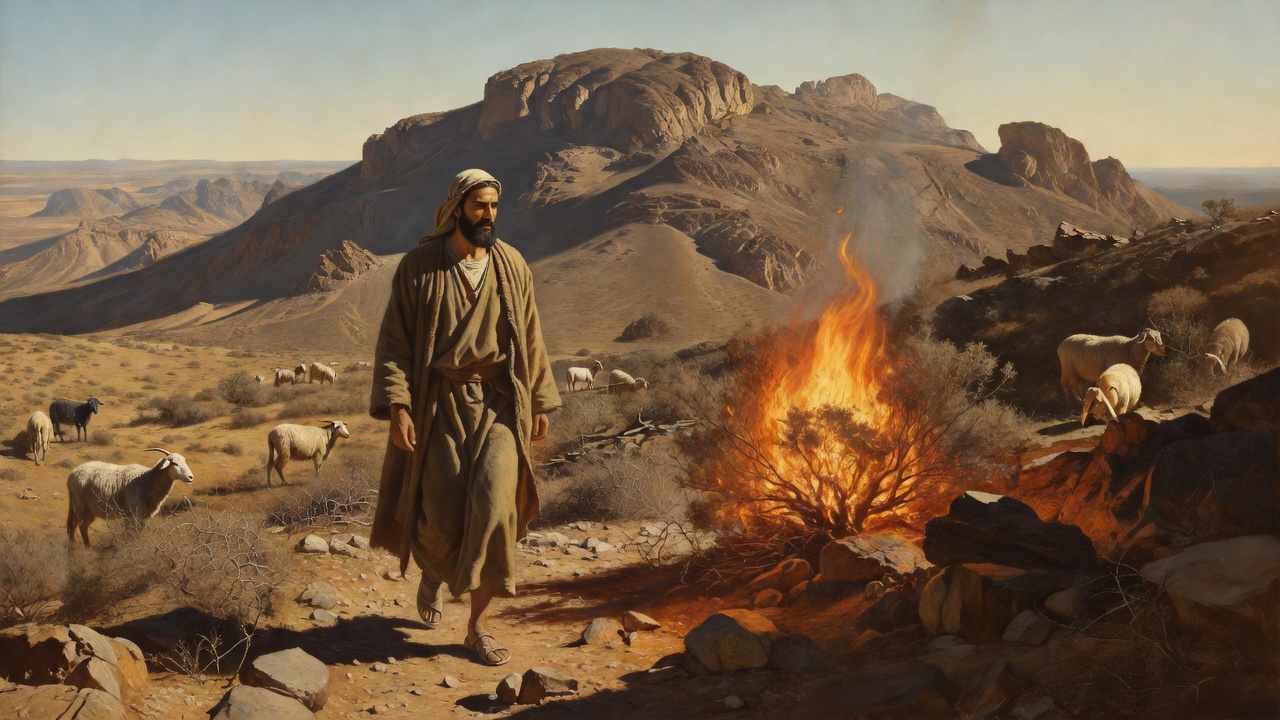
Moses at the Burning Bush
1Forsothe Moises kepte the scheep of Jetro, `his wyues fadir, preest of Madian; and whanne he hadde dryue the floc to the ynnere partis of deseert, he cam to Oreb, the hil of God. 2Forsothe the Lord apperide to hym in the flawme of fier fro the myddis of the buysch, and he seiy that the buysch brente, and was not forbrent. 3Therfor Moyses seide, Y schal go and schal se this greet siyt, whi the buysch is not forbrent. 4Sotheli the Lord seiy that Moises yede to se, and he clepide Moises fro the myddis of the buysch, and seide, Moyses! Moises! Which answeride, Y am present. 5And the Lord seide, Neiye thou not hidur, but vnbynde thou the scho of thi feet, for the place in which thou stondist is hooli lond. 6And the Lord seide, Y am God of thi fadir, God of Abraham, and God of Isaac, and God of Jacob. Moises hidde his face, for he durste not biholde ayens God. 7To whom the Lord seide, Y seiy the affliccion of my puple in Egipt, and Y herde the cry therof, for the hardnesse of hem that ben souereyns of werkis. 8And Y knew the sorewe of the puple, and Y cam down to delyuere it fro the hondis of Egipcians, and lede out of that lond in to a good lond and brood, into a lond that flowith with milk and hony, to the places of Cananey, and of Ethei, of Amorrey, and of Feresei, of Euey, and of Jebusei. 9Therfor the cry of the sones of Israel cam to me, and Y seiy the turment of hem, bi which thei ben oppressid of Egipcians. 10But come thou, I schal sende thee to Farao, that thou lede out my puple, the sones of Israel, fro Egipt. 11And Moises seide to hym, Who am Y, that Y go to Farao, and lede out the sones of Israel fro Egipt? 12And the Lord seide to Moises, Y schal be with thee, and thou schalt haue this signe, that Y haue sent thee, whanne thou hast led out my puple fro Egipt, thou schalt offre to God on this hil. 13Moises seide to God, Lo! Y schal go to the sones of Israel, and Y schal seie to hem, God of youre fadris sente me to you; if thei schulen seie to me, what is his name, what schal Y seie to hem? 14The Lord seide to Moises, Y am that am. The Lord seide, Thus thou schalt seie to the sones of Israel, He that is sente me to you. 15And eft God seide to Moises, Thou schalt seie these thingis to the sones of Israel, The Lord God of youre fadris, God of Abraham, and God of Isaac, and God of Jacob, sente me to you; this name is to me with outen ende, and this is my memorial in generacioun and in to generacioun. 16Go thou, gadere thou the eldere men, that is, iugis, of Israel, and thou schalt seie to hem, The Lord God of youre fadris apperide to me, God of Abraham, and God of Ysaac, and God of Jacob, and seide, Y visitynge haue visitid you, and Y seiy alle thingis that bifelden to you in Egipt; 17and Y seide, that Y lede out you fro the affliccioun of Egipt in to the lond of Cananey, and of Ethei, and of Amorrei, and of Ferezei and of Euei, and of Jebusei, to the lond flowynge with mylk and hony. 18And thei schulen here thi vois; and thou schalt entre, and the eldere men of Israel to the kyng of Egipt, and thou schalt seie to hym, The Lord God of Ebrews clepide vs; we schulen go the weie of thre daies in to wildirnesse, that we offre to oure Lord God. 19But Y woot, that the kyng of Egipt schal not delyuere you that ye go, but bi strong hond; 20for Y schal holde forthe myn hond, and I schal smyte Egipt in alle my marueils, whiche Y schal do in the myddis of hem; aftir these thingis he schal delyuere you. 21And Y schal yyue grace to this puple bifore Egipcians, and whanne ye schulen go out, ye schulen not go out voide; 22but a womman schal axe of hir neiyboresse and of her hoosteesse siluerne vesselis, and goldun, and clothis, and ye schulen putte tho on youre sones and douytris, and ye schulen make nakid Egipt.
¿Sabías que…?
El llamado de Moisés en la zarza ardente
- Moisés está pastoreando en Madián cuando comienza este capítulo. Los madianitas eran una tribu árabe nómada, descendiente de Madián, el cuarto hijo de Abraham con Cetura, cuyo nombre se explica como contienda. Vivían sobre todo en el desierto al norte de Arabia, y la península del Sinaí era tierra de pastoreo para sus rebaños; allí, tras huir de Egipto, Moisés llegó a ser siervo y luego yerno del sacerdote.Fuentes: el propio texto bíblico · Midian · Midian
- Su suegro es Jetro, llamado sacerdote de Madián. El Diccionario Bíblico de Easton (1897) identifica a ese sacerdote con Raguel y dice que, si los dos nombres corresponden a un mismo hombre, Raguel puede considerarse su nombre personal y Jetro, que significa excelencia, un título oficial.Fuentes: el propio texto bíblico · Jethro
- Moisés lleva el rebaño hasta Horeb, el monte de Dios. El nombre se explica como desierto, o monte, del suelo reseco, un término general para toda la cordillera de la cual el Sinaí era una de las cumbres; el Diccionario Bíblico de Easton (1897) da a la cordillera el nombre moderno de Jebel Musa y la describe como un enorme bloque de unas dos millas de largo por cerca de una milla de ancho, con una llanura muy espaciosa llamada Er Rahah en su extremo noreste, donde los israelitas acamparon después durante casi un año.Fuentes: el propio texto bíblico · Horeb
Notas escritas con ayuda de IA a partir de fuentes abiertas (Theographic Bible Metadata, CC BY-SA 4.0; Easton’s Bible Dictionary, dominio público) y revisadas antes de publicarse.
Lugares de este capítulo
- Midian · 28.495, 35.012 · versículo 1
- Mount Horeb · Hoy: Jebel Musa · 28.540, 33.973 · versículo 1
- Egypt · 30.129, 31.308 · versículos 7, 8, 10, 11, 12, 16, 17, 18, 19, 20, 22
Solo aparecen lugares identificados con alta confianza (90 % o más según las fuentes académicas reunidas por OpenBible). Mapa de la época: DARE (Digital Atlas of the Roman Empire), CC BY 4.0; mapa actual: © colaboradores de OpenStreetMap; lugares: OpenBible.info (CC BY 4.0).
Créditos y licencia de esta traducción
Wycliffe Bible
This is the Pentateuch and Gospels from The Holy Bible, containing the Old and New Testaments, with the apocryphal books, in the earliest English version made from the latin Vulgate by John Wycliffe and his followers. c.1395
Public Domain
Language: Middle English (English)
Dialect: Middle
Translation by: John Wycliffe
2016-11-08
Títulos de sección adaptados de la Berean Standard Bible (dominio público); no forman parte del texto bíblico de esta traducción.
Fuente: http://ebible.org/engWycliffe/ · eBible.org