Exodus 2
Wycliffe Bible · Tap a verse to see its cross-references.
The Birth and Adoption of Moses
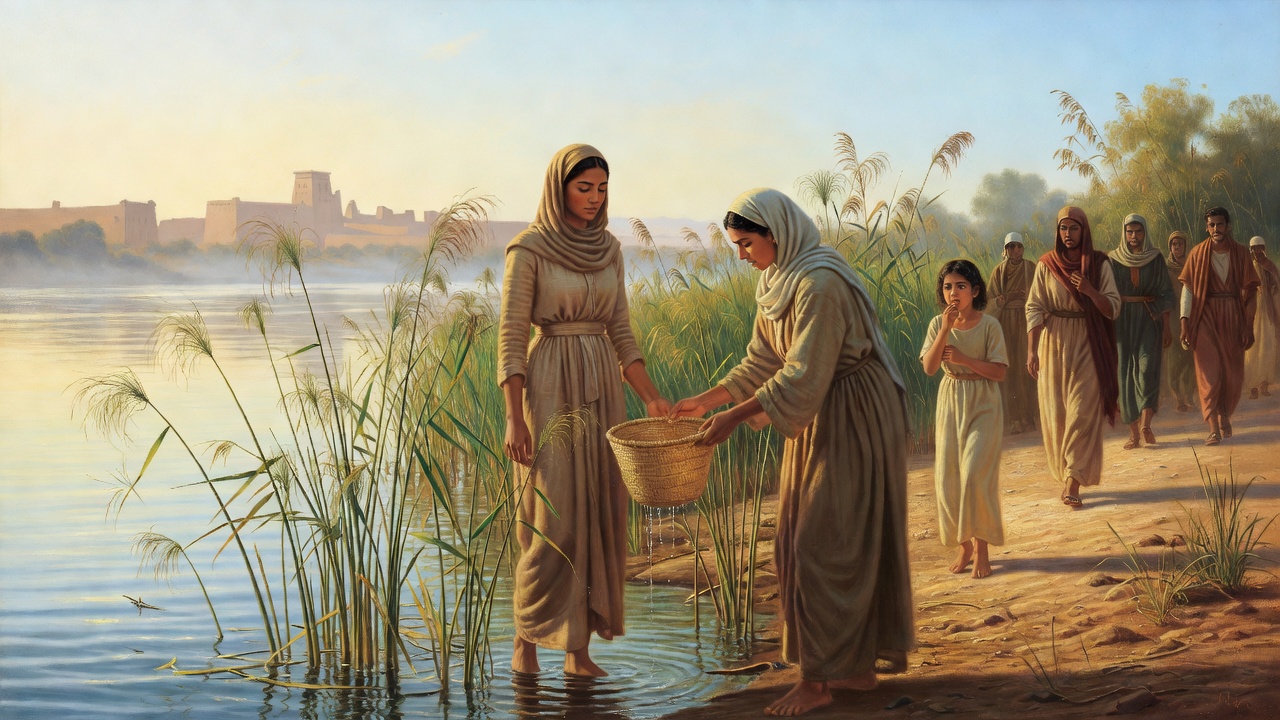
1Aftir these thingis a man of `the hows of Leuy yede out, and took a wijf of his kyn, 2which conseyuede, and childide a sone. And sche seiy hym wel farynge, and hidde him bi thre monethis. 3And whanne sche myyte not hele, thanne sche took a `leep of segge, and bawmede it with tar and pitch, and puttide the yong child with ynne, and puttide hym forth in a `place of spier of the brenke of the flood, 4the while his sistir stood afer, and bihelde the bifalling of the thing. 5Lo! forsothe the douytir of Farao cam doun to be waischun in the flood, and hir damysels walkiden bi the brenke of the flood. And whanne sche hadde seyn a leep in the `place of spier, sche sente oon of hir seruauntessis, 6and sche openyde the leep brouyt to hir, and seiy a litil child wepynge ther ynne. And sche hadde mercy on the child, and seide, It is of the yonge children of Ebrews. 7To whom the `sister of the child seide, Wolt thou that Y go, and clepe to thee an Ebrew womman, that may nurische the yong child? 8She answeride, Go thou. The damysel yede, and clepide the `modir of the child. 9To whom `the douytir of Farao spak, and seide, Take thou this child, and nurische to me; Y schal yyue to thee thi mede. The womman took, and nurischide the child, and bitook hym woxun to `the douytir of Farao, 10whom sche purchaside `in to the place of sone; and sche clepide his name Moises, and seide, For Y took hym fro the watir.
The Rejection and Flight of Moses
11In tho daies, aftir that Moises encreesside, he yede out to hise britheren, and seiy the turment of hem, and a man Egipcian smytynge `oon of Ebrews, hise britheren. 12And whanne he hadde biholdun hidur and thidir, and hadde seyn, that no man was present, he killide the Egipcian, and hidde in soond. 13And he yede out in another dai, and seiy tweyne Ebrews chidynge, and he seide to hym that dide wrong, Whi smytist thou thi brother? 14Which answeride, Who ordeynede thee prince, ether iuge on vs? Whether thou wolt sle me, as thou killidist yisterdai the Egipcian? Moises dredde, and seide, Hou is this word maad opun? 15And Farao herde this word, and souyte to sle Moyses, which fledde fro his siyt, and dwellide in the lond of Madian, and sat bisidis a pit. 16Forsothe seuene douytris weren to the preest of Madian, that camen to drawe watir; and whanne the trouyis weren fillid, thei coueitiden to watere `the flockis of her fadir. 17Scheepherdis camen aboue, and dreuen hem awei; and Moises roos, and defendide the dameselis; and he watride `the scheep of hem. 18And whanne thei hadden turned ayen to Jetro, her fadir, he seide to hem, Whi camen ye swiftliere than ye weren wont? 19Thei answeriden, A man of Egipt delyuerede vs fro the hond of scheepherdis; ferthermore and he drow watir with vs, and yaf drynk to the scheep. 20And he seide, Where is that man? whi leften ye the man? clepe ye hym, that he ete breed. 21Therfor Moises swoor, that he wolde dwelle with Jetro; and he took a wijf, Sefora, `the douyter of Jetro. 22And sche childide a sone to hym, whom he clepide Gersan, and seide, Y was a comelyng in an alyen lond. Forsothe sche childide an othir sone, whom he clepide Eliezer, and seide, For God of my fadir is myn helpere, and delyuerede me fro the hond of Farao.
God Hears the Cry of the Israelites
23Forsothe aftir myche tyme the kyng of Egipt diede, and the sones of Israel inwardli weiliden for werkis, and crieden, and the cry of hem for werkis stiede to God. 24And he herde the weilyng of hem, and he hadde mynde of the boond of pees, which he hadde maad with Abraham, Ysaac, and Jacob; and he bihelde the sones of Israel, 25and knewe hem.
Did you know?
The birth and flight of Moses
- Pharaoh’s daughter named the child Moses, explaining that she had drawn him out of the water. Easton's Bible Dictionary (1897) links his name with “drawn,” or with the Egyptian word mesu, “son”—the element from which the dictionary also explains Rameses as “royal son.”Sources: the Bible text itself · Moses
- In Exodus 2 a daughter of Levi hides her son for three months, and Pharaoh’s daughter, finding him among the Nile reeds, recognizes a Hebrew child. Easton's Bible Dictionary (1897) links the Israelites’ affliction to “the new king who knew not Joseph,” long supposed to be Aahmes I, called Amosis by Josephus, though the dictionary, citing discoveries then recent, names Seti instead. Their hardship, it says, began after the Hyksos, masters of Egypt for some five centuries, were driven out and the old dynasty restored.Sources: the Bible text itself · Pharaoh
- After Pharaoh sought to kill him, Moses fled to Midian and sat down beside a well; he later married Zipporah, one of the seven daughters of the priest of Midian. The Midianites were nomadic Arabians descended from Midian, Abraham’s fourth son by Keturah, and they pastured their flocks in the Sinai peninsula and in the desert north of the Arabian peninsula. This chapter calls the priest Reuel, whom Easton's Bible Dictionary (1897) names Raguel, regarding that form as his personal name and Jethro—“excellency”—as an official title if the two are identified.Sources: the Bible text itself · Midian · Midian · Jethro
Notes written with AI assistance from open sources (Theographic Bible Metadata, CC BY-SA 4.0; Easton’s Bible Dictionary, public domain) and reviewed before publishing.
Places in this chapter
- Nile · Today: Nile River · 31.465, 30.367 · verses 3, 5
- Midian · 28.495, 35.012 · verses 15, 16
- Egypt · 30.129, 31.308 · verse 23
Only places identified with high confidence are shown (90% or more according to the scholarly sources compiled by OpenBible). Period map: DARE (Digital Atlas of the Roman Empire), CC BY 4.0; modern map: © OpenStreetMap contributors; places: OpenBible.info (CC BY 4.0).
Credits and license for this translation
Wycliffe Bible
This is the Pentateuch and Gospels from The Holy Bible, containing the Old and New Testaments, with the apocryphal books, in the earliest English version made from the latin Vulgate by John Wycliffe and his followers. c.1395
Public Domain
Language: Middle English (English)
Dialect: Middle
Translation by: John Wycliffe
2016-11-08
Section headings adapted from the Berean Standard Bible (public domain); they are not part of this translation’s text.
Source: http://ebible.org/engWycliffe/ · eBible.org