Éxodo 2
Wycliffe Bible · Toca un versículo para ver sus referencias cruzadas.
The Birth and Adoption of Moses
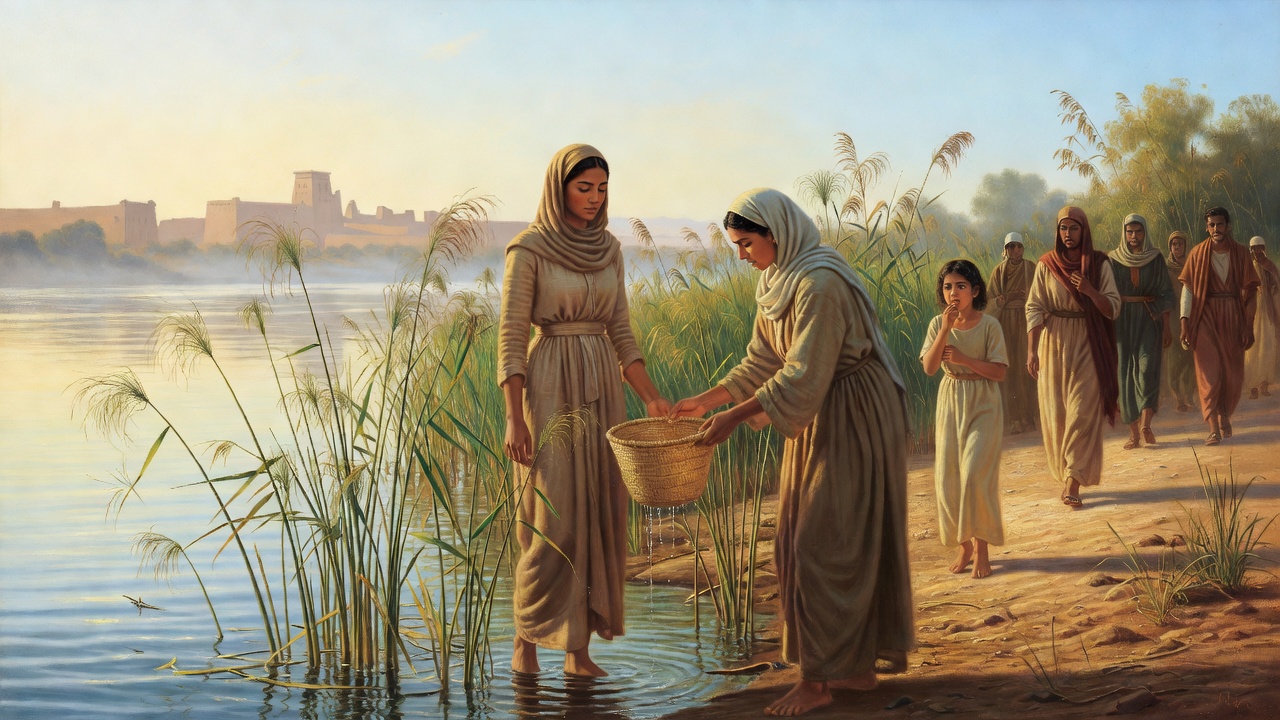
1Aftir these thingis a man of `the hows of Leuy yede out, and took a wijf of his kyn, 2which conseyuede, and childide a sone. And sche seiy hym wel farynge, and hidde him bi thre monethis. 3And whanne sche myyte not hele, thanne sche took a `leep of segge, and bawmede it with tar and pitch, and puttide the yong child with ynne, and puttide hym forth in a `place of spier of the brenke of the flood, 4the while his sistir stood afer, and bihelde the bifalling of the thing. 5Lo! forsothe the douytir of Farao cam doun to be waischun in the flood, and hir damysels walkiden bi the brenke of the flood. And whanne sche hadde seyn a leep in the `place of spier, sche sente oon of hir seruauntessis, 6and sche openyde the leep brouyt to hir, and seiy a litil child wepynge ther ynne. And sche hadde mercy on the child, and seide, It is of the yonge children of Ebrews. 7To whom the `sister of the child seide, Wolt thou that Y go, and clepe to thee an Ebrew womman, that may nurische the yong child? 8She answeride, Go thou. The damysel yede, and clepide the `modir of the child. 9To whom `the douytir of Farao spak, and seide, Take thou this child, and nurische to me; Y schal yyue to thee thi mede. The womman took, and nurischide the child, and bitook hym woxun to `the douytir of Farao, 10whom sche purchaside `in to the place of sone; and sche clepide his name Moises, and seide, For Y took hym fro the watir.
The Rejection and Flight of Moses
11In tho daies, aftir that Moises encreesside, he yede out to hise britheren, and seiy the turment of hem, and a man Egipcian smytynge `oon of Ebrews, hise britheren. 12And whanne he hadde biholdun hidur and thidir, and hadde seyn, that no man was present, he killide the Egipcian, and hidde in soond. 13And he yede out in another dai, and seiy tweyne Ebrews chidynge, and he seide to hym that dide wrong, Whi smytist thou thi brother? 14Which answeride, Who ordeynede thee prince, ether iuge on vs? Whether thou wolt sle me, as thou killidist yisterdai the Egipcian? Moises dredde, and seide, Hou is this word maad opun? 15And Farao herde this word, and souyte to sle Moyses, which fledde fro his siyt, and dwellide in the lond of Madian, and sat bisidis a pit. 16Forsothe seuene douytris weren to the preest of Madian, that camen to drawe watir; and whanne the trouyis weren fillid, thei coueitiden to watere `the flockis of her fadir. 17Scheepherdis camen aboue, and dreuen hem awei; and Moises roos, and defendide the dameselis; and he watride `the scheep of hem. 18And whanne thei hadden turned ayen to Jetro, her fadir, he seide to hem, Whi camen ye swiftliere than ye weren wont? 19Thei answeriden, A man of Egipt delyuerede vs fro the hond of scheepherdis; ferthermore and he drow watir with vs, and yaf drynk to the scheep. 20And he seide, Where is that man? whi leften ye the man? clepe ye hym, that he ete breed. 21Therfor Moises swoor, that he wolde dwelle with Jetro; and he took a wijf, Sefora, `the douyter of Jetro. 22And sche childide a sone to hym, whom he clepide Gersan, and seide, Y was a comelyng in an alyen lond. Forsothe sche childide an othir sone, whom he clepide Eliezer, and seide, For God of my fadir is myn helpere, and delyuerede me fro the hond of Farao.
God Hears the Cry of the Israelites
23Forsothe aftir myche tyme the kyng of Egipt diede, and the sones of Israel inwardli weiliden for werkis, and crieden, and the cry of hem for werkis stiede to God. 24And he herde the weilyng of hem, and he hadde mynde of the boond of pees, which he hadde maad with Abraham, Ysaac, and Jacob; and he bihelde the sones of Israel, 25and knewe hem.
¿Sabías que…?
El nacimiento y la huida de Moisés
- La hija del faraón le puso al niño el nombre de Moisés y explicó que lo había sacado del agua. El Diccionario Bíblico de Easton (1897) relaciona su nombre con “sacado”, o con la palabra egipcia mesu, “hijo”, el elemento a partir del cual el diccionario también explica Ramsés como “hijo real”.Fuentes: el propio texto bíblico · Moses
- En Éxodo 2, una hija de Leví esconde a su hijo durante tres meses, y la hija del faraón, al hallarlo entre los juncos del Nilo, reconoce a un niño hebreo. El Diccionario Bíblico de Easton (1897) vincula la aflicción de los israelitas con “el nuevo rey que no conocía a José”, durante mucho tiempo tenido por Aahmes I, llamado Amosis por Josefo, aunque el diccionario, citando descubrimientos entonces recientes, lo identifica como Seti. Su penuria, dice la obra, comenzó después de que los hicsos, dueños de Egipto durante unos cinco siglos, fueron expulsados y se restauró la antigua dinastía.Fuentes: el propio texto bíblico · Pharaoh
- Después de que el faraón buscó matarlo, Moisés huyó a Madián y se sentó junto a un pozo; más tarde se casó con Séfora, una de las siete hijas del sacerdote de Madián. Los madianitas eran árabes nómadas, descendientes de Madián, el cuarto hijo de Abraham con Cetura, y apacentaban sus rebaños en la península del Sinaí y en el desierto al norte de la península arábiga. En este capítulo el sacerdote se llama Reuel, a quien el Diccionario Bíblico de Easton (1897) llama Raguel, y considera esa forma su nombre personal y a Jetro —“excelencia”— un título oficial, si es que ambos se identifican.Fuentes: el propio texto bíblico · Midian · Midian · Jethro
Notas escritas con ayuda de IA a partir de fuentes abiertas (Theographic Bible Metadata, CC BY-SA 4.0; Easton’s Bible Dictionary, dominio público) y revisadas antes de publicarse.
Lugares de este capítulo
- Nile · Hoy: Nile River · 31.465, 30.367 · versículos 3, 5
- Midian · 28.495, 35.012 · versículos 15, 16
- Egypt · 30.129, 31.308 · versículo 23
Solo aparecen lugares identificados con alta confianza (90 % o más según las fuentes académicas reunidas por OpenBible). Mapa de la época: DARE (Digital Atlas of the Roman Empire), CC BY 4.0; mapa actual: © colaboradores de OpenStreetMap; lugares: OpenBible.info (CC BY 4.0).
Créditos y licencia de esta traducción
Wycliffe Bible
This is the Pentateuch and Gospels from The Holy Bible, containing the Old and New Testaments, with the apocryphal books, in the earliest English version made from the latin Vulgate by John Wycliffe and his followers. c.1395
Public Domain
Language: Middle English (English)
Dialect: Middle
Translation by: John Wycliffe
2016-11-08
Títulos de sección adaptados de la Berean Standard Bible (dominio público); no forman parte del texto bíblico de esta traducción.
Fuente: http://ebible.org/engWycliffe/ · eBible.org