Génesis 11
Berean Standard Bible · Toca un versículo para ver sus referencias cruzadas.
The Tower of Babel
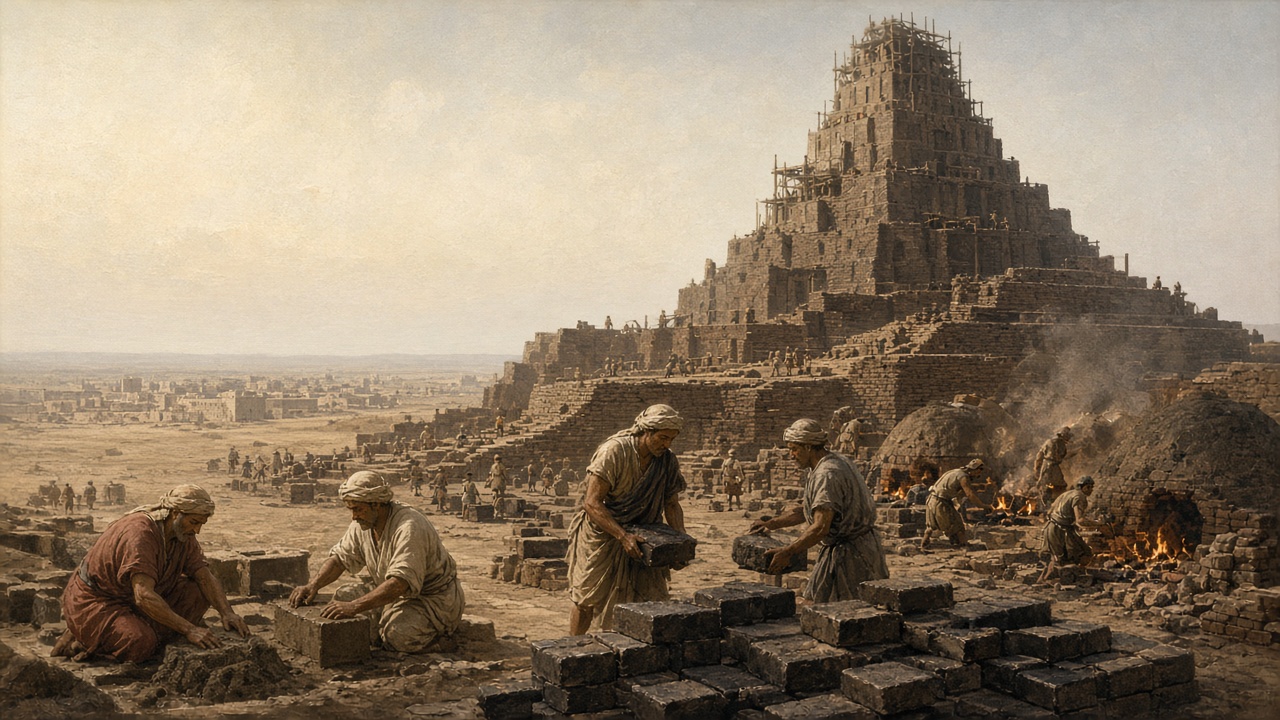
1Now the whole world had one language and a common form of speech. 2And as people journeyed eastward, they found a plain in the land of Shinar and settled there.
3And they said to one another, “Come, let us make bricks and bake them thoroughly.” So they used brick instead of stone, and tar instead of mortar.
4“Come,” they said, “let us build for ourselves a city with a tower that reaches to the heavens, that we may make a name for ourselves and not be scattered over the face of all the earth.”
5Then the LORD came down to see the city and the tower that the sons of men were building. 6And the LORD said, “If they have begun to do this as one people speaking the same language, then nothing they devise will be beyond them. 7Come, let Us go down and confuse their language, so that they will not understand one another’s speech.”
8So the LORD scattered them from there over the face of all the earth, and they stopped building the city. 9That is why it is called Babel, for there the LORD confused the language of the whole world, and from that place the LORD scattered them over the face of all the earth.
Genealogy from Shem to Abram
10This is the account of Shem. Two years after the flood, when Shem was 100 years old, he became the father of Arphaxad. 11And after he had become the father of Arphaxad, Shem lived 500 years and had other sons and daughters.
12When Arphaxad was 35 years old, he became the father of Shelah. 13And after he had become the father of Shelah, Arphaxad lived 403 years and had other sons and daughters.
14When Shelah was 30 years old, he became the father of Eber. 15And after he had become the father of Eber, Shelah lived 403 years and had other sons and daughters.
16When Eber was 34 years old, he became the father of Peleg. 17And after he had become the father of Peleg, Eber lived 430 years and had other sons and daughters.
18When Peleg was 30 years old, he became the father of Reu. 19And after he had become the father of Reu, Peleg lived 209 years and had other sons and daughters.
20When Reu was 32 years old, he became the father of Serug. 21And after he had become the father of Serug, Reu lived 207 years and had other sons and daughters.
22When Serug was 30 years old, he became the father of Nahor. 23And after he had become the father of Nahor, Serug lived 200 years and had other sons and daughters.
24When Nahor was 29 years old, he became the father of Terah. 25And after he had become the father of Terah, Nahor lived 119 years and had other sons and daughters.
26When Terah was 70 years old, he became the father of Abram, Nahor, and Haran.
Terah’s Descendants
27This is the account of Terah. Terah became the father of Abram, Nahor, and Haran. And Haran became the father of Lot. 28During his father Terah’s lifetime, Haran died in his native land, in Ur of the Chaldeans.
29And Abram and Nahor took wives for themselves. Abram’s wife was named Sarai, and Nahor’s wife was named Milcah; she was the daughter of Haran, who was the father of both Milcah and Iscah. 30But Sarai was barren; she had no children.
31And Terah took his son Abram, his grandson Lot son of Haran, and his daughter-in-law Sarai the wife of Abram, and they set out from Ur of the Chaldeans for the land of Canaan. But when they arrived in Haran, they settled there. 32Terah lived 205 years, and he died in Haran.
¿Sabías que…?
Babel y el camino desde Ur
- En este capítulo, unos viajeros se establecen en una llanura de Sinar y construyen con ladrillo cocido y asfalto, en lugar de piedra y mezcla. Un diccionario considera Sinar, probablemente, como Babilonia o el sur de Mesopotamia, que se extiende casi hasta el golfo Pérsico, dice que allí se construyó la torre de Babel y describe a los primeros habitantes de la tierra como gente que hacía ladrillos y edificaba ciudades.Fuentes: el propio texto bíblico · Shinar
- La ciudad inconclusa recibe el nombre de Babel porque, según el relato, allí el Señor confundió la lengua de todo el mundo y dispersó a la gente. Un diccionario explica el nombre como 'confusión' y sugiere que la torre se pensó, probablemente, como un punto de reunión en la extensa llanura de Sinar, tras una migración desde las tierras altas de Armenia, para que los constructores no se dispersaran.Fuentes: el propio texto bíblico · Babel
- El capítulo termina con Taré saliendo de Ur de los caldeos hacia Canaán, con Abram, Sarai y su nieto Lot, y estableciéndose luego en Harán, donde muere a los 205 años; su hijo Harán ya había muerto en Ur. Un diccionario llama a Ur lugar de nacimiento de ese hijo, la ciudad más grande de Sinar o de la Caldea del norte, y un centro de comercio y poder político, y sitúa Harán, hoy Harran y llamada Charrán en el Antiguo Testamento griego y en Hechos, junto al Belik, afluente del Éufrates en la Alta Mesopotamia, donde Abram permaneció hasta la muerte de Taré.Fuentes: el propio texto bíblico · Terah · Ur of the Chaldees · Haran
Notas escritas con ayuda de IA a partir de fuentes abiertas (Theographic Bible Metadata, CC BY-SA 4.0; Easton’s Bible Dictionary, dominio público) y revisadas antes de publicarse.
Lugares de este capítulo
- Shinar · Hoy: Babylonia · 32.543, 44.422 · versículo 2
- Chaldea · 30.962, 46.104 · versículos 28, 31
- Canaan · 32.767, 35.333 · versículo 31
- Haran · Hoy: Harran · 36.864, 39.033 · versículos 31, 32
Solo aparecen lugares identificados con alta confianza (90 % o más según las fuentes académicas reunidas por OpenBible). Mapa de la época: DARE (Digital Atlas of the Roman Empire), CC BY 4.0; mapa actual: © colaboradores de OpenStreetMap; lugares: OpenBible.info (CC BY 4.0).
Créditos y licencia de esta traducción
Berean Standard Bible
The Holy Bible in English: Berean Standard Bible
Public Domain
Language: English
Contributor: BSB Publishing, LLC
2026-10-02
Fuente: http://ebible.org/engbsb/ · eBible.org