Genesis 11
Berean Standard Bible · Tap a verse to see its cross-references.
The Tower of Babel
1Now the whole world had one language and a common form of speech. 2And as people journeyed eastward, they found a plain in the land of Shinar and settled there.
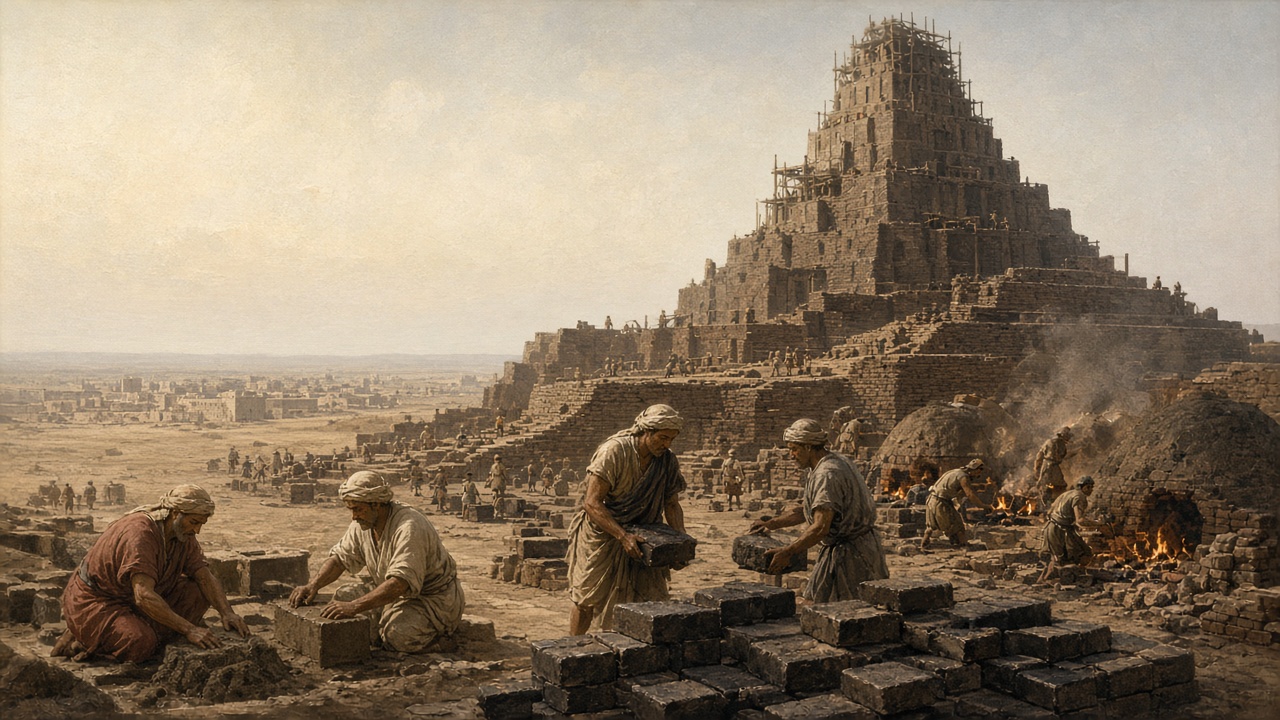
3And they said to one another, “Come, let us make bricks and bake them thoroughly.” So they used brick instead of stone, and tar instead of mortar.
4“Come,” they said, “let us build for ourselves a city with a tower that reaches to the heavens, that we may make a name for ourselves and not be scattered over the face of all the earth.”
5Then the LORD came down to see the city and the tower that the sons of men were building. 6And the LORD said, “If they have begun to do this as one people speaking the same language, then nothing they devise will be beyond them. 7Come, let Us go down and confuse their language, so that they will not understand one another’s speech.”
8So the LORD scattered them from there over the face of all the earth, and they stopped building the city. 9That is why it is called Babel, for there the LORD confused the language of the whole world, and from that place the LORD scattered them over the face of all the earth.
Genealogy from Shem to Abram
10This is the account of Shem. Two years after the flood, when Shem was 100 years old, he became the father of Arphaxad. 11And after he had become the father of Arphaxad, Shem lived 500 years and had other sons and daughters.
12When Arphaxad was 35 years old, he became the father of Shelah. 13And after he had become the father of Shelah, Arphaxad lived 403 years and had other sons and daughters.
14When Shelah was 30 years old, he became the father of Eber. 15And after he had become the father of Eber, Shelah lived 403 years and had other sons and daughters.
16When Eber was 34 years old, he became the father of Peleg. 17And after he had become the father of Peleg, Eber lived 430 years and had other sons and daughters.
18When Peleg was 30 years old, he became the father of Reu. 19And after he had become the father of Reu, Peleg lived 209 years and had other sons and daughters.
20When Reu was 32 years old, he became the father of Serug. 21And after he had become the father of Serug, Reu lived 207 years and had other sons and daughters.
22When Serug was 30 years old, he became the father of Nahor. 23And after he had become the father of Nahor, Serug lived 200 years and had other sons and daughters.
24When Nahor was 29 years old, he became the father of Terah. 25And after he had become the father of Terah, Nahor lived 119 years and had other sons and daughters.
26When Terah was 70 years old, he became the father of Abram, Nahor, and Haran.
Terah’s Descendants
27This is the account of Terah. Terah became the father of Abram, Nahor, and Haran. And Haran became the father of Lot. 28During his father Terah’s lifetime, Haran died in his native land, in Ur of the Chaldeans.
29And Abram and Nahor took wives for themselves. Abram’s wife was named Sarai, and Nahor’s wife was named Milcah; she was the daughter of Haran, who was the father of both Milcah and Iscah. 30But Sarai was barren; she had no children.
31And Terah took his son Abram, his grandson Lot son of Haran, and his daughter-in-law Sarai the wife of Abram, and they set out from Ur of the Chaldeans for the land of Canaan. But when they arrived in Haran, they settled there. 32Terah lived 205 years, and he died in Haran.
Did you know?
Babel and the Road from Ur
- Travelers in this chapter settle on a plain in Shinar and build with baked brick and tar instead of stone and mortar. A dictionary treats Shinar as probably Babylonia or southern Mesopotamia, extending almost to the Persian Gulf, says the tower of Babel was built there, and describes the land's early inhabitants as people who made bricks and built cities.Sources: the Bible text itself · Shinar
- The unfinished city is named Babel because, the narrative says, there the Lord confused the language of the whole world and scattered its people. A dictionary explains the name as 'confusion' and suggests the tower was probably meant as a rallying-point on the wide plain of Shinar, after a migration from the uplands of Armenia, so the builders would not be scattered.Sources: the Bible text itself · Babel
- The chapter ends with Terah leaving Ur of the Chaldeans for Canaan with Abram, Sarai, and his grandson Lot, then settling in Haran, where he dies at 205; his son Haran had already died in Ur. A dictionary calls Ur that son's birthplace, the largest city of Shinar or northern Chaldea, and a center of trade and political power, and places Haran, now Harran and called Charran in the Greek Old Testament and in Acts, on the Belik, a Euphrates tributary in Upper Mesopotamia, where Abram stayed until Terah died.Sources: the Bible text itself · Terah · Ur of the Chaldees · Haran
Notes written with AI assistance from open sources (Theographic Bible Metadata, CC BY-SA 4.0; Easton’s Bible Dictionary, public domain) and reviewed before publishing.
Places in this chapter
- Shinar · Today: Babylonia · 32.543, 44.422 · verse 2
- Chaldea · 30.962, 46.104 · verses 28, 31
- Canaan · 32.767, 35.333 · verse 31
- Haran · Today: Harran · 36.864, 39.033 · verses 31, 32
Only places identified with high confidence are shown (90% or more according to the scholarly sources compiled by OpenBible). Period map: DARE (Digital Atlas of the Roman Empire), CC BY 4.0; modern map: © OpenStreetMap contributors; places: OpenBible.info (CC BY 4.0).
Credits and license for this translation
Berean Standard Bible
The Holy Bible in English: Berean Standard Bible
Public Domain
Language: English
Contributor: BSB Publishing, LLC
2026-10-02
Source: http://ebible.org/engbsb/ · eBible.org