Éxodo 6
I tnalù dwata · Toca un versículo para ver sus referencias cruzadas.
1Na talù Dwata i Amu di ku Mosis, manan, “Mdà ani kadang teenam i nimògu di ku Faraon. Mdà di bong gnagangu nlegesgu kenen na falohan i dad togu lamwà di banwe ani. Nlegesgu kenen, du fye kenen baling i falwà dale di banwen.”
2Fadlug Dwata talù di ku Mosis, manan, “Agu sa Dwata i Amu. 3Di muna fa, tafitegu di ku Abraham, di ku Isaak, na di ku Dyékob deg i Dwata Too Mtulus, bay i dagitgu, dunan Dwata i Amu, làgu fgadè di dale. 4Tafakanggu di dale i blégu dale i banwe Kanaan, i banwe flo gumnèla di muna, i ise ale mfun dun. 5Na talingegu i dalong i dad togu, dad bel Israél, i nlifan i dad to Idyif, na làgu glifet i gfakanggu di dad gutambulla. 6Taman tnulenam ale i mangu, manam, ‘Agu Dwata i Amu, na falwàta gamu di falel i dad to Idyif. Falwàta gamu mdà di kaglifanyu di dale. Nsògu gamu di agotla, fagu di bong gnagangu i gfitegu, na fanlayamgu ale. 7Dnawatgu gamu i too dad togu, na deg sa i Dwata fnangamfùyu. Na gadèyu kadang deg sa Dwata i Amu, i Dwata tooyu fnangamfù, di kafalwàgu gamu di kaglifanyu di dad to Idyif. 8Na nebeta gamu di tanà i toogu fakang blé ku Abraham, Isaak, na Dyékob. Hae, blégu di gamu kadang, du fye nfunyu. Agu sa Dwata i Amu.’ Ani tulenam kadang di dad bel Israél.”
9Na taman tulen Mosis di dad bel Israél i gman Dwata, bay, là ale mayè flinge dun, du too sè klidùla, du mdà di kaglifanla di dad to Idyif.
10Na lêman man Dwata i Amu di ku Mosis, 11“Salu ge lêman di ku Faraon, harì di Idyif, na tulenam kenen toon faloh i dad bel Israél lamwà di banwen Idyif.”
12Kabay man Mosis di Dwata i Amu, “Ku là flinge di deg i dad dademegu bel Israél, lumban fa i harì là flinge, na labi fa, du là agu fulung talù.”
¿Sabías que…?
Yo soy el SEÑOR
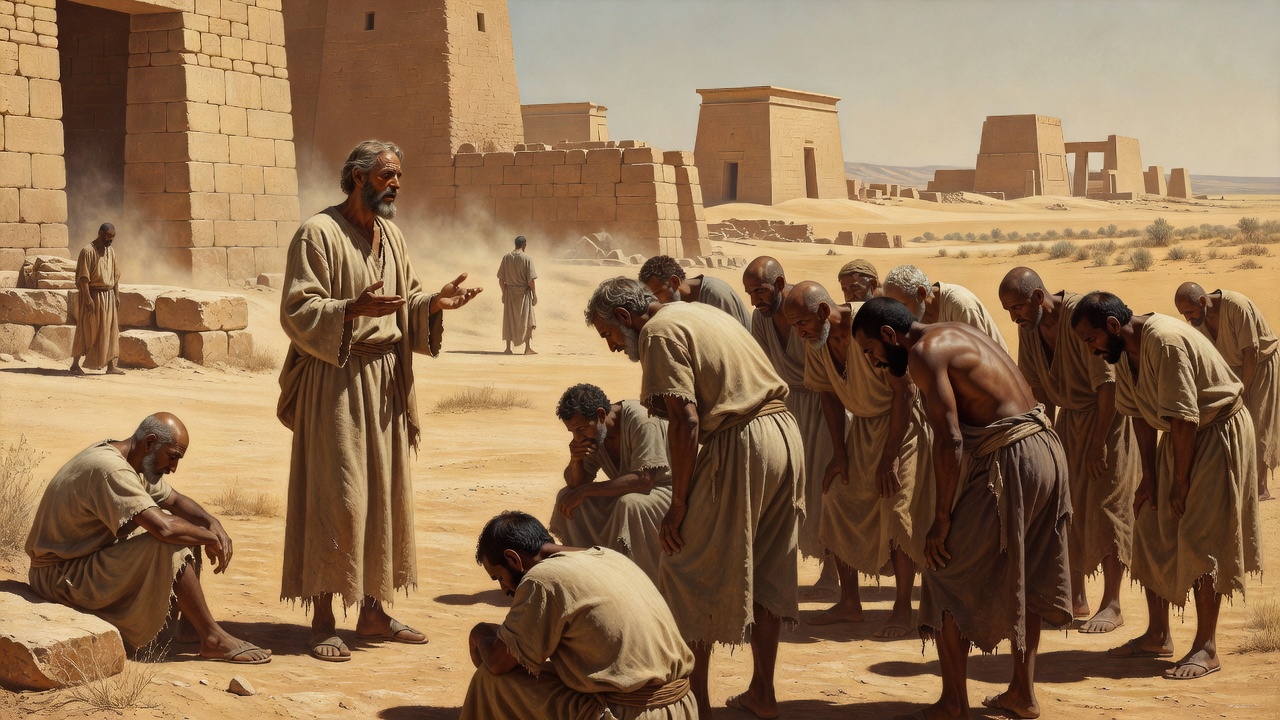
- En Éxodo 6, Dios le dice a Moisés que él es el SEÑOR, y que se apareció a Abraham, a Isaac y a Jacob como Dios Todopoderoso, pero no se dio a conocer a ellos por el nombre el SEÑOR. Él recuerda el pacto de darles la tierra de Canaán, donde habían vivido como extranjeros. El Diccionario Bíblico de Easton (1897) dice que el nombre Canaán significa las tierras bajas y que, en tiempos de Moisés y de Josué, designaba todo el país al oeste del Jordán y del mar Muerto.Fuentes: el propio texto bíblico · Canaan
- Una lista familiar identifica entonces a los hombres encargados de sacar a los israelitas de Egipto: Leví, tercer hijo de Jacob con Lea, cuyo nombre se vincula a la palabra hebrea de ella que significa unido, y los hijos de Leví, Gersón, Coat y Merari. Leví vivió 137 años, y Coat, padre de Amram, vivió 133; Amram se casó con la hermana de su padre, Jocabed, hija de Leví, y ella dio a luz a Aarón y a Moisés. Aarón, el hermano mayor, nació en Egipto tres años antes que Moisés y se casó con Elisabet, hija de Aminadab, de la casa de Judá.Fuentes: el propio texto bíblico · Levi (patriarch) · Kohath · Aaron
- Moisés y Aarón son enviados a hablar con el faraón, rey de Egipto. El Diccionario Bíblico de Easton (1897) dice que el faraón del Éxodo fue probablemente Menephtah I, el decimocuarto hijo y el mayor de los sobrevivientes de Rameses II, quien residía en Zoán, donde tuvieron lugar esas entrevistas. Esa entrada aún deja abierto si Seti II o su padre Menephtah fue ese faraón, y señala que algunos creen que las evidencias favorecen a Seti II.Fuentes: el propio texto bíblico · Pharaoh (of the Exodus)
Notas escritas con ayuda de IA a partir de fuentes abiertas (Theographic Bible Metadata, CC BY-SA 4.0; Easton’s Bible Dictionary, dominio público) y revisadas antes de publicarse.
Lugares de este capítulo
- Canaan · 32.767, 35.333 · versículo 4
- Egypt · 30.129, 31.308 · versículos 6, 7, 11, 13, 26, 27, 28, 29
Solo aparecen lugares identificados con alta confianza (90 % o más según las fuentes académicas reunidas por OpenBible). Mapa de la época: DARE (Digital Atlas of the Roman Empire), CC BY 4.0; mapa actual: © colaboradores de OpenStreetMap; lugares: OpenBible.info (CC BY 4.0).
Créditos y licencia de esta traducción
I tnalù dwata
New Testament in Blaan, Sarangani
copyright © 1998 Wycliffe Bible Translators, Inc.
Language: Sarangani Blaan (Blaan, Sarangani)
Translation by: Wycliffe Bible Translators
Contributor: Wycliffe Bible Translators, Inc.
Copyright Information
© 1998, Wycliffe Bible Translators, Inc. All rights reserved.
This translation text is made available to you under the
terms of the Creative Commons License: Attribution-Noncommercial-No Derivative Works.
( http://creativecommons.org/licenses/by-nc-nd/3.0/ )
In addition, you have permission to port the text to different file formats, as long as you
do not change any of the text or punctuation of the Bible.
You may share, copy, distribute, transmit, and extract portions
or quotations from this work, provided that you include the above copyright
information:
You must give Attribution to the work.
You do not sell this work for a profit.
You do not make any derivative works that change any of the actual words or punctuation of the Scriptures.
Permissions beyond the scope of this license may be
available if you contact
us with your request.
The New Testament
in Blaan, Sarangani
© 1998, Wycliffe Bible Translators, Inc. All rights reserved.
This translation is made available to you under the terms of the
Creative Commons Attribution-Noncommercial-No Derivatives license 4.0.
You may share and redistribute this Bible translation or extracts from it in any format, provided that:
You include the above copyright and source information.
You do not sell this work for a profit.
You do not change any of the words or punctuation of the Scriptures.
Pictures included with Scriptures and other documents on this site are licensed just for use with those Scriptures and documents.
For other uses, please contact the respective copyright owners.
2015-03-17
Fuente: http://ebible.org/bps/ · eBible.org