Exodus 6
I tnalù dwata · Tap a verse to see its cross-references.
1Na talù Dwata i Amu di ku Mosis, manan, “Mdà ani kadang teenam i nimògu di ku Faraon. Mdà di bong gnagangu nlegesgu kenen na falohan i dad togu lamwà di banwe ani. Nlegesgu kenen, du fye kenen baling i falwà dale di banwen.”
2Fadlug Dwata talù di ku Mosis, manan, “Agu sa Dwata i Amu. 3Di muna fa, tafitegu di ku Abraham, di ku Isaak, na di ku Dyékob deg i Dwata Too Mtulus, bay i dagitgu, dunan Dwata i Amu, làgu fgadè di dale. 4Tafakanggu di dale i blégu dale i banwe Kanaan, i banwe flo gumnèla di muna, i ise ale mfun dun. 5Na talingegu i dalong i dad togu, dad bel Israél, i nlifan i dad to Idyif, na làgu glifet i gfakanggu di dad gutambulla. 6Taman tnulenam ale i mangu, manam, ‘Agu Dwata i Amu, na falwàta gamu di falel i dad to Idyif. Falwàta gamu mdà di kaglifanyu di dale. Nsògu gamu di agotla, fagu di bong gnagangu i gfitegu, na fanlayamgu ale. 7Dnawatgu gamu i too dad togu, na deg sa i Dwata fnangamfùyu. Na gadèyu kadang deg sa Dwata i Amu, i Dwata tooyu fnangamfù, di kafalwàgu gamu di kaglifanyu di dad to Idyif. 8Na nebeta gamu di tanà i toogu fakang blé ku Abraham, Isaak, na Dyékob. Hae, blégu di gamu kadang, du fye nfunyu. Agu sa Dwata i Amu.’ Ani tulenam kadang di dad bel Israél.”
9Na taman tulen Mosis di dad bel Israél i gman Dwata, bay, là ale mayè flinge dun, du too sè klidùla, du mdà di kaglifanla di dad to Idyif.
10Na lêman man Dwata i Amu di ku Mosis, 11“Salu ge lêman di ku Faraon, harì di Idyif, na tulenam kenen toon faloh i dad bel Israél lamwà di banwen Idyif.”
12Kabay man Mosis di Dwata i Amu, “Ku là flinge di deg i dad dademegu bel Israél, lumban fa i harì là flinge, na labi fa, du là agu fulung talù.”
Did you know?
I Am the LORD
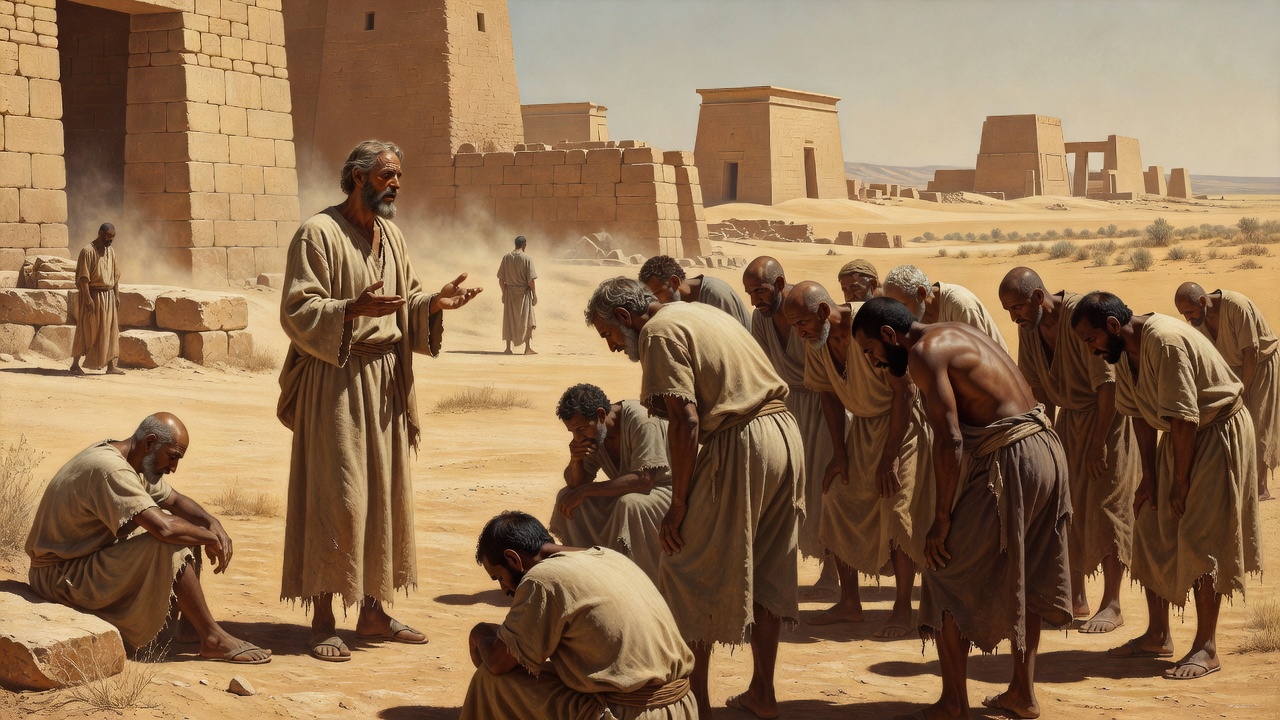
- In Exodus 6 God tells Moses that he is the LORD, and that he appeared to Abraham, Isaac, and Jacob as God Almighty but did not make himself known to them by the name the LORD. He recalls the covenant to give them the land of Canaan, where they had lived as foreigners. Easton's Bible Dictionary (1897) says the name Canaan signifies the lowlands, and that in the time of Moses and Joshua it denoted the whole country west of the Jordan and the Dead Sea.Sources: the Bible text itself · Canaan
- A family list then identifies the men charged to bring the Israelites out of Egypt: Levi, Jacob’s third son by Leah, whose name is linked to her Hebrew word meaning joined, and Levi’s sons Gershon, Kohath, and Merari. Levi lived 137 years, and Kohath, Amram’s father, lived 133; Amram married his father’s sister Jochebed, a daughter of Levi, and she bore Aaron and Moses. Aaron, the elder brother, was born in Egypt three years before Moses and married Elisheba, daughter of Amminadab of the house of Judah.Sources: the Bible text itself · Levi (patriarch) · Kohath · Aaron
- Moses and Aaron are sent to speak to Pharaoh king of Egypt. Easton's Bible Dictionary (1897) says the Pharaoh of the Exodus was probably Menephtah I, the fourteenth and eldest surviving son of Rameses II, who resided at Zoan, where those interviews took place. That entry still leaves open whether Seti II or his father Menephtah was that Pharaoh, and notes that some think the evidence favors Seti II.Sources: the Bible text itself · Pharaoh (of the Exodus)
Notes written with AI assistance from open sources (Theographic Bible Metadata, CC BY-SA 4.0; Easton’s Bible Dictionary, public domain) and reviewed before publishing.
Places in this chapter
Only places identified with high confidence are shown (90% or more according to the scholarly sources compiled by OpenBible). Period map: DARE (Digital Atlas of the Roman Empire), CC BY 4.0; modern map: © OpenStreetMap contributors; places: OpenBible.info (CC BY 4.0).
Credits and license for this translation
I tnalù dwata
New Testament in Blaan, Sarangani
copyright © 1998 Wycliffe Bible Translators, Inc.
Language: Sarangani Blaan (Blaan, Sarangani)
Translation by: Wycliffe Bible Translators
Contributor: Wycliffe Bible Translators, Inc.
Copyright Information
© 1998, Wycliffe Bible Translators, Inc. All rights reserved.
This translation text is made available to you under the
terms of the Creative Commons License: Attribution-Noncommercial-No Derivative Works.
( http://creativecommons.org/licenses/by-nc-nd/3.0/ )
In addition, you have permission to port the text to different file formats, as long as you
do not change any of the text or punctuation of the Bible.
You may share, copy, distribute, transmit, and extract portions
or quotations from this work, provided that you include the above copyright
information:
You must give Attribution to the work.
You do not sell this work for a profit.
You do not make any derivative works that change any of the actual words or punctuation of the Scriptures.
Permissions beyond the scope of this license may be
available if you contact
us with your request.
The New Testament
in Blaan, Sarangani
© 1998, Wycliffe Bible Translators, Inc. All rights reserved.
This translation is made available to you under the terms of the
Creative Commons Attribution-Noncommercial-No Derivatives license 4.0.
You may share and redistribute this Bible translation or extracts from it in any format, provided that:
You include the above copyright and source information.
You do not sell this work for a profit.
You do not change any of the words or punctuation of the Scriptures.
Pictures included with Scriptures and other documents on this site are licensed just for use with those Scriptures and documents.
For other uses, please contact the respective copyright owners.
2015-03-17
Source: http://ebible.org/bps/ · eBible.org