Éxodo 7
I tnalù dwata · Toca un versículo para ver sus referencias cruzadas.
1Na Dwata i Amu talù di ku Mosis, manan, “Fanbalingta ge gambet deg di fandam Faraon, du ge tmulen i flanekam Aron ku tan i manan di harì ani. 2Tnulenam Aron i kdee dad dekgu ge ani, na kenen i tmulen di ku Faraon toon faloh i dad bel Israél lamwà di banwen Idyif. 3Kabay fgalgu i ulun, na balù fa ku mimò agu i dee tnikeng, 4knean laan flinge ge. Kafnge én, toogu fanlayam i dad to Idyif, na agu sa falwà i dad togu dad bel Israél di banwe Idyif, fagu i dad flayamgu di dad to Idyif. 5Na di kaflayamgu i dad to Idyif, na di kebegu i dad bel Israél lamwà di banwela, gadèla agu sa Dwata i Amu.”
Én man Dwata.
6Na kafnge én, nimen Mosis na Aron i dek Dwata i Amu dale. 7Di bang ktalùla di harì di Idyif, tawalu falò fali Mosis na Aron tawalu falò tlu fali.
I tugad Aron mbaling ulad
8Na man Dwata i Amu di ku Mosis na Aron, 9“Ku fni Faraon kadang i gamtikeng di gamu, dekam ku Aron batan i tugadan di tanà di muna Faraon na mbaling ulad.”
10Kafnge én, salu Mosis na Aron di ku Faraon, na nimenla i dek Dwata i Amu dale. Bat Aron i tugadan di muna Faraon na di dad ganlalan, na tì mbaling ulad. 11Kafnge én, fatlo Faraon i kdee dad to nun gnadè, na dad dademe fulung mimò tnikeng, na fagu di dad gnadèla gamgimò ale salngad nimò Aron. 12Hae, di kbatla i dad tugadla mgimò dad ulad. Kabay i tugad Aron i mbaling ulad gine, fanlon i dademe dad ulad. 13Kabay glut i gman Dwata i Amu, du balù ani tnikeng teenan, mgal fa ulu harì, na laan fanlinge ale Mosis.
I katbù i kaflayam Dwata i dad to Idyif
14Na lêman man Dwata i Amu di ku Mosis, “I ulu Faraon too mgal, na laan faloh i dad bel Israél lamwà di banwe ani. 15Taman fayah flafus salu gamu di kenen di slaan salu di yéél Nilu. Na déén di kilil gufatanyu kenen, na nebeyu i tugad i tambaling ulad. 16Na manyu di kenen, manyu, ‘Dwata i Amu, i Dwata fnangamfù dad to Hibru, mdek gami dini di ge, du stulen di ge, fye faloham lamwà dini i dad ton, fye mangamfù ale di kenen di banwe gulandè to. Kabay kel ani là ge mayè flinge. 17Na man Dwata i Amu, fagu di fanan nimò, gadeam kadang kenen sa Dwata i Amu. Taman bunalgu i tugad ani di tah i yéél ani, na mbaling litè. 18Na di kimògu ani, i dad nalaf mti mati, na i yéél kadang mbaling bun balok, na i dad to Idyif là ale kadang gamginum i yéél ani.’ ”
19Na fadlug talù Dwata i Amu di ku Mosis, manan, “Tnulenam Aron tdoan kadang i tugadan di kdee dad yéél, i dad yéél maloh di gusambang i tanà, i dad ktufa, na dad tunà di Idyif ani, na i dad yéél ani mbaling litè. Maloh i litè ani kadang di klamang Idyif, balù i yéél di gumusekla mbaling litè.”
Yéél Nilu mbaling litè
20Di kafnge talù Dwata, nimen Mosis na Aron i kdee dek Dwata i Amu dale. Di muna i harì na dad ganlalan bunal Aron i tugad di tah i yéél Nilu, na tì mbaling litè. 21Mti mati i dad nalaf, na i yéél ani mbaling litè gine too bun balok, taman i dad to Idyif talà gamginum i yéélan. Na maloh litè di klamang Idyif. 22Kabay i dad to nun gnadè di Idyif, fagu di dale gnadè, gamgimò ale salngad nimò Aron. Taman glut i gman Dwata i Amu, du mgal fa ulu Faraon, na laan flinge ku Mosis na Aron. 23Baling samfulê i harì di bong gumnean, na fbayaan i mgimò ale Mosis gine. 24Na i dad to Idyif makol ale i dad ktufa di kilil i yéél Nilu, du fye gamwè ale yéél ninumla, du talà ginum sa i yéél mdà di laweh i yéél ani.
I kagsut dad fak
25Takubu i fitu duh, kafnge Dwata i Amu fbalingan litè i yéél.
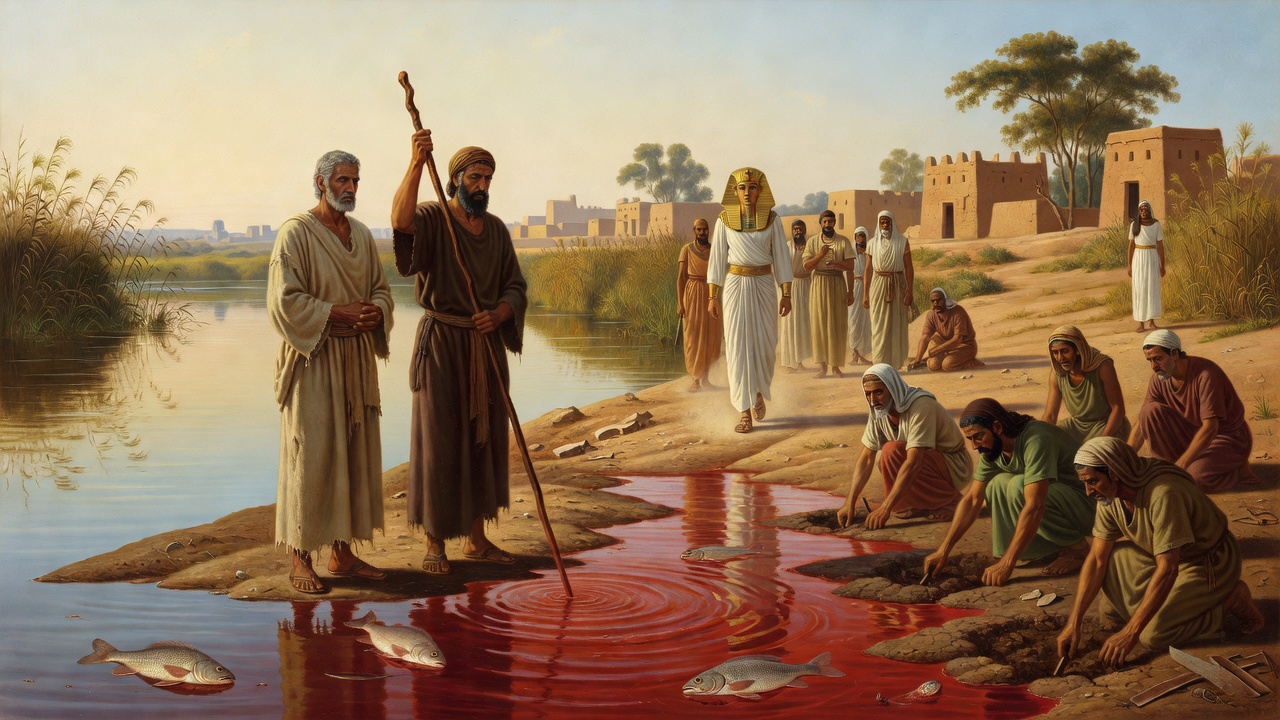
¿Sabías que…?
Moisés y Aarón ante el faraón
- Moisés tenía ochenta años y Aarón ochenta y tres cuando hablaron al faraón. El Easton's Bible Dictionary (1897) señala que Aarón, el hijo mayor de Amram y Jocabed, nació en Egipto tres años antes que su hermano Moisés. En este capítulo, el SEÑOR dice que ha hecho a Moisés "como Dios para el faraón", y que Aarón será su profeta: Moisés debe hablar todo lo que se le ordene, y Aarón debe decirle al faraón que deje salir a los israelitas de su tierra.Fuentes: el propio texto bíblico · Aaron
- El Easton's Bible Dictionary (1897) señala que el nombre Nilo no se encuentra en las Escrituras; el Antiguo Testamento llama a ese río Sihor, "la corriente negra", o simplemente "el río", y también "la inundación de Egipto". El Nilo está formado por el Nilo Blanco y el Nilo Azul, que se unen en Jartum, y es el agua que Aarón golpea en este capítulo. Los peces murieron, el río apestó, los egipcios no pudieron beberla y cavaron alrededor del Nilo en busca de agua, y pasaron siete días completos.Fuentes: Nile · el propio texto bíblico
- El Easton's Bible Dictionary (1897) dice que el faraón del Éxodo fue probablemente Menephtah I, el decimocuarto y mayor de los hijos sobrevivientes de Rameses II, y que residía en Zoan, donde tuvo las entrevistas con Moisés y Aarón registradas en Éxodo. La misma entrada deja abierta la identificación: sigue siendo una cuestión si Seti II o su padre Menephtah fue ese faraón, y algunos creen que las evidencias favorecen a Seti II.Fuentes: Pharaoh (of the Exodus) · el propio texto bíblico
Notas escritas con ayuda de IA a partir de fuentes abiertas (Theographic Bible Metadata, CC BY-SA 4.0; Easton’s Bible Dictionary, dominio público) y revisadas antes de publicarse.
Lugares de este capítulo
- Egypt · 30.129, 31.308 · versículos 3, 4, 5, 11, 19, 21, 22
- Nile · Hoy: Nile River · 31.465, 30.367 · versículos 15, 17, 18, 20, 21, 24, 25
Solo aparecen lugares identificados con alta confianza (90 % o más según las fuentes académicas reunidas por OpenBible). Mapa de la época: DARE (Digital Atlas of the Roman Empire), CC BY 4.0; mapa actual: © colaboradores de OpenStreetMap; lugares: OpenBible.info (CC BY 4.0).
Créditos y licencia de esta traducción
I tnalù dwata
New Testament in Blaan, Sarangani
copyright © 1998 Wycliffe Bible Translators, Inc.
Language: Sarangani Blaan (Blaan, Sarangani)
Translation by: Wycliffe Bible Translators
Contributor: Wycliffe Bible Translators, Inc.
Copyright Information
© 1998, Wycliffe Bible Translators, Inc. All rights reserved.
This translation text is made available to you under the
terms of the Creative Commons License: Attribution-Noncommercial-No Derivative Works.
( http://creativecommons.org/licenses/by-nc-nd/3.0/ )
In addition, you have permission to port the text to different file formats, as long as you
do not change any of the text or punctuation of the Bible.
You may share, copy, distribute, transmit, and extract portions
or quotations from this work, provided that you include the above copyright
information:
You must give Attribution to the work.
You do not sell this work for a profit.
You do not make any derivative works that change any of the actual words or punctuation of the Scriptures.
Permissions beyond the scope of this license may be
available if you contact
us with your request.
The New Testament
in Blaan, Sarangani
© 1998, Wycliffe Bible Translators, Inc. All rights reserved.
This translation is made available to you under the terms of the
Creative Commons Attribution-Noncommercial-No Derivatives license 4.0.
You may share and redistribute this Bible translation or extracts from it in any format, provided that:
You include the above copyright and source information.
You do not sell this work for a profit.
You do not change any of the words or punctuation of the Scriptures.
Pictures included with Scriptures and other documents on this site are licensed just for use with those Scriptures and documents.
For other uses, please contact the respective copyright owners.
2015-03-17
Fuente: http://ebible.org/bps/ · eBible.org