Jonah 1
YAUBADA YANA VONA'AWAUFAUFA 'IVAUNA · Tap a verse to see its cross-references.
About this book
About Jonah
- Jonah, whose name means “a dove,” was the son of Amittai of Gath-hepher and a prophet of Israel. Easton's Bible Dictionary (1897) holds that he wrote the book himself. His ministry is placed very early in the reign of Jeroboam II: he was contemporary with Hosea and Amos, or possibly earlier, and so may have been the oldest of the prophets whose writings survive.Sources: Jonah · Amittai · Easton: Jonah, Book of
- The book professes to tell what actually happened to the prophet. Some critics have read it as a parable or allegory rather than history, because miracle is so prominent and the form is narrative rather than prophecy, or because they deny miracles altogether. Easton's Bible Dictionary (1897) instead treats it as history, attaching great weight to the mention of Jonah in Matthew 12:39-40 and Luke 11:29.Sources: Easton: Jonah, Book of
- Jonah was commissioned to go to Nineveh, described as a great and populous city and the flourishing capital of the Assyrian empire, but he sailed from Joppa, Judea's chief seaport, to flee toward Tarshish. Where Tarshish lay is disputed: some place it in the east, on the Indian coast, some identify it with Carthage, and Easton's dictionary takes it to be a Phoenician port in Spain.Sources: Easton: Jonah, Book of · Nineveh · Joppa · Tarshish
- Easton's outline has four movements: the divine commission, disobedience, and punishment; Jonah's prayer and deliverance; a second commission, the Ninevites' repentance, and God's sparing mercy; and Jonah's anger at that mercy, followed by a rebuke. The same dictionary notes that Nineveh was spared for more than a century after his mission.Sources: Easton: Jonah, Book of
- As a prophet of Israel, Jonah foretold the restoration of the kingdom's ancient borders. A biographical note presents him both as a missionary to Nineveh and as a type of the Son of man. The book of Nahum is taken up almost entirely with denunciations of that city, and Zephaniah also predicts its destruction.Sources: Jonah · Nineveh
Notes written with AI assistance from open sources (Theographic Bible Metadata, CC BY-SA 4.0; Easton’s Bible Dictionary, public domain) and reviewed before publishing.
Iona i dega 'Auvea 'wainega
1'Auvea vala i vetunei Iona Amitai natuna 'waineye. 2I voneni i vo, 'U na 'idewadewa 'u na nago Ninive, 'atamananina bwaikina 'waineye. Tomotoganidi 'u na vonedi, yadi sauluva sakoidi 'akonadi a 'asetadi begaidi a na vematavulogidi.
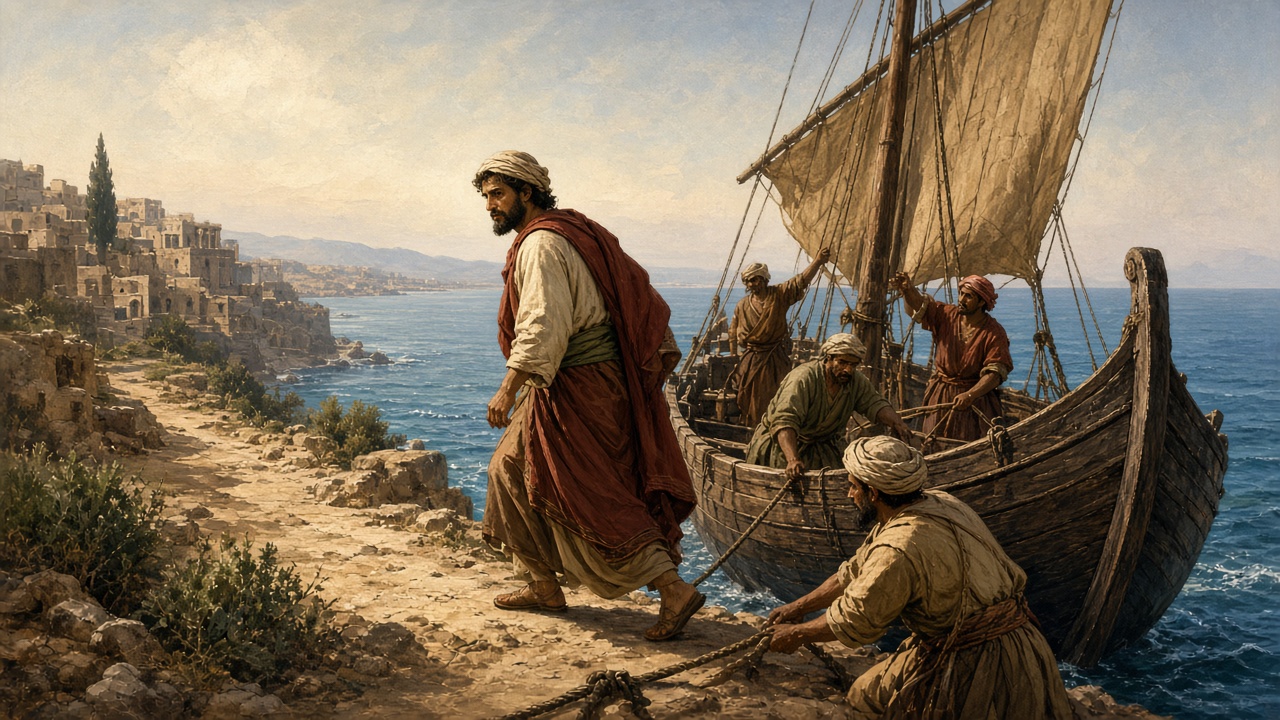
3Siwe Iona i tovoi i 'abiwalowaloga i dega 'Auvea 'wainega. I nago Iofa, tamu waka i veluagai i tautauya Tasisi faifaina. Yana 'eda i tutuli i dodoga i na nago Tasisi.
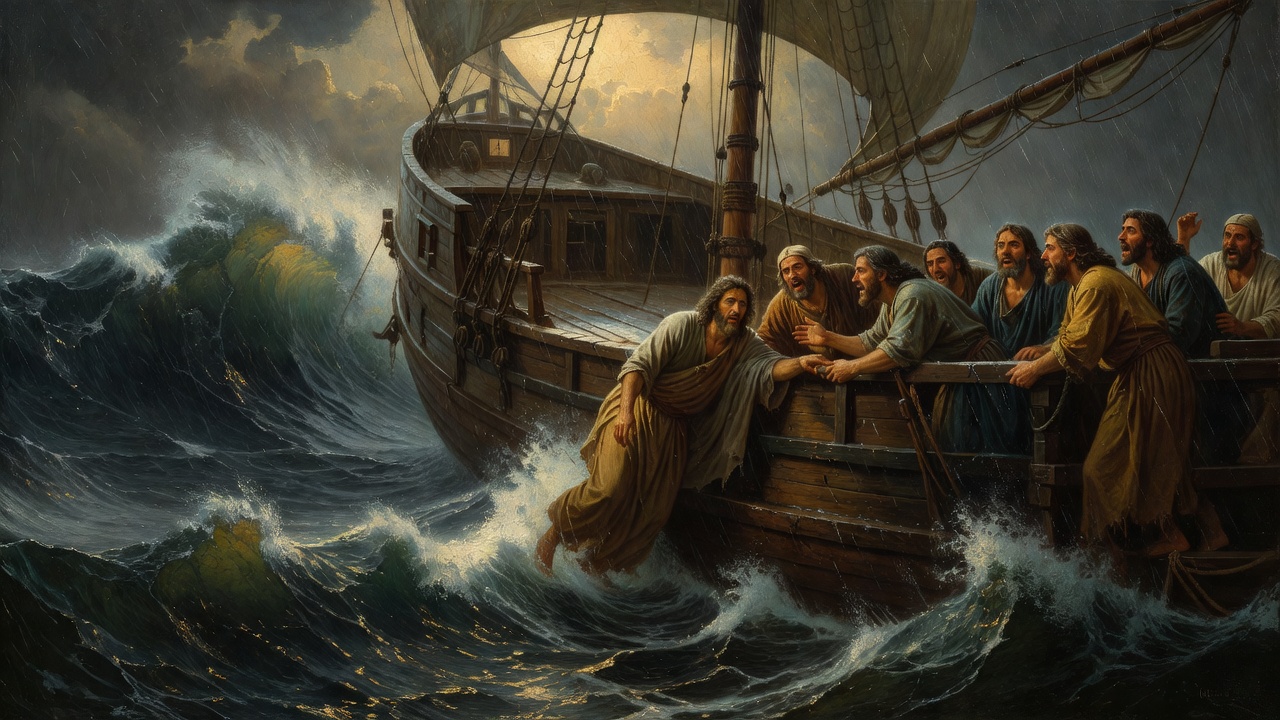
4Siwe 'Auvea kaukau toketokena i butuya malaveseye, yagina bwaikina i velamu igodi waka i da kuali. 5Waka 'ana tofolovavo i kololo-'afo'afo, yadi yaubadavo 'waidie i vevegole 'aivaita faifaina. We'e kukua i tawetawedi malaveseye bega waka i na safaila. |alt="Boat in storm" src="32_Jon_01_03_RG.jpg" size="span" loc="half page" copy="WBT" ref="1:5"
We'e Iona i obu waka nageneye i 'eno-mwadumwadu. 6Tomuli'auta i obu waka nageneye, Iona i 'iseni i luvagoni i vo, Awale 'u 'eno'eno? 'U tovoi 'u velu'ui yamu Yaubada 'waineye voke bonamu i na nogai, i na 'ita'ita'ieda nika kebu ta na wafaga.”
Waka 'ana tofolovavo Iona i taweni eyage
7Waka 'ana tofolovavo ma ediavo i veifufu i vo, Tamu 'wava ta na 'waveni bega ta na lualeni aitoi mogitana vita de'e i mieni 'waideye.” Yadi 'wavanina 'wainega Iona 'ana wagava i vemageta nika vita i tovoieni.
8I velutolieni i vo, 'U na vonema, aitoi vita de'e i na tovoieni? 'Omu ava'ai folovaga 'waineye 'u folofolova? Ava'aiega 'u mai? Ava'ai 'awalawaga 'wainega? Ava'ai 'aila'aga 'wainega 'u mai?”
9Iona i tutula i vo, Yau tomogo Ibeliu, 'Auvea Yaubada abame 'waineye a 'odu'odu, kumanina fwayafwaya wata eyaga 'adi to'idewadewa.”
10Tutuyanina waka 'ana tofolovavo i 'asetai Iona tamu 'Auvea yana tomotoga, i kololo-'afo'afo i voneni i vo, Awale naninina sakoiotogina 'u 'idewai?” Bani'odi i voneyediga fai Iona nagami i vonedi 'Auvea 'wainega i degadega.
11Kaukau wata yagina i toke i vebwaika-'afo'afo, bega waka 'ana tofolovavo i velutolieni i vo, Ava'ai 'a na 'idewai 'waimuye bega yagina i na niwalova?”
12Iona i tutula i vo, Vita de'e lamuna 'akonadi a 'asetai, yau yaku sakona 'wainega yagina bwaikina i nikenikeda, begaidi 'wa na silakaiku 'wa na taweku a na obu eyage, nika yagina i na niwalova.”
13Waka 'ana tofolovavo kebu nuanuadi Iona i na taweni i na obu malaveseye, bega matatabudi i toke i voivoi nuanuadi waka i na vevilai i da luku 'avale, siwe i vetafewa-wayoga fai yagina bwaikaotogina. 14Bega waka 'ana tofolovavo i toke i velu'ui 'Auvea 'waineye i vo, 'Auvea, kebu nuanuama 'a na wafa tomogo de'e yana sakona faifaina wata kebu 'u na vevitama tomogonina i na wafaga faifaina. Kaukau wata yagina bwaikidi 'u 'idewadiga, taunimu yamu nuanua 'ana laubwaina 'wainega.”
15Tutuyanina waka 'ana tofolovavo i vona'a'ava, Iona i silakai i taweni i obu malaveseye. Kebu tutuya manamanawenaga, yagina i niwalova. 16Tutuyanina waka 'ana tofolovavo i 'iseni, matatabudi 'Auvea i kololoyeni, bega i velomu 'waineye wata i vona'awaufaufa i na vematayakeyakeni.
17Siwe 'Auvea yana veimea 'wainega, igana bwaikaotogina i mai i bodaboda, tutuyanina Iona i taweni i obu malaveseye igana i tononi. Iona igana kamoneye i miamia 'aiata 'aitonu wata lovana 'aitonu.
Did you know?
Jonah Flees from the Lord
- Jonah, the son of Amittai from Gath-hepher, is also recorded in 2 Kings 14:25 as a prophet active in the northern kingdom of Israel during the reign of Jeroboam II. God instructed him to travel east to Nineveh, the prominent and populous capital of the Assyrian empire, to preach against its wickedness.Sources: Jonah · Amittai · Nineveh · the Bible text itself
- Rather than traveling northeast overland to Nineveh, Jonah journeyed down to the Mediterranean seaport of Joppa to board a ship for Tarshish. Tarshish is traditionally identified as a Phoenician trading port located far to the west in southern Spain, representing the exact opposite direction.Sources: Joppa · Tarshish · the Bible text itself
- The sailors aboard the cargo ship came from polytheistic backgrounds, each calling out to his own deity during the violent tempest. After throwing the ship's cargo overboard to lighten the vessel, they turned to the ancient practice of casting lots to determine who was responsible for the calamity.Sources: the Bible text itself
Notes written with AI assistance from open sources (Theographic Bible Metadata, CC BY-SA 4.0; Easton’s Bible Dictionary, public domain) and reviewed before publishing.
Places in this chapter
Only places identified with high confidence are shown (90% or more according to the scholarly sources compiled by OpenBible). Period map: DARE (Digital Atlas of the Roman Empire), CC BY 4.0; modern map: © OpenStreetMap contributors; places: OpenBible.info (CC BY 4.0).
Credits and license for this translation
YAUBADA YANA VONA'AWAUFAUFA 'IVAUNA
The New Testament in the Iamalele dialect of the Ubuvala Language of Papua New Guinea
Nupela Testamen long tokples Ubuvala long Niugini
copyright © 1984, 1988, 2025 Wycliffe Bible Translators, Inc. and SIL Papua New Guinea
Language: Ubuvala (Iamalele)
Dialect: Iamalele
Translation by: SIL PNG
Contributor: Wycliffe Bible Translators
This translation is made available to you under the terms of the
Creative Commons Attribution-Noncommercial-No Derivatives license 4.0.
You may share and redistribute this Bible translation or extracts from it in any format, provided that:
You include the above copyright and source information.
You do not sell this work for a profit.
You do not change any of the words or punctuation of the Scriptures.
Pictures included with Scriptures and other documents on this site are licensed just for use with those Scriptures and documents.
For other uses, please contact the respective copyright owners.
2026-09-30
Source: http://png.bible/yml/ · eBible.org