Job 5
Bib Sen An · Tap a verse to see its cross-references.
1“Rele koulye a; èske gen moun ki pou reponn?
A kilès nan sen fidèl yo ke ou va vire?
2Paske rankin va touye moun ki plen foli,
e jalouzi va touye moun senp lan.
3Mwen te wè moun san konprann ki t ap pran rasin,
e byen vit, mwen te denonse kay li.
4Fis li yo pa jwenn sekirite ditou;
menm nan pòtay la, yo oprime,
ni pa gen moun pou delivre yo.
5Moun grangou yo devore rekòlt li,
e mennen l yon kote plen pikan.
Epi pèlen an rete ouvè pou sezi tout byen yo.
6Paske malè pa sòti nan pousyè,
ni gwo twoub pa pouse soti nan tè;
7paske lòm fèt pou gwo twoub,
tankou etensèl dife vole anlè.
8“Men pou mwen, mwen ta chache Bondye,
pou m ta plede kòz mwen devan Bondye.
9Bondye Ki konn fè gwo bagay ki depase konesans lan;
mèvèy ki pa kab menm konte yo.
10Li bay lapli sou tè a,
e voye dlo sou chan yo,
11Jiskaske Li leve sila ki enb yo,
e sila ki an dèy yo, li leve bay sekou.
12Li anile manèv a sila ki gen riz yo
pou men yo pa reyisi.
13Li kaptire saj yo nan pwòp riz pa yo,
e konsèy a moun k ap twonpe moun nan
vin kontrekare byen vit.
14Nan gwo lajounen, yo jwenn ak tenèb,
e yo egare gwo midi tankou se te lannwit.
15Men li sove yo de nepe a pwop bouch yo,
e menm malere a chape nan men pwisan an.
16Akoz sa, sila ki san sekou a gen espwa,
e inikite oblije pe bouch li.
17“Gade byen kijan nonm
ke Bondye bay chatiman an gen kè kontan.
Konsa, pa meprize disiplin Toupwisan an.
18Paske se Li menm ki blese,
e se Li menm ki retire blesi a;
Li fè donmaj la, e pwòp men L ki geri l.
19Soti sis fwa, Li va delivre ou de twoub ou yo;
Menm nan sèt fwa, mal la p ap kab touche ou.
20Nan gwo grangou Li va delivre ou devan lanmò,
e nan lagè, devan pouvwa nepe a.
21Ou va pwoteje devan blese a lang lan,
e ou p ap pè vyolans lan lè l vin parèt.
22Ou va ri devan vyolans ak grangou,
e ou p ap pè bèt sovaj yo.
23Paske ou va fè alyans ak wòch chan yo,
e bèt sovaj yo va anpè avèk ou.
24Ou va konnen ke tant ou an pwoteje,
paske ou va vizite lakay ou san krent ni pèt.
25Anplis, ou va konnen ke desandan ou yo va anpil,
e sila ki sòti nan ou yo anpil tankou zèb latè.
26Ou va rive nan tonbo a ak tout fòs ou,
tankou gwo sak ble nan sezon li.
27Gade sa byen; nou te fè ankèt li, e se konsa li ye.
Tande sa e konnen l pou kont ou.”
Did you know?
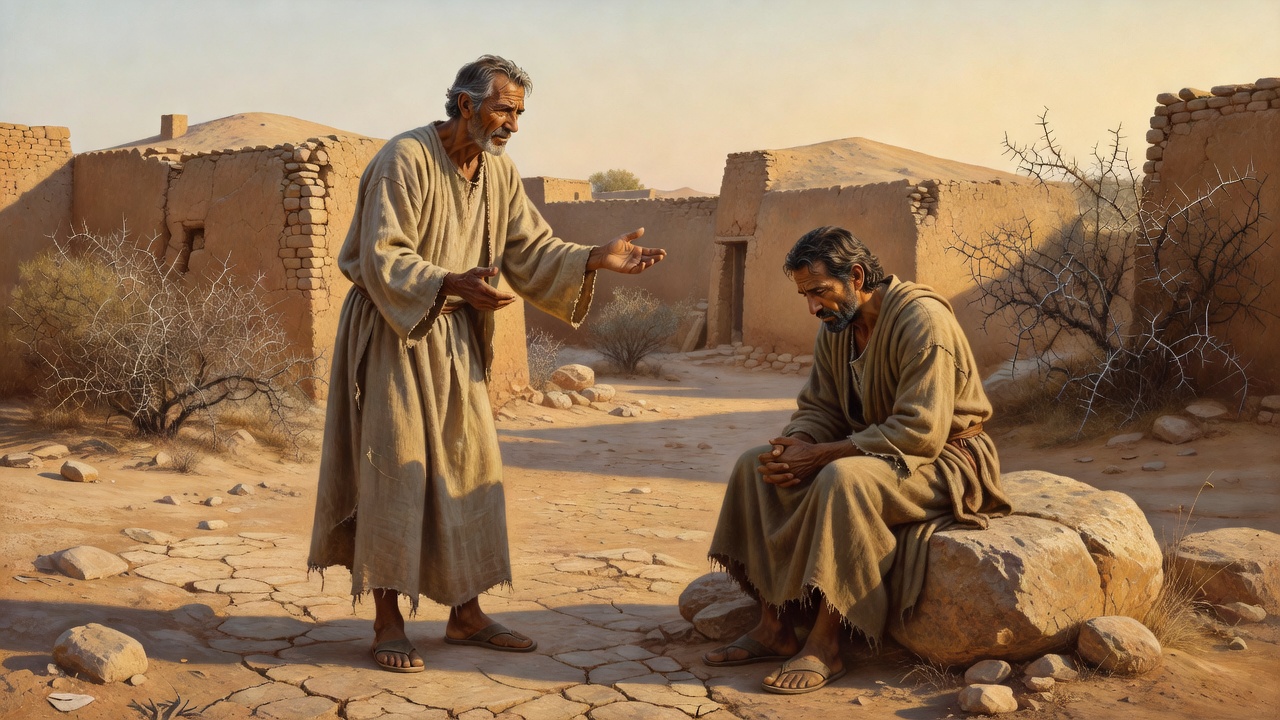
Eliphaz's Counsel on Suffering and Divine Correction
- Eliphaz portrays suffering as purposeful divine discipline rather than arbitrary misfortune, asserting that trouble does not arise without cause from the soil. He urges Job not to despise the correction of the Almighty, who wounds only to heal and restore.Sources: the Bible text itself
- In promising deliverance from six calamities and even seven, Eliphaz employs a traditional poetic formula known as graded numerical parallelism. This rhetorical pattern, common in ancient Near Eastern wisdom poetry, builds emphasis to express comprehensive and complete protection.Sources: the Bible text itself
- Eliphaz describes ultimate restoration in vivid agricultural and pastoral terms, depicting a life where wild beasts and stony soil cease to be hostile. He envisions a peaceful death occurring in full vigor, likened to a sheaf of grain harvested at the proper season.Sources: the Bible text itself
Notes written with AI assistance from open sources (Theographic Bible Metadata, CC BY-SA 4.0; Easton’s Bible Dictionary, public domain) and reviewed before publishing.
Credits and license for this translation
Bib Sen An
The Holy Bible in Haitian Creole, 2023 update
copyright © 2017-2023 Ron Smith
Language: Kreyòl Ayisyen (Haitian)
Translation by: Ron Smith
Contributor: Felix Nixon
This translation is made available to you under the terms of the
Creative Commons Attribution Share-Alike license 4.0.
You have permission to share and redistribute this Bible translation in any format and to make reasonable revisions and adaptations of this translation, provided that:
You include the above copyright and source information.
If you make any changes to the text, you must indicate that you did so in a way that makes it clear that the original licensor is not necessarily endorsing your changes.
If you redistribute this text, you must distribute your contributions under the same license as the original.
Pictures included with Scriptures and other documents on this site are licensed just for use with those Scriptures and documents.
For other uses, please contact the respective copyright owners.
Note that in addition to the rules above, revising and adapting God's Word involves a great responsibility to be true to God's Word. See Revelation 22:18-19.
2026-06-11
Source: http://ebible.org/hatbsa/ · eBible.org