Leviticus 16
Kuninjku Selections · Tap a verse to see its cross-references.
About this book
About Leviticus
- Easton's Bible Dictionary (1897) presents Leviticus as the third book of the Pentateuch and as the third book of Moses. The name, used in the Vulgate following the LXX, reflects the book's chief concern: the Levitical service.Sources: Easton: Leviticus
- Easton states that every ordinance in the book was delivered within one month, the first month of the second year after the Exodus. His entry on Sinai, also called Horeb, says the Hebrews reached that mountain district in the third month after the Exodus and remained encamped for about a whole year, and that the whole of Leviticus records what occurred there.Sources: Easton: Leviticus · Mount Sinai
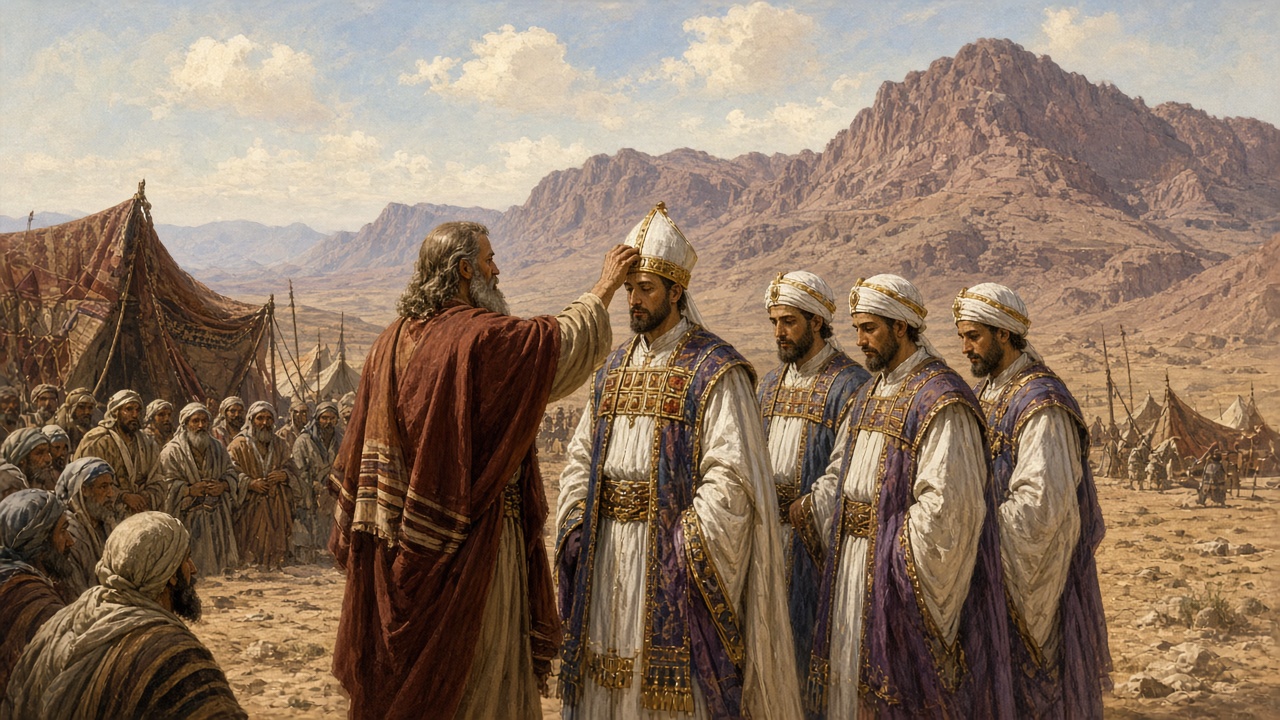
- Chapters 1–7 give laws for burnt offerings, meat offerings, and thank offerings, then for sin offerings and trespass offerings, and for the priests' duties in offering sacrifice. Chapters 8–10 recount the consecration of Aaron and his sons, Aaron's first offering for himself and the people, and the death of Nadab and Abihu, who were struck dead and buried outside the camp after offering strange, or common, fire not taken from the great brazen altar. Chapters 11–16 concern purity and the sacrifices and ordinances for putting impurity away.Sources: Easton: Leviticus · Nadab · Abihu
- Easton describes chapters 17–20 as laws marking the separation between Israel and other peoples. Further laws concern the priests' personal purity and their eating of holy things, offerings without blemish, and the due celebration of the great festivals in chapters 23 and 25. Promises and warnings about obedience follow, the book closes with a section on vows, and Easton notes that God is the direct speaker through almost the whole of it.Sources: Easton: Leviticus
- In the rites of chapter 16, one goat is associated with Azazel, which the Authorized Version renders scapegoat and the Revised Version leaves as Azazel. Easton reports that some Jewish interpreters take it as a place in the wilderness about twelve miles east of Jerusalem, while others take it as an evil spirit or even Satan, and he also notes a root meaning of separation.Sources: Azazel
Notes written with AI assistance from open sources (Theographic Bible Metadata, CC BY-SA 4.0; Easton’s Bible Dictionary, public domain) and reviewed before publishing.
Kunmak benbekad bu Yahwey Kaworhnan kabularrbun kure kunwarre bedberre bininj.
1Benebokenh Eron nuye bebeywurd bu korroko bedda benewokweng Yahwey Kaworhnan nuye kunwok, benewam darnki kunwarre dorrengh kure Yahwey Kaworhnan wanjh benedoweng.
Wanjh nawu Yahwey Kaworhnan bimarneyimeng Modji, “Modji, ngudda yimarneyimen Eron mane kunwok”.
“Ngayi Yahwey Ngaworhnan marnebebme kurruk kure kungol kaddum kure dangno manekke karrangbarrhmikendi kaddum kure Budmanda nakimuk nadjamun, kure kurrurrk kurrurrkdjamun dabbulin kure kubodme kurrurrk kawelhwelhme manburrba. Bengdayhke minj yire kure kurrurrkdjamun dabbulin, wardi yiman yire wanjh yirrowen bu yingimen kure kundjamun dabbulin kahdi. Minj yirrowen ngudda kunkudji yire kumekke bu ngayi marneyime mandjad.
3Eron, yimre kure kurrurrkdjamun dabbulin yibenka mayh kunbid kunkudji. Ngudda yidjirridjburren. Wanjh ba yidjongburren madjbele kunmadj nawu linen, yiman kayime kandjiken mak kunmadj nakuyeng.
Eron, ngudda yiwon kunmakmak narangem bulikki, yibun ngudda kenh kabularrbun kunwarre ngudda Eron mak ke namud.
Eron, ngudda yiwon kunmakmak narangem djib ngudda Eron mak ke namud, bu yibun ba kanmarnbun nganjilngmakmen.
Wanjh bininj Yidjrayelbeh kabirrimkan benebokenh narahrangem nanikud, bu kunwarre bedberre bininj Yidjrayelbeh. Ngudda yibenka namekke bokenh narahrangem nanikud kanbukka kure ngayi ngardduk kuberrk kure ngahdi kurrurrkdjamun dabbulin kahdi.
Eron yiburriwe bokenh kunwardde, ba manekke bokenh kunwardde yinan yibengkan baleh kabenere narahrangem nanikud. Nakudji narangem nanikud ngudda yiwon kunmakmak ngardduk, yibun bu kunwarre bedberre bininj Yidjrayelbeh, mak nabuyika narangem nanikud yimka karrarrkid kure ngayi. Yimunkewen kare kure manberrkombuk kure wayarra Nadjadjel. Nungka nane nanikud kakan kunwarre bedberre bininj birridjalwern.
Wanjh bininj Yidjrayelbeh kabirrimkan narangem djib. Wanjh ngudda yiwon kunmakmak namekke narangem djib bu yibun ba yimarnbun kannjilmakmen.
Mane kunwok marneyimeng ngudda mandjad ba yire ngudda yingimen kure kurrurrkdjamun dabbulin kahdi.
Did you know?
The Day of Atonement Rituals
- The high priest entered the Most Holy Place behind the veil only on the Day of Atonement, observed on the tenth day of the seventh month. Before entering, he bathed and put on simple holy linen garments rather than elaborate robes, carrying incense to create a protective cloud over the mercy seat.Sources: the Bible text itself · Holy Place
- The ritual required two male goats: one was sacrificed as a sin offering to purify the sanctuary, while the other was sent alive into the wilderness bearing the sins of Israel. The Hebrew designation for the released goat, Azazel, has been interpreted variously as a remote geographic location in the desert, an evil spirit, or a word meaning separation.Sources: the Bible text itself · Azazel
Notes written with AI assistance from open sources (Theographic Bible Metadata, CC BY-SA 4.0; Easton’s Bible Dictionary, public domain) and reviewed before publishing.
Credits and license for this translation
Kuninjku Selections
Scripture portions in the Kuninjku language of Australia
copyright © 2021-2026 Wycliffe Bible Translators, Inc.
Language: Kuninjku (Kunwinjku)
This translation is made available to you under the terms of the
Creative Commons Attribution-Noncommercial-No Derivatives license 4.0.
You may share and redistribute this Bible translation or extracts from it in any format, provided that:
You include the above copyright and source information.
You do not sell this work for a profit.
You do not change any of the words or punctuation of the Scriptures.
Pictures included with Scriptures and other documents on this site are licensed just for use with those Scriptures and documents.
For other uses, please contact the respective copyright owners.
2026-09-09
Source: http://ebible.org/gupk/ · eBible.org