Revelation 1
Berean Standard Bible · Tap a verse to see its cross-references.
About this book
About Revelation
- Easton's Bible Dictionary (1897) identifies the author as the apostle John, whose name appears four times in the book (1:1, 4, 9; 22:8). The same entry says the date has generally been fixed at A.D. 96, under Domitian, while some contend for A.D. 68 or 69, under Nero. Those who favor the later date appeal to the Christian father Irenaeus, who had received information about the book from people that had seen John face to face, and who said that the Apocalypse “was seen no long time ago.”Sources: Easton: Revelation, Book of
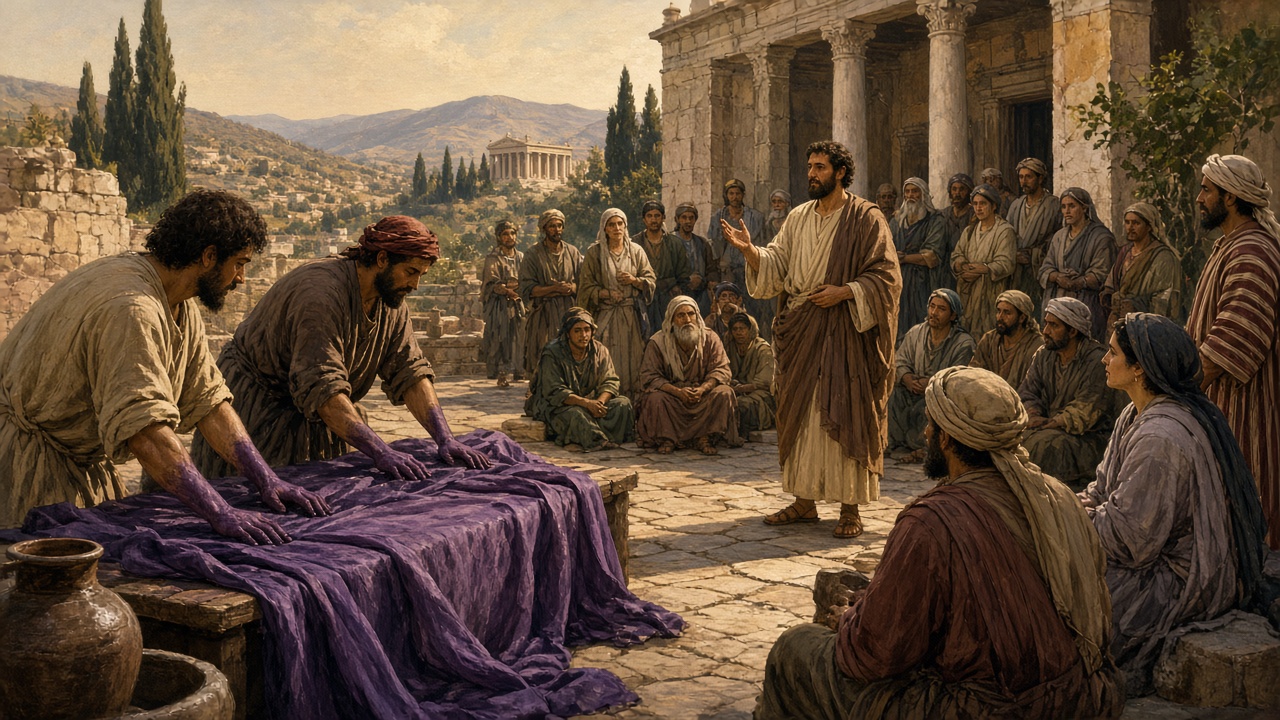
- Revelation names churches in cities of Asia Minor. Thyatira, on the borders of Lydia and Mysia and long famous for dyeing, and Sardis, the metropolis of Lydia on the river Pactolus at the foot of Mount Tmolus, were each one of the seven churches. Laodicea, on the confines of Phrygia and Lydia, beside the Lycus about forty miles east of Ephesus, is also cited; it had been called Diospolis and then Rhoas before Antiochus II of Syria rebuilt it and named it for his wife Laodice.Sources: Thyatira · Sardis · Laodicea
- Easton's Bible Dictionary (1897) calls Revelation the Apocalypse, the closing book and the only prophetical book of the New Testament canon. Citing Plummer, it says this book and the Gospel of John share the same leading ideas: one gives a magnificent vision, the other a great historic drama, of the supreme conflict between good and evil and its outcome. In both, the entry adds, Jesus Christ is the central figure, whose victory through defeat is that outcome, and his warfare and triumph are described in language saturated with the Old Testament.Sources: Easton: Revelation, Book of
- A manuscript of about the twelfth century calls the author “John the divine,” though Easton's Bible Dictionary (1897) says no reason can be assigned for that title. In the book, Satan is called “the dragon” and “the old serpent,” and Antipas is named a “faithful martyr,” of whom nothing more is certainly known.Sources: Easton: Revelation, Book of · Satan · Antipas
Notes written with AI assistance from open sources (Theographic Bible Metadata, CC BY-SA 4.0; Easton’s Bible Dictionary, public domain) and reviewed before publishing.
Prologue
1This is the revelation of Jesus Christ, which God gave Him to show His servants what must soon come to pass. He made it known by sending His angel to His servant John, 2who testifies to everything he saw. This is the word of God and the testimony of Jesus Christ.
3Blessed is the one who reads aloud the words of this prophecy, and blessed are those who hear and obey what is written in it, because the time is near.
John Greets the Seven Churches
4John,
To the seven churches in the province of Asia:
Grace and peace to you from Him who is and was and is to come, and from the seven Spirits before His throne, 5and from Jesus Christ, the faithful witness, the firstborn from the dead, and the ruler of the kings of the earth.
To Him who loves us and has released us from our sins by His blood, 6who has made us to be a kingdom, priests to His God and Father—to Him be the glory and power forever and ever! Amen.
7Behold, He is coming with the clouds, and every eye will see Him—even those who pierced Him. And all the tribes of the earth will mourn because of Him. So shall it be! Amen.
8“I am the Alpha and the Omega,” says the Lord God, who is and was and is to come—the Almighty.
John’s Vision on Patmos
9I, John, your brother and partner in the tribulation and kingdom and perseverance that are in Jesus, was on the island of Patmos because of the word of God and my testimony about Jesus. 10On the Lord’s day I was in the Spirit, and I heard behind me a loud voice like a trumpet, 11saying, “Write on a scroll what you see and send it to the seven churches: to Ephesus, Smyrna, Pergamum, Thyatira, Sardis, Philadelphia, and Laodicea.”
12Then I turned to see the voice that was speaking with me. And having turned, I saw seven golden lampstands, 13and among the lampstands was One like the Son of Man, dressed in a long robe, with a golden sash around His chest. 14The hair of His head was white like wool, as white as snow, and His eyes were like a blazing fire. 15His feet were like polished bronze refined in a furnace, and His voice was like the roar of many waters. 16He held in His right hand seven stars, and a sharp double-edged sword came from His mouth. His face was like the sun shining at its brightest.
17When I saw Him, I fell at His feet like a dead man. But He placed His right hand on me and said, “Do not be afraid. I am the First and the Last, 18the Living One. I was dead, and behold, now I am alive forever and ever! And I hold the keys of Death and of Hades.
19Therefore write down the things you have seen, and the things that are, and the things that will happen after this. 20This is the mystery of the seven stars you saw in My right hand and of the seven golden lampstands: The seven stars are the angels of the seven churches, and the seven lampstands are the seven churches.
Did you know?
A vision on Patmos for the churches of Asia
- John writes that he was on the island of Patmos because of the word of God and his testimony about Jesus. Patmos is a small, rocky, and barren island in the Sporades, in the Aegean Sea, and it is mentioned in Scripture only in this chapter. Easton's Bible Dictionary (1897) states that the emperor Domitian banished John there in A.D. 95, and that he received this revelation on the island.Sources: the Bible text itself · Patmos
- The message is addressed to seven churches in the province of Asia, the Roman province of Proconsular Asia, which covered the western part of Asia Minor and had Ephesus as its capital. John is told to write on a scroll what he sees and send it to Ephesus, Smyrna, Pergamum, Thyatira, Sardis, Philadelphia, and Laodicea, the seven churches of that province.Sources: the Bible text itself · Asia
- Ephesus, the provincial capital, bore the Roman title "the first and greatest metropolis of Asia." It was known for the temple of Diana and for an open-air theatre, the largest in the world, able to hold 50,000 spectators. Thyatira, on the borders of Lydia and Mysia, was famous for dyeing; Sardis, the metropolis of Lydia, stood on the river Pactolus at the foot of Mount Tmolus; and Laodicea lay about forty miles east of Ephesus, on the banks of the Lycus.Sources: Ephesus · Thyatira · Sardis · Laodicea
Notes written with AI assistance from open sources (Theographic Bible Metadata, CC BY-SA 4.0; Easton’s Bible Dictionary, public domain) and reviewed before publishing.
Places in this chapter
- Asia · 38.400, 28.300 · verses 4, 11
- Patmos · 37.325, 26.542 · verse 9
- Ephesus · 37.939, 27.341 · verse 11
- Laodicea · Today: Laodicea on the Lycus · 37.836, 29.108 · verse 11
- Pergamum · Today: Pergamon · 39.132, 27.184 · verse 11
- Philadelphia · Today: Alaşehir · 38.350, 28.517 · verse 11
- Sardis · 38.488, 28.040 · verse 11
- Smyrna · Today: Izmir · 38.419, 27.138 · verse 11
- Thyatira · Today: Akhisar · 38.920, 27.837 · verse 11
Only places identified with high confidence are shown (90% or more according to the scholarly sources compiled by OpenBible). Period map: DARE (Digital Atlas of the Roman Empire), CC BY 4.0; modern map: © OpenStreetMap contributors; places: OpenBible.info (CC BY 4.0).
Credits and license for this translation
Berean Standard Bible
The Holy Bible in English: Berean Standard Bible
Public Domain
Language: English
Contributor: BSB Publishing, LLC
2026-10-02
Source: http://ebible.org/engbsb/ · eBible.org