Genesis 12
Berean Standard Bible · Tap a verse to see its cross-references.
The Call of Abram
1Then the LORD said to Abram, “Leave your country, your kindred, and your father’s household, and go to the land I will show you.
2I will make you into a great nation,
and I will bless you;
I will make your name great,
so that you will be a blessing.
3I will bless those who bless you
and curse those who curse you;
and all the families of the earth
will be blessed through you.”
4So Abram departed, as the LORD had directed him, and Lot went with him. Abram was seventy-five years old when he left Haran. 5And Abram took his wife Sarai, his nephew Lot, and all the possessions and people they had acquired in Haran, and set out for the land of Canaan.
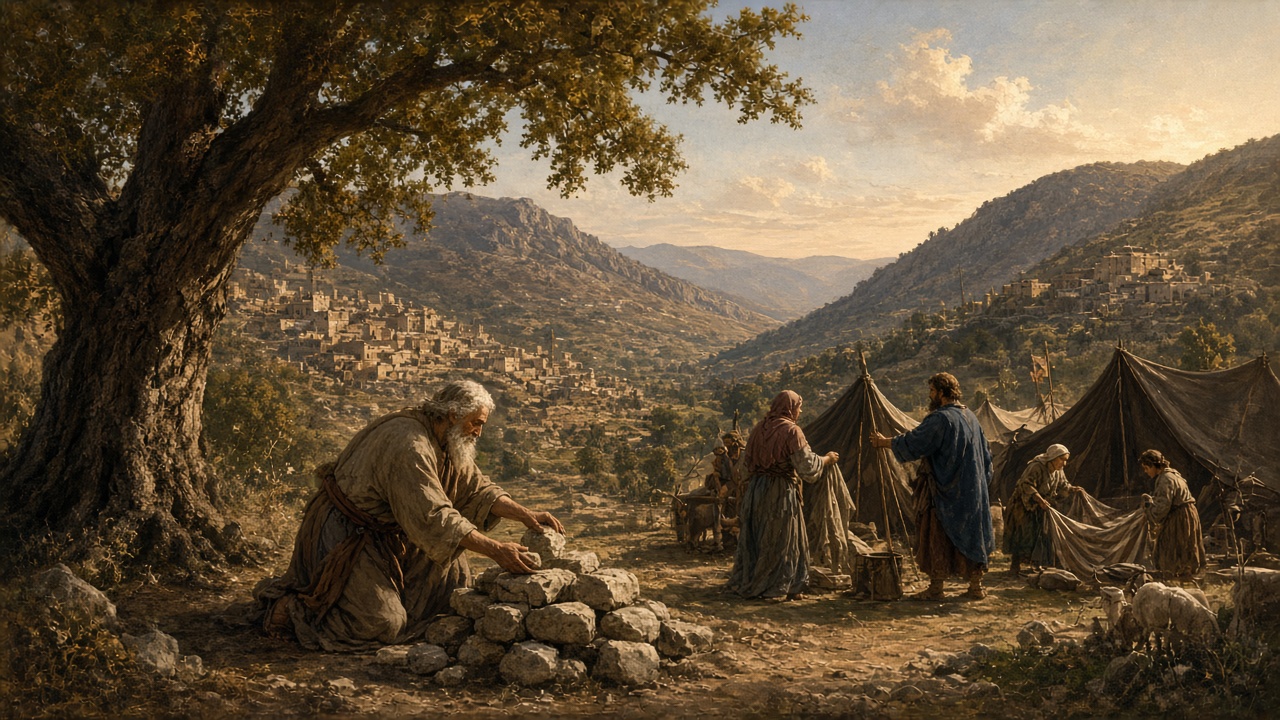
When they came to the land of Canaan, 6Abram traveled through the land as far as the site of the Oak of Moreh at Shechem. And at that time the Canaanites were in the land.
7Then the LORD appeared to Abram and said, “I will give this land to your offspring.” So Abram built an altar there to the LORD, who had appeared to him.
8From there Abram moved on to the hill country east of Bethel and pitched his tent, with Bethel to the west and Ai to the east. There he built an altar to the LORD, and he called on the name of the LORD.
9And Abram journeyed on toward the Negev.
Abram and Sarai in Egypt
10Now there was a famine in the land. So Abram went down to Egypt to live there for a while because the famine was severe. 11As he was about to enter Egypt, he said to his wife Sarai, “Look, I know that you are a beautiful woman, 12and when the Egyptians see you, they will say, ‘This is his wife.’ Then they will kill me but will let you live. 13Please say you are my sister, so that I will be treated well for your sake, and on account of you my life will be spared.”
14So when Abram entered Egypt, the Egyptians saw that the woman was very beautiful. 15When Pharaoh’s officials saw Sarai, they commended her to him, and she was taken into the palace of Pharaoh. 16He treated Abram well on her account, and Abram acquired sheep and cattle, male and female donkeys, menservants and maidservants, and camels.
17The LORD, however, afflicted Pharaoh and his household with severe plagues because of Abram’s wife Sarai. 18So Pharaoh summoned Abram and asked, “What have you done to me? Why didn’t you tell me she was your wife? 19Why did you say, ‘She is my sister,’ so that I took her as my wife? Now then, here is your wife. Take her and go!”
20Then Pharaoh gave his men orders concerning Abram, and they sent him away with his wife and all his possessions.
Did you know?
Abram's Call and Journey to Canaan
- Easton's Bible Dictionary treats the call that opens this chapter as a second, more definite summons. An earlier call, noted in Acts but not narrated in the Old Testament, and only implied here, had already taken Abram from Ur of the Chaldees some three hundred miles north to Haran, where he stayed until his father Terah died. Genesis says he was seventy-five when he left Haran with his wife Sarai, his nephew Lot, and the people and possessions gathered there.Sources: Abraham · Haran · the Bible text itself
- Abram's first halt in the land was at the Oak of Moreh, by Shechem, in the narrow valley between Mount Ebal and Mount Gerizim, whose bases stand only some five hundred yards apart. Easton's Bible Dictionary says Moreh was probably a Canaanite who gave the place its name, and that here Abram pitched his tent, built his first altar, and received the promise of the land for his offspring, even though the Canaanites were then in the land. What some older versions call a plain, the Revised Version calls an oak.Sources: Shechem · Moreh (Shechem) · the Bible text itself
- A severe famine then led Abram down to Egypt, where he asked Sarai to say that she was his sister. Easton's Bible Dictionary (1897) identifies Sarai as both his wife and his half-sister; the name Sarah, it notes, was given only later, when it was announced to Abraham that she would be the mother of the promised child. It suggests that the Pharaoh of this visit was probably one of the Hyksos, or shepherd kings, rulers of Semitic origin whose capital was Zoan, also called Tanis.Sources: Sarah · Pharaoh (during Abraham's Journey) · the Bible text itself
Notes written with AI assistance from open sources (Theographic Bible Metadata, CC BY-SA 4.0; Easton’s Bible Dictionary, public domain) and reviewed before publishing.
Places in this chapter
- Haran · Today: Harran · 36.864, 39.033 · verses 4, 5
- Canaan · 32.767, 35.333 · verses 5, 10
- Moreh · Today: within 1 km of Tell Balatah · 32.214, 35.282 · verse 6
- Shechem · Today: Tell Balatah · 32.214, 35.282 · verse 6
- Negeb · 31.245, 34.841 · verse 9
- Egypt · 30.129, 31.308 · verses 10, 11, 14
Only places identified with high confidence are shown (90% or more according to the scholarly sources compiled by OpenBible). Period map: DARE (Digital Atlas of the Roman Empire), CC BY 4.0; modern map: © OpenStreetMap contributors; places: OpenBible.info (CC BY 4.0).
Credits and license for this translation
Berean Standard Bible
The Holy Bible in English: Berean Standard Bible
Public Domain
Language: English
Contributor: BSB Publishing, LLC
2026-10-02
Source: http://ebible.org/engbsb/ · eBible.org