Jonah 1
Plain English Version · Tap a verse to see its cross-references.
About this book
About Jonah
- Jonah, whose name means “a dove,” was the son of Amittai of Gath-hepher and a prophet of Israel. Easton's Bible Dictionary (1897) holds that he wrote the book himself. His ministry is placed very early in the reign of Jeroboam II: he was contemporary with Hosea and Amos, or possibly earlier, and so may have been the oldest of the prophets whose writings survive.Sources: Jonah · Amittai · Easton: Jonah, Book of
- The book professes to tell what actually happened to the prophet. Some critics have read it as a parable or allegory rather than history, because miracle is so prominent and the form is narrative rather than prophecy, or because they deny miracles altogether. Easton's Bible Dictionary (1897) instead treats it as history, attaching great weight to the mention of Jonah in Matthew 12:39-40 and Luke 11:29.Sources: Easton: Jonah, Book of
- Jonah was commissioned to go to Nineveh, described as a great and populous city and the flourishing capital of the Assyrian empire, but he sailed from Joppa, Judea's chief seaport, to flee toward Tarshish. Where Tarshish lay is disputed: some place it in the east, on the Indian coast, some identify it with Carthage, and Easton's dictionary takes it to be a Phoenician port in Spain.Sources: Easton: Jonah, Book of · Nineveh · Joppa · Tarshish
- Easton's outline has four movements: the divine commission, disobedience, and punishment; Jonah's prayer and deliverance; a second commission, the Ninevites' repentance, and God's sparing mercy; and Jonah's anger at that mercy, followed by a rebuke. The same dictionary notes that Nineveh was spared for more than a century after his mission.Sources: Easton: Jonah, Book of
- As a prophet of Israel, Jonah foretold the restoration of the kingdom's ancient borders. A biographical note presents him both as a missionary to Nineveh and as a type of the Son of man. The book of Nahum is taken up almost entirely with denunciations of that city, and Zephaniah also predicts its destruction.Sources: Jonah · Nineveh
Notes written with AI assistance from open sources (Theographic Bible Metadata, CC BY-SA 4.0; Easton’s Bible Dictionary, public domain) and reviewed before publishing.
Jonah ran away from God
1There was a man in Israel country called Jonah. His father’s name was Amittai. One day, the God of Israel talked to Jonah. God said to Jonah, 2“You know the big city called Nineveh that is not in Israel country? The people in that city do really bad things, and I see all the things they do. So you have to go there now, to that big city called Nineveh. You have to tell those people, ‘God is angry with you.’”
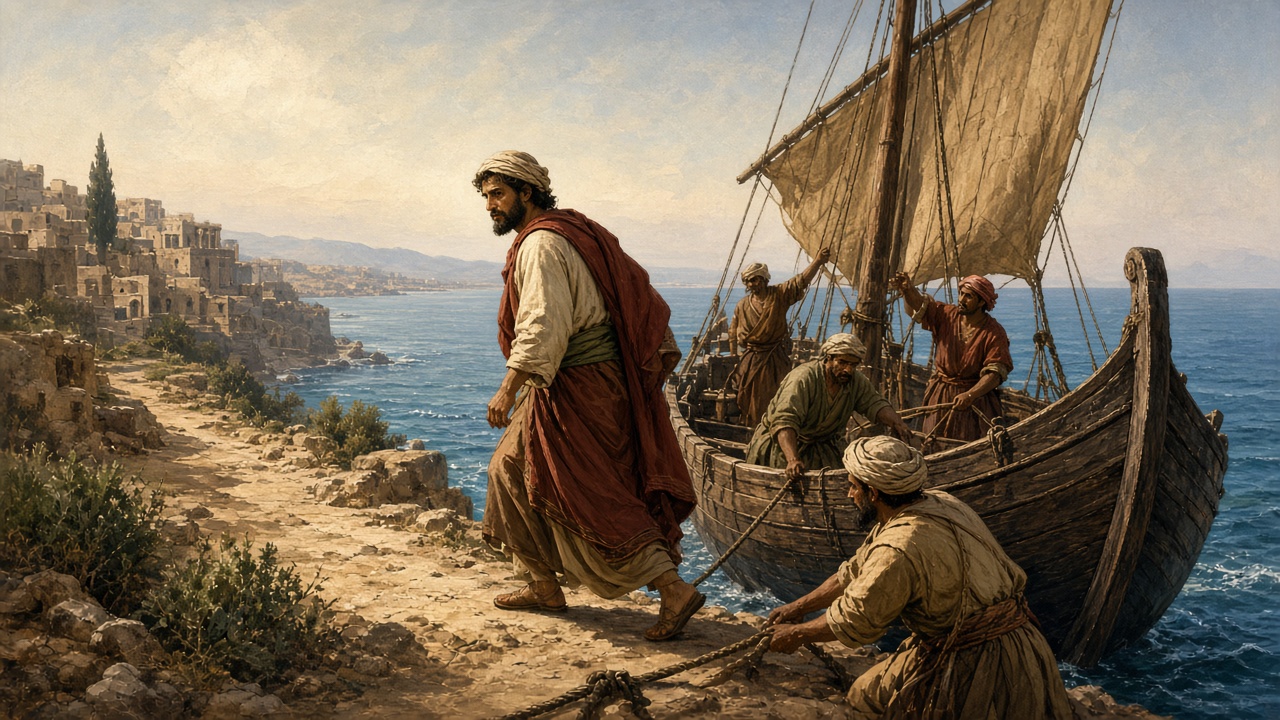
3But Jonah didn’t listen to God. Instead, he ran away from God. He went down to the town called Joppa. He wanted to get on a ship there, and go to the town called Tarshish. Tarshish is a long way away from Nineveh. Jonah ran away from God and got on a ship|src="lll5-07.jpg" size="col" ref="1:3"
In Joppa, Jonah found a ship that was going to Tarshish, so he paid some money to the ship-men so he can go on that ship. Then he got on the ship to go to Tarshish with them. Jonah was running away from God.
4Then Jonah went down inside the ship and lay down, and he fell asleep.
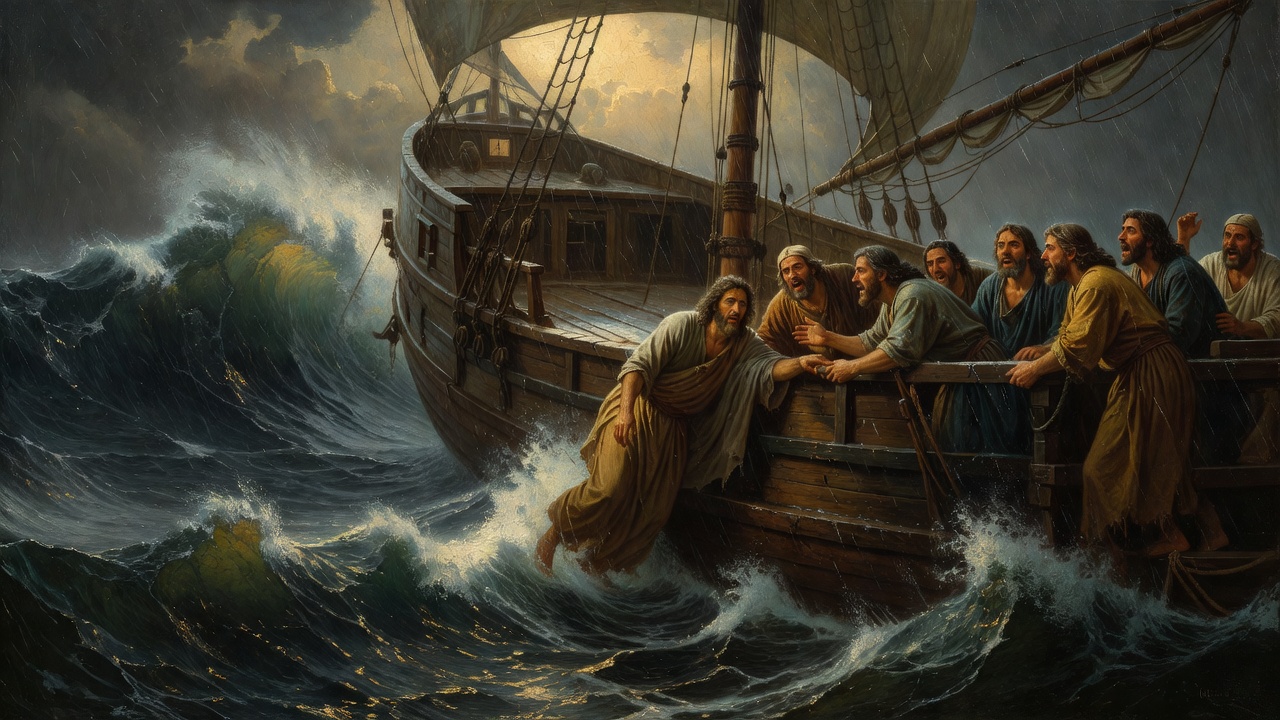
While they were sailing, God sent a big wind over the sea, and there was a big storm. There was a big storm and the ship-men were frightened|src="AP-04-02c - edited.jpg" size="col" ref="1:4-5" That storm was really strong, and the ship-men thought the ship might break up. All the ship-men were frightened, so they called out to their own gods and asked them to help.
That ship was carrying lots of heavy boxes and bags of things, to take them to Tarshish. But that storm was really big, so the ship-men threw all those heavy things into the sea to make the ship lighter. The ship-men threw all the heavy boxes and bags into the sea|src="Bible1085 - edited.jpg" size="col" ref="1:4-5"
6Jonah was still asleep down inside the ship, so the ship’s boss went to Jonah and said, “Why are you sleeping? Get up and pray to your god. Maybe he will feel sorry for us and help us, so that we don’t die.”
7Then the ship-men talked to each other. They said, “Why do we have this trouble? Who did something wrong to make this trouble come on us? Let’s put small stones in a bag, one stone for each of us, and we’ll pull out one person’s stone. That stone will show us who made this trouble come on us.” So they did that, and they pulled out Jonah’s stone. The sailors pulled out Jonah’s stone, so they knew that the storm was Jonah’s fault|src="GT Jonah Sailors cast lots.tif" size="col" ref="1:7"
8So those ship-men asked Jonah, “Did you make this trouble come on us? Did you do something bad? Who are you? What is your job? And where do you come from? What country are you from? And who are your people?”
9Jonah said to them, “I am from the Hebrew people, from Israel country. Our God’s name is Yahweh, and we have to respect him. I know he has all the power. He is the big boss in heaven. He made the sea and the land. 10But right now, I am running away from him.”
Then the ship-men got really frightened. They asked Jonah, “Why are you running away from your god? That is a bad thing to do.”
11The sea was getting more and more rough. So the ship-men asked Jonah, “How can we stop this storm and make the sea quiet and still? What do we have to do to you?”
12Jonah said to them, “You have to pick me up and throw me into the sea. Then the storm will stop, and the sea will be quiet and still. This storm is my fault. I did something wrong, and that’s the reason why you are in this big storm.”
13But the ship-men didn’t want to throw Jonah into the sea, so they tried hard to row back to the land. But the sea was getting more and more rough, so they couldn’t do it.
14Then the ship-men prayed to Jonah’s God. They said, “Yahweh, you sent this storm and made all of this happen. If we throw this man into the sea, please don’t kill us. Maybe he did nothing wrong, we don’t know, but please don’t do payback to us.”
15Then they picked up Jonah, and they threw him into the sea, and the storm stopped, and the sea was quiet and still. The ship-men threw Jonah into the sea|src="AP-04-07c - edited.jpg" size="col" ref="1:15"
16Then the ship-men knew that Jonah’s God is powerful, and they showed him lots of respect. They killed an animal to give to Jonah’s God, and they made promises to him.
God sent a big fish to Jonah
17While the ship-men did that, God sent a big fish to Jonah. Jonah was deep down in the water, and that big fish came and swallowed Jonah alive. Jonah stayed inside that fish for 3 days and 3 nights. Jonah was deep down in the water, and God sent a big fish|src="GT Jonah in the deep.tif" size="col" ref="1:17"
Did you know?
Jonah Flees from the Lord
- Jonah, the son of Amittai from Gath-hepher, is also recorded in 2 Kings 14:25 as a prophet active in the northern kingdom of Israel during the reign of Jeroboam II. God instructed him to travel east to Nineveh, the prominent and populous capital of the Assyrian empire, to preach against its wickedness.Sources: Jonah · Amittai · Nineveh · the Bible text itself
- Rather than traveling northeast overland to Nineveh, Jonah journeyed down to the Mediterranean seaport of Joppa to board a ship for Tarshish. Tarshish is traditionally identified as a Phoenician trading port located far to the west in southern Spain, representing the exact opposite direction.Sources: Joppa · Tarshish · the Bible text itself
- The sailors aboard the cargo ship came from polytheistic backgrounds, each calling out to his own deity during the violent tempest. After throwing the ship's cargo overboard to lighten the vessel, they turned to the ancient practice of casting lots to determine who was responsible for the calamity.Sources: the Bible text itself
Notes written with AI assistance from open sources (Theographic Bible Metadata, CC BY-SA 4.0; Easton’s Bible Dictionary, public domain) and reviewed before publishing.
Places in this chapter
Only places identified with high confidence are shown (90% or more according to the scholarly sources compiled by OpenBible). Period map: DARE (Digital Atlas of the Roman Empire), CC BY 4.0; modern map: © OpenStreetMap contributors; places: OpenBible.info (CC BY 4.0).
Credits and license for this translation
Plain English Version
Portions of the Holy Bible in the Plain English Version translation for Australian Aboriginal people who speak English as a second language
Copyright © 2026 Wycliffe Bible Translators Australia
Language: Aboriginal English (English)
Dialect: Australian Aboriginal
Plain English Version © 2026 by Wycliffe Bible Translators Australia, licensed under Creative Commons Attribution-Share Alike 4.0 International (CC BY SA 4.0)
This licence allows you to copy and redistribute the material in any medium or format, even commercially. You may adapt, remix, transform, and build upon the material for any purpose, but if you do so, you must distribute your contributions under the same license as the original. You must always give appropriate credit, provide a link to the license, and indicate if changes were made. You may not suggest that Wycliffe Bible Translators endorses you or your use.
For full details of the licence, visit: creativecommons.org/licenses/by-sa/4.0/legalcode
This translation is made available to you under the terms of the
Creative Commons Attribution Share-Alike license 4.0.
You have permission to share and redistribute this Bible translation in any format and to make reasonable revisions and adaptations of this translation, provided that:
You include the above copyright and source information.
If you make any changes to the text, you must indicate that you did so in a way that makes it clear that the original licensor is not necessarily endorsing your changes.
If you redistribute this text, you must distribute your contributions under the same license as the original.
Pictures included with Scriptures and other documents on this site are licensed just for use with those Scriptures and documents.
For other uses, please contact the respective copyright owners.
Note that in addition to the rules above, revising and adapting God's Word involves a great responsibility to be true to God's Word. See Revelation 22:18-19.
2026-10-02
Source: http://ebible.org/engPEV/ · eBible.org