Jonás 1
Plain English Version · Toca un versículo para ver sus referencias cruzadas.
Acerca de este libro
Acerca de Jonás
- Jonás, cuyo nombre significa “una paloma”, era hijo de Amitai, de Gat-hefer, y profeta de Israel. El Easton's Bible Dictionary (1897) sostiene que él mismo escribió el libro. Su ministerio se sitúa muy al comienzo del reinado de Jeroboam II: fue contemporáneo de Oseas y Amós, o posiblemente anterior, y así puede haber sido el más antiguo de los profetas cuyos escritos se conservan.Fuentes: Jonah · Amittai · Easton: Jonah, Book of
- El libro se presenta como el relato de lo que realmente le ocurrió al profeta. Algunos críticos lo han leído como parábola o alegoría, y no como historia, porque el milagro ocupa un lugar tan amplio y la forma es narrativa, no profética, o porque niegan los milagros por completo. El Easton's Bible Dictionary (1897), en cambio, lo trata como historia y da gran peso a la mención de Jonás en Mateo 12:39-40 y Lucas 11:29.Fuentes: Easton: Jonah, Book of
- Jonás recibió el encargo de ir a Nínive, descrita como una ciudad grande y populosa y floreciente capital del imperio asirio, pero zarpó de Jope, el principal puerto marítimo de Judá, para huir hacia Tarsis. La ubicación de Tarsis se discute: algunos la sitúan en Oriente, en la costa de la India, otros la identifican con Cartago, y el diccionario de Easton la entiende como un puerto fenicio en España.Fuentes: Easton: Jonah, Book of · Nineveh · Joppa · Tarshish
- El esquema de Easton tiene cuatro movimientos: el encargo divino, la desobediencia y el castigo; la oración de Jonás y su liberación; un segundo encargo, el arrepentimiento de los ninivitas y la misericordia de Dios que los preservó; y el enojo de Jonás ante esa misericordia, seguido de una reprensión. El mismo diccionario señala que Nínive fue preservada durante más de un siglo después de su misión.Fuentes: Easton: Jonah, Book of
- Como profeta de Israel, Jonás anunció la restauración de las antiguas fronteras del reino. Una nota biográfica lo presenta tanto como misionero enviado a Nínive como tipo del Hijo del hombre. El libro de Nahúm está ocupado casi por completo por denuncias contra esa ciudad, y Sofonías también predice su destrucción.Fuentes: Jonah · Nineveh
Notas escritas con ayuda de IA a partir de fuentes abiertas (Theographic Bible Metadata, CC BY-SA 4.0; Easton’s Bible Dictionary, dominio público) y revisadas antes de publicarse.
Jonah ran away from God
1There was a man in Israel country called Jonah. His father’s name was Amittai. One day, the God of Israel talked to Jonah. God said to Jonah, 2“You know the big city called Nineveh that is not in Israel country? The people in that city do really bad things, and I see all the things they do. So you have to go there now, to that big city called Nineveh. You have to tell those people, ‘God is angry with you.’”
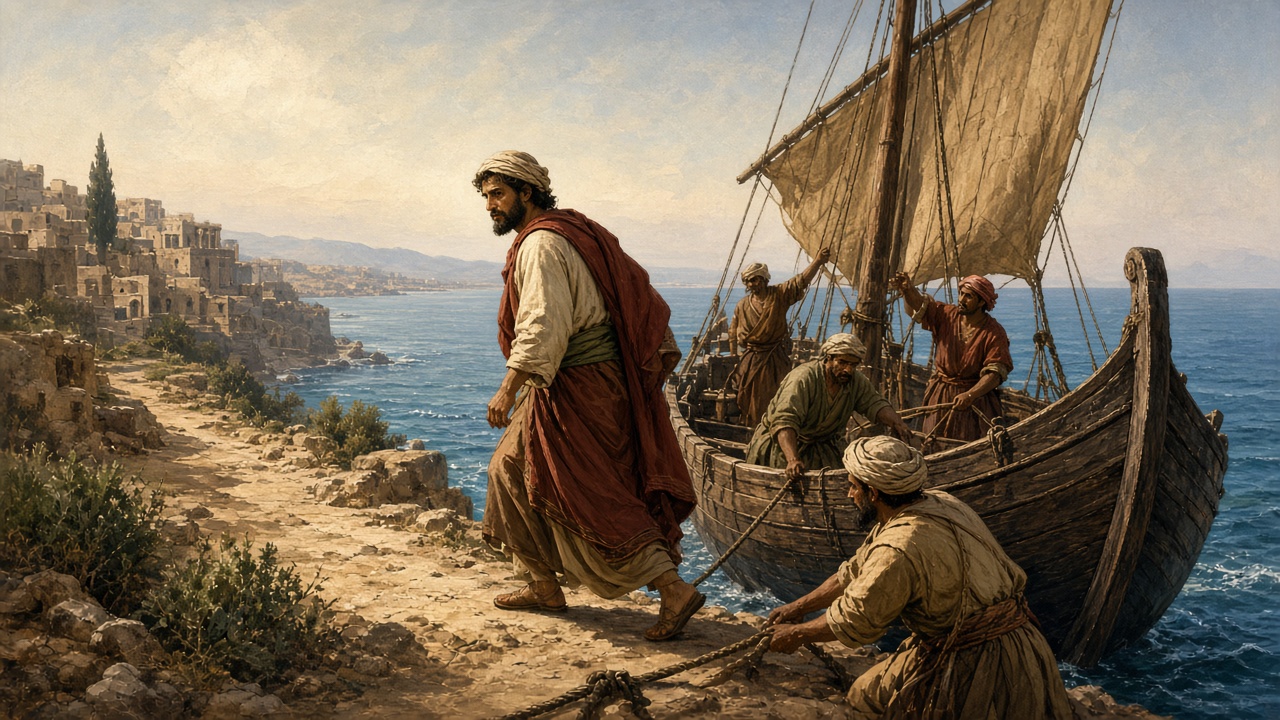
3But Jonah didn’t listen to God. Instead, he ran away from God. He went down to the town called Joppa. He wanted to get on a ship there, and go to the town called Tarshish. Tarshish is a long way away from Nineveh. Jonah ran away from God and got on a ship|src="lll5-07.jpg" size="col" ref="1:3"
In Joppa, Jonah found a ship that was going to Tarshish, so he paid some money to the ship-men so he can go on that ship. Then he got on the ship to go to Tarshish with them. Jonah was running away from God.
4Then Jonah went down inside the ship and lay down, and he fell asleep.
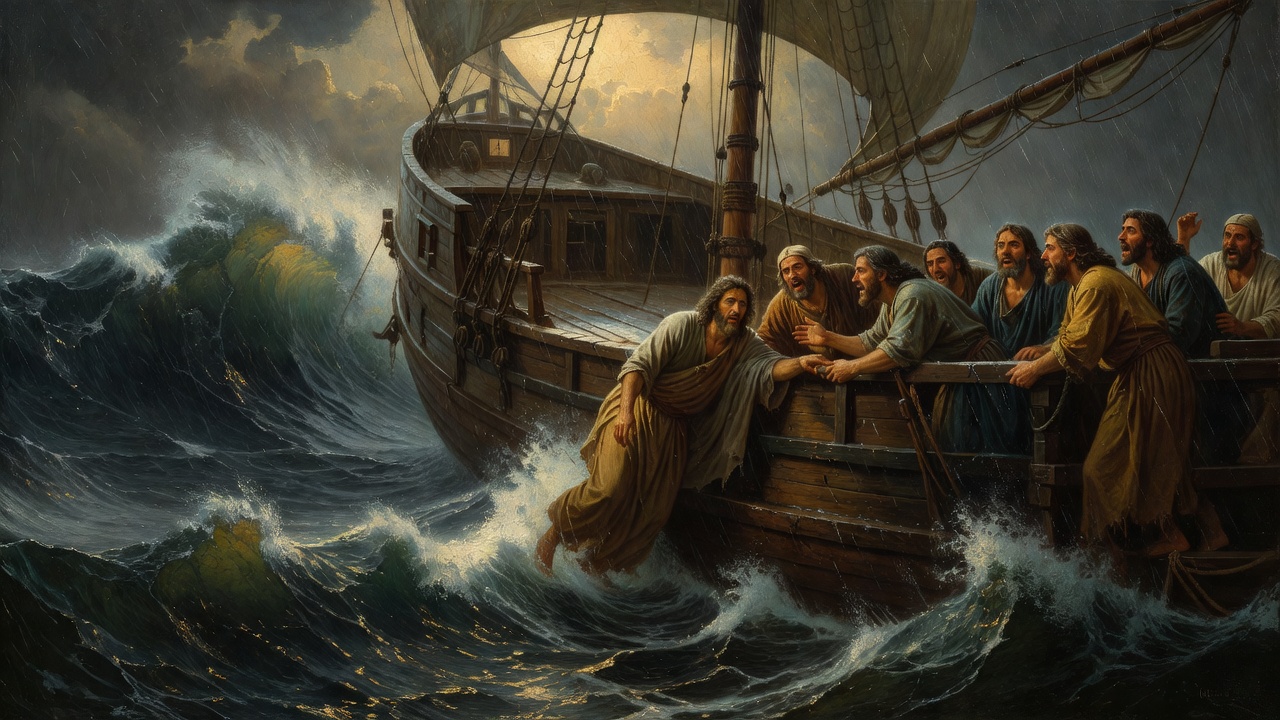
While they were sailing, God sent a big wind over the sea, and there was a big storm. There was a big storm and the ship-men were frightened|src="AP-04-02c - edited.jpg" size="col" ref="1:4-5" That storm was really strong, and the ship-men thought the ship might break up. All the ship-men were frightened, so they called out to their own gods and asked them to help.
That ship was carrying lots of heavy boxes and bags of things, to take them to Tarshish. But that storm was really big, so the ship-men threw all those heavy things into the sea to make the ship lighter. The ship-men threw all the heavy boxes and bags into the sea|src="Bible1085 - edited.jpg" size="col" ref="1:4-5"
6Jonah was still asleep down inside the ship, so the ship’s boss went to Jonah and said, “Why are you sleeping? Get up and pray to your god. Maybe he will feel sorry for us and help us, so that we don’t die.”
7Then the ship-men talked to each other. They said, “Why do we have this trouble? Who did something wrong to make this trouble come on us? Let’s put small stones in a bag, one stone for each of us, and we’ll pull out one person’s stone. That stone will show us who made this trouble come on us.” So they did that, and they pulled out Jonah’s stone. The sailors pulled out Jonah’s stone, so they knew that the storm was Jonah’s fault|src="GT Jonah Sailors cast lots.tif" size="col" ref="1:7"
8So those ship-men asked Jonah, “Did you make this trouble come on us? Did you do something bad? Who are you? What is your job? And where do you come from? What country are you from? And who are your people?”
9Jonah said to them, “I am from the Hebrew people, from Israel country. Our God’s name is Yahweh, and we have to respect him. I know he has all the power. He is the big boss in heaven. He made the sea and the land. 10But right now, I am running away from him.”
Then the ship-men got really frightened. They asked Jonah, “Why are you running away from your god? That is a bad thing to do.”
11The sea was getting more and more rough. So the ship-men asked Jonah, “How can we stop this storm and make the sea quiet and still? What do we have to do to you?”
12Jonah said to them, “You have to pick me up and throw me into the sea. Then the storm will stop, and the sea will be quiet and still. This storm is my fault. I did something wrong, and that’s the reason why you are in this big storm.”
13But the ship-men didn’t want to throw Jonah into the sea, so they tried hard to row back to the land. But the sea was getting more and more rough, so they couldn’t do it.
14Then the ship-men prayed to Jonah’s God. They said, “Yahweh, you sent this storm and made all of this happen. If we throw this man into the sea, please don’t kill us. Maybe he did nothing wrong, we don’t know, but please don’t do payback to us.”
15Then they picked up Jonah, and they threw him into the sea, and the storm stopped, and the sea was quiet and still. The ship-men threw Jonah into the sea|src="AP-04-07c - edited.jpg" size="col" ref="1:15"
16Then the ship-men knew that Jonah’s God is powerful, and they showed him lots of respect. They killed an animal to give to Jonah’s God, and they made promises to him.
God sent a big fish to Jonah
17While the ship-men did that, God sent a big fish to Jonah. Jonah was deep down in the water, and that big fish came and swallowed Jonah alive. Jonah stayed inside that fish for 3 days and 3 nights. Jonah was deep down in the water, and God sent a big fish|src="GT Jonah in the deep.tif" size="col" ref="1:17"
¿Sabías que…?
Jonás huye del Señor
- Jonás, hijo de Amitai y oriundo de Gat-hefer, también figura en 2 Reyes 14:25 como profeta en Israel durante el reinado de Jeroboam II. Dios le ordenó viajar hacia el este hasta Nínive, la gran y populosa capital del Imperio asirio, para proclamar juicio contra su maldad.Fuentes: Jonah · Amittai · Nineveh · el propio texto bíblico
- En lugar de dirigirse por tierra al noreste hacia Nínive, Jonás bajó al puerto mediterráneo de Jope para embarcarse rumbo a Tarsis. Tarsis se identifica tradicionalmente con un puerto comercial fenicio situado en el sur de España, en la dirección exactamente opuesta.Fuentes: Joppa · Tarshish · el propio texto bíblico
- Los marineros de la nave pertenecían a diversas tradiciones politeístas y clamaban cada uno a su propio dios en medio de la violenta tempestad. Tras arrojar la carga al mar para aligerar el barco, recurrieron a la antigua costumbre de echar suertes para descubrir quién era el causante de la calamidad.Fuentes: el propio texto bíblico
Notas escritas con ayuda de IA a partir de fuentes abiertas (Theographic Bible Metadata, CC BY-SA 4.0; Easton’s Bible Dictionary, dominio público) y revisadas antes de publicarse.
Lugares de este capítulo
Solo aparecen lugares identificados con alta confianza (90 % o más según las fuentes académicas reunidas por OpenBible). Mapa de la época: DARE (Digital Atlas of the Roman Empire), CC BY 4.0; mapa actual: © colaboradores de OpenStreetMap; lugares: OpenBible.info (CC BY 4.0).
Créditos y licencia de esta traducción
Plain English Version
Portions of the Holy Bible in the Plain English Version translation for Australian Aboriginal people who speak English as a second language
Copyright © 2026 Wycliffe Bible Translators Australia
Language: Aboriginal English (English)
Dialect: Australian Aboriginal
Plain English Version © 2026 by Wycliffe Bible Translators Australia, licensed under Creative Commons Attribution-Share Alike 4.0 International (CC BY SA 4.0)
This licence allows you to copy and redistribute the material in any medium or format, even commercially. You may adapt, remix, transform, and build upon the material for any purpose, but if you do so, you must distribute your contributions under the same license as the original. You must always give appropriate credit, provide a link to the license, and indicate if changes were made. You may not suggest that Wycliffe Bible Translators endorses you or your use.
For full details of the licence, visit: creativecommons.org/licenses/by-sa/4.0/legalcode
This translation is made available to you under the terms of the
Creative Commons Attribution Share-Alike license 4.0.
You have permission to share and redistribute this Bible translation in any format and to make reasonable revisions and adaptations of this translation, provided that:
You include the above copyright and source information.
If you make any changes to the text, you must indicate that you did so in a way that makes it clear that the original licensor is not necessarily endorsing your changes.
If you redistribute this text, you must distribute your contributions under the same license as the original.
Pictures included with Scriptures and other documents on this site are licensed just for use with those Scriptures and documents.
For other uses, please contact the respective copyright owners.
Note that in addition to the rules above, revising and adapting God's Word involves a great responsibility to be true to God's Word. See Revelation 22:18-19.
2026-10-02
Fuente: http://ebible.org/engPEV/ · eBible.org