Genesis 46
I tnalù dwata · Tap a verse to see its cross-references.
I ksalu Dyékob ditù di banwe Idyif
1Taman flulen Dyékob i kdee nfunan, na mdà ale di Kanaan. Na di kakella di banwe Bérsiba dsù Dyékob dad lmanaf di Dwata, i Dwata maan Isaak.
2Na di kakifun nun kanteen Dyékob, na tlo kenen Dwata, manan, “E Dyékob.”
Na tmimel Dyékob, manan, “Hae, gani agu.”
3Na man Dwata, “Agu i Dwata, i Dwata i maam. Na nang ge likò salu di Idyif, du ditù kadang toogu fbel gamu, na gamu mgimò kadang i satu bung dad to too mlabung. 4Naginta ge salu ditù di Idyif, na kafnge én, nebegu i dad belam samfulê di banwe Kanaan. Na kadang di kfatim déén Dyosif di safédam.” Én gman Dwata di ku Dyékob.
5Na kafnge én, mdà ale Dyékob di Bérsiba, na fadlug ale di kagula. Fsakay i dad ngaan i màla, na i dad ngala, na i dad yaanla di dad kaditon febe Faraon, i harì di Idyif. 6Na nebela dad lmanafla, na i dad kandeenla gwèla di Kanaan, na salu ale di Idyif. Na fagin Dyékob di Idyif i kdee dad belan, 7i dad ngaan lagi, i dad ngaan libun, na i kdee dad fuan lagi na libun.
26Na nam falò nam i kdee dad bel Dyékob magin kenen salu di Idyif. Na là gakuf di kse ani i dad yaan i dad ngaan lagi. 27Na nun lwe dad ngà Dyosif sut di Idyif, na taman i kdee dad malay Dyékob masdagub fitu falò di ksalula di Idyif.
I ksite ale Dyékob na Dyosif
28Na fsalu Dyékob i tingaan Dyuda muna ditù di ku Dyosif, du fatdoan i dalan salu di Gosén. Na di kakella mdadong nan di Gosén, 29smakay Dyosif i snakayan fadyol i kudà, na salu di Gosén, du snitongan maan. Na di kakelan, lkafan i maan na too mlo mngel. 30Na man Dyékob di ku Dyosif, “Tò, balù kilen nan gatlagad agu mati. Hae, du tateenta ge na toogu gadè mto ge fa.”
31Kafnge ani, man Dyosif di dad flanekan na i dad dademe dad malay i maan, manan, “Salu agu ditù di ku Faraon i harì, du tulengu kenen, takel gamu i dad flanekgu, na i dad dademe dad malay i màgu, mdà di banwe Kanaan. 32Tulengu kenen kadang, gamu i dad gal mifat i dad bilibili, na dad baka, na tanebeyu dini i dad bilibiliyu, i dad kambingyu, na i dad bakayu, na i kdee nfunyu. 33Taman ku tlo gamu i harì na snalekan ku tan i galyu nimò, 34tooyu man di kenen, gamu i dad lifanan, gamu gal mifat i dad bilibili mdà fa di tingà gamu fa, salngad tamgimò i dad gutambulyu di muna. Ani manyu di kenen, du fye i gufnean gamu dini di Gosén, du dad to mnè di Idyif ani knangla dad to mifat bilibili.”
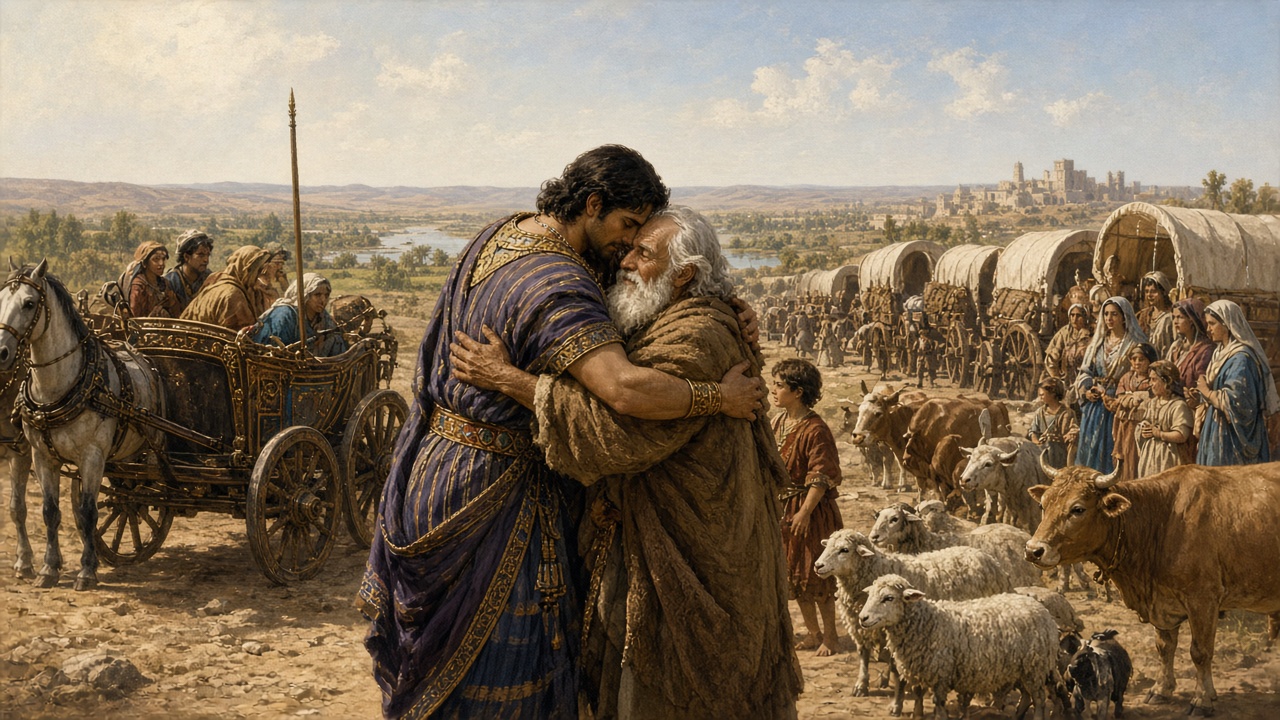
Did you know?
Israel Goes Down to Egypt
- As Israel set out for Egypt with all that he had, he stopped at Beersheba and offered sacrifices to the God of his father Isaac. Beersheba, meaning well of the oath or well of seven, was a well Abraham dug and named after a compact with Abimelech; when Isaac reopened it, he gave it the same name. It was a favorite dwelling of both patriarchs, and there that night God spoke to Jacob in a vision, telling him not to fear going down to Egypt, for he would make him a great nation there.Sources: the Bible text itself · Beersheba
- Jacob sent Judah ahead to Joseph for directions to Goshen, an Egyptian district east of the Nile, apparently near the royal residence, where the family remained until the Exodus. Easton's Bible Dictionary (1897) calls it the best of the land, now a desert, and also the land of Rameses. Joseph told his brothers to say they had raised livestock from youth, so they might settle there, because shepherds were detestable to the Egyptians; that dictionary suggests Pharaoh was probably Apopi, last of the Hyksos, who welcomed these Asiatic shepherds, while native Egyptians abhorred them, though some argue Joseph arrived later, under Thothmes III, after the Hyksos were expelled.Sources: the Bible text itself · Goshen · Pharaoh (of Joseph)
- The chapter counts sixty-six of Jacob's direct descendants who came to Egypt, not counting the wives of his sons, and seventy when Joseph's two sons already born in Egypt are included. Leah's sons and her daughter Dinah are named in that tally, although Easton's Bible Dictionary (1897) says Leah herself had died in Canaan before the journey and was buried in the cave of Machpelah; Rachel had died earlier giving birth to Benjamin and was buried on the way to Ephrath, that is, Bethlehem. Manasseh and Ephraim were born to Joseph in Egypt by Asenath, daughter of Potiphera, priest of On, a center of sun-worship that the Septuagint and Vulgate call Heliopolis.Sources: the Bible text itself · Leah · Rachel · On
Notes written with AI assistance from open sources (Theographic Bible Metadata, CC BY-SA 4.0; Easton’s Bible Dictionary, public domain) and reviewed before publishing.
Places in this chapter
- Egypt · 30.129, 31.308 · verses 1, 3, 4, 5, 6, 7, 8, 20, 26, 27
- Canaan · 32.767, 35.333 · verses 6, 12, 31
- Heliopolis · Today: Ain Shams · 30.129, 31.308 · verse 20
- Goshen · Today: Goshen 1 · 30.799, 31.834 · verses 28, 29, 34
Only places identified with high confidence are shown (90% or more according to the scholarly sources compiled by OpenBible). Period map: DARE (Digital Atlas of the Roman Empire), CC BY 4.0; modern map: © OpenStreetMap contributors; places: OpenBible.info (CC BY 4.0).
Credits and license for this translation
I tnalù dwata
New Testament in Blaan, Sarangani
copyright © 1998 Wycliffe Bible Translators, Inc.
Language: Sarangani Blaan (Blaan, Sarangani)
Translation by: Wycliffe Bible Translators
Contributor: Wycliffe Bible Translators, Inc.
Copyright Information
© 1998, Wycliffe Bible Translators, Inc. All rights reserved.
This translation text is made available to you under the
terms of the Creative Commons License: Attribution-Noncommercial-No Derivative Works.
( http://creativecommons.org/licenses/by-nc-nd/3.0/ )
In addition, you have permission to port the text to different file formats, as long as you
do not change any of the text or punctuation of the Bible.
You may share, copy, distribute, transmit, and extract portions
or quotations from this work, provided that you include the above copyright
information:
You must give Attribution to the work.
You do not sell this work for a profit.
You do not make any derivative works that change any of the actual words or punctuation of the Scriptures.
Permissions beyond the scope of this license may be
available if you contact
us with your request.
The New Testament
in Blaan, Sarangani
© 1998, Wycliffe Bible Translators, Inc. All rights reserved.
This translation is made available to you under the terms of the
Creative Commons Attribution-Noncommercial-No Derivatives license 4.0.
You may share and redistribute this Bible translation or extracts from it in any format, provided that:
You include the above copyright and source information.
You do not sell this work for a profit.
You do not change any of the words or punctuation of the Scriptures.
Pictures included with Scriptures and other documents on this site are licensed just for use with those Scriptures and documents.
For other uses, please contact the respective copyright owners.
2015-03-17
Source: http://ebible.org/bps/ · eBible.org