Génesis 46
I tnalù dwata · Toca un versículo para ver sus referencias cruzadas.
I ksalu Dyékob ditù di banwe Idyif
1Taman flulen Dyékob i kdee nfunan, na mdà ale di Kanaan. Na di kakella di banwe Bérsiba dsù Dyékob dad lmanaf di Dwata, i Dwata maan Isaak.
2Na di kakifun nun kanteen Dyékob, na tlo kenen Dwata, manan, “E Dyékob.”
Na tmimel Dyékob, manan, “Hae, gani agu.”
3Na man Dwata, “Agu i Dwata, i Dwata i maam. Na nang ge likò salu di Idyif, du ditù kadang toogu fbel gamu, na gamu mgimò kadang i satu bung dad to too mlabung. 4Naginta ge salu ditù di Idyif, na kafnge én, nebegu i dad belam samfulê di banwe Kanaan. Na kadang di kfatim déén Dyosif di safédam.” Én gman Dwata di ku Dyékob.
5Na kafnge én, mdà ale Dyékob di Bérsiba, na fadlug ale di kagula. Fsakay i dad ngaan i màla, na i dad ngala, na i dad yaanla di dad kaditon febe Faraon, i harì di Idyif. 6Na nebela dad lmanafla, na i dad kandeenla gwèla di Kanaan, na salu ale di Idyif. Na fagin Dyékob di Idyif i kdee dad belan, 7i dad ngaan lagi, i dad ngaan libun, na i kdee dad fuan lagi na libun.
26Na nam falò nam i kdee dad bel Dyékob magin kenen salu di Idyif. Na là gakuf di kse ani i dad yaan i dad ngaan lagi. 27Na nun lwe dad ngà Dyosif sut di Idyif, na taman i kdee dad malay Dyékob masdagub fitu falò di ksalula di Idyif.
I ksite ale Dyékob na Dyosif
28Na fsalu Dyékob i tingaan Dyuda muna ditù di ku Dyosif, du fatdoan i dalan salu di Gosén. Na di kakella mdadong nan di Gosén, 29smakay Dyosif i snakayan fadyol i kudà, na salu di Gosén, du snitongan maan. Na di kakelan, lkafan i maan na too mlo mngel. 30Na man Dyékob di ku Dyosif, “Tò, balù kilen nan gatlagad agu mati. Hae, du tateenta ge na toogu gadè mto ge fa.”
31Kafnge ani, man Dyosif di dad flanekan na i dad dademe dad malay i maan, manan, “Salu agu ditù di ku Faraon i harì, du tulengu kenen, takel gamu i dad flanekgu, na i dad dademe dad malay i màgu, mdà di banwe Kanaan. 32Tulengu kenen kadang, gamu i dad gal mifat i dad bilibili, na dad baka, na tanebeyu dini i dad bilibiliyu, i dad kambingyu, na i dad bakayu, na i kdee nfunyu. 33Taman ku tlo gamu i harì na snalekan ku tan i galyu nimò, 34tooyu man di kenen, gamu i dad lifanan, gamu gal mifat i dad bilibili mdà fa di tingà gamu fa, salngad tamgimò i dad gutambulyu di muna. Ani manyu di kenen, du fye i gufnean gamu dini di Gosén, du dad to mnè di Idyif ani knangla dad to mifat bilibili.”
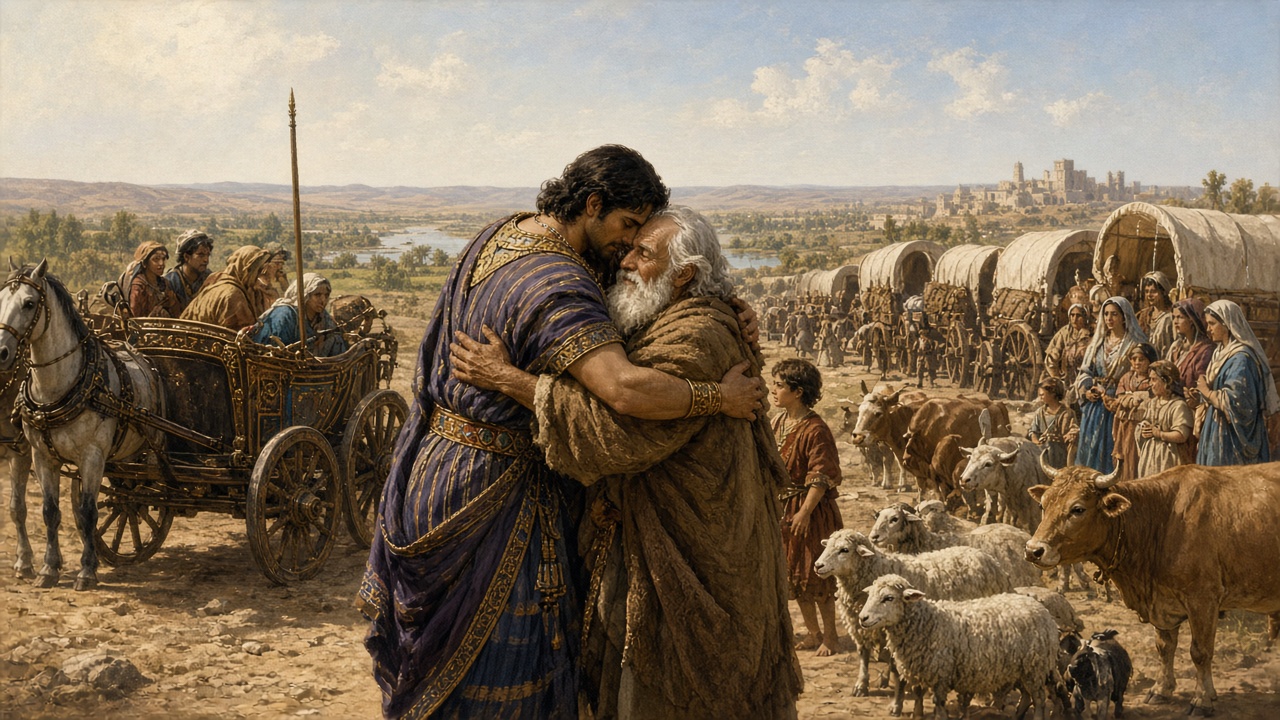
¿Sabías que…?
Israel desciende a Egipto
- Cuando Israel partió hacia Egipto con todo lo que tenía, se detuvo en Beerseba y ofreció sacrificios al Dios de su padre Isaac. Beerseba, que significa pozo del juramento o pozo de los siete, fue un pozo que Abraham cavó y nombró tras un pacto con Abimelec; cuando Isaac lo reabrió, le dio el mismo nombre. Era un lugar favorito de residencia de ambos patriarcas, y allí, aquella noche, Dios habló a Jacob en una visión y le dijo que no temiera bajar a Egipto, porque allí lo haría una gran nación.Fuentes: el propio texto bíblico · Beersheba
- Jacob envió a Judá por delante hacia José para que le indicara el camino a Gosén, un distrito egipcio al este del Nilo, al parecer cerca de la residencia real, donde la familia permaneció hasta el Éxodo. El Easton's Bible Dictionary (1897) la llama lo mejor de la tierra, hoy un desierto, y también tierra de Ramesés. José dijo a sus hermanos que afirmaran haber criado ganado desde su juventud, para poder establecerse allí, porque los pastores eran detestables para los egipcios; ese diccionario sugiere que el faraón fue probablemente Apopi, el último rey de los hicsos, que acogió a estos pastores asiáticos, mientras los egipcios nativos los aborrecían, aunque algunos argumentan que José llegó más tarde, bajo Tutmosis III, después de la expulsión de los hicsos.Fuentes: el propio texto bíblico · Goshen · Pharaoh (of Joseph)
- El capítulo cuenta sesenta y seis descendientes directos de Jacob que llegaron a Egipto, sin incluir a las esposas de sus hijos, y setenta al incluir a los dos hijos de José ya nacidos en Egipto. Los hijos de Lea y su hija Dina aparecen en esa lista, aunque el Easton's Bible Dictionary (1897) dice que la propia Lea ya había muerto en Canaán antes del viaje y fue sepultada en la cueva de Macpela; Raquel había muerto antes, al dar a luz a Benjamín, y fue sepultada en el camino a Efrata, es decir, Belén. Manasés y Efraín nacieron a José en Egipto de Asenat, hija de Potifera, sacerdote de On, un centro del culto al sol que la Septuaginta y la Vulgata llaman Heliópolis.Fuentes: el propio texto bíblico · Leah · Rachel · On
Notas escritas con ayuda de IA a partir de fuentes abiertas (Theographic Bible Metadata, CC BY-SA 4.0; Easton’s Bible Dictionary, dominio público) y revisadas antes de publicarse.
Lugares de este capítulo
- Egypt · 30.129, 31.308 · versículos 1, 3, 4, 5, 6, 7, 8, 20, 26, 27
- Canaan · 32.767, 35.333 · versículos 6, 12, 31
- Heliopolis · Hoy: Ain Shams · 30.129, 31.308 · versículo 20
- Goshen · Hoy: Goshen 1 · 30.799, 31.834 · versículos 28, 29, 34
Solo aparecen lugares identificados con alta confianza (90 % o más según las fuentes académicas reunidas por OpenBible). Mapa de la época: DARE (Digital Atlas of the Roman Empire), CC BY 4.0; mapa actual: © colaboradores de OpenStreetMap; lugares: OpenBible.info (CC BY 4.0).
Créditos y licencia de esta traducción
I tnalù dwata
New Testament in Blaan, Sarangani
copyright © 1998 Wycliffe Bible Translators, Inc.
Language: Sarangani Blaan (Blaan, Sarangani)
Translation by: Wycliffe Bible Translators
Contributor: Wycliffe Bible Translators, Inc.
Copyright Information
© 1998, Wycliffe Bible Translators, Inc. All rights reserved.
This translation text is made available to you under the
terms of the Creative Commons License: Attribution-Noncommercial-No Derivative Works.
( http://creativecommons.org/licenses/by-nc-nd/3.0/ )
In addition, you have permission to port the text to different file formats, as long as you
do not change any of the text or punctuation of the Bible.
You may share, copy, distribute, transmit, and extract portions
or quotations from this work, provided that you include the above copyright
information:
You must give Attribution to the work.
You do not sell this work for a profit.
You do not make any derivative works that change any of the actual words or punctuation of the Scriptures.
Permissions beyond the scope of this license may be
available if you contact
us with your request.
The New Testament
in Blaan, Sarangani
© 1998, Wycliffe Bible Translators, Inc. All rights reserved.
This translation is made available to you under the terms of the
Creative Commons Attribution-Noncommercial-No Derivatives license 4.0.
You may share and redistribute this Bible translation or extracts from it in any format, provided that:
You include the above copyright and source information.
You do not sell this work for a profit.
You do not change any of the words or punctuation of the Scriptures.
Pictures included with Scriptures and other documents on this site are licensed just for use with those Scriptures and documents.
For other uses, please contact the respective copyright owners.
2015-03-17
Fuente: http://ebible.org/bps/ · eBible.org