Gênesis 10
Targum Onkelos Etheridge · Toque num versículo para ver as referências cruzadas.
The Table of Nations
1And these are the generations of the sons of Noach, Shem, Cham, and Yapheth; and sons were born to them after the deluge.
The Japhethites
2The sons of Yepheth, Gomer, and Magog, and Madai, and Yavan, and Thuval, and Meshek, and Tiras. 3And the sons of Gomer, Ashkenaz, and Rephath, and Thogarmah. 4And the sons of Yavan, Elishah and Tharshish, and Dodanim. 5From these were the isles ( nagvath) of the peoples divided in their lands, each according to his language, according to their families in their nations.
The Hamites
6And the sons of Cham, Kush, and Mizraim, and Phut, and Kenaan. 7And the sons of Kush, Seba, and Chavilah, and Sabetha, and Raamah, and Sabtekah. And the sons of Raamah, Sheba and Dedan. 8And Kush begat Nimrod: he began to be a powerful man in the earth. 9He was a powerful man before the Lord: therefore it is said, Like Nimrod the man of might before the Lord. 10And the head (beginning) of his kingdom was Bavel, and Erek, and Akad, and Kalneh in the land of Bavel. 11From that land he went forth to Athura, and built Nineveh, and the city of Rechov, and Kalach, 12and Resen, between Nineveh and Kalach, which was a great city. 13And Mizraim begat the Ludaee, and Anamaee, and Lehabaee, and Naphtuhaee, 14and Pathrusaee, and Kasluchaee, from whom came forth the Pelishtaee and Kaputkaee.
15And Kenaan begat Zidon his firstborn, and Cheth, 16and the Jebusaee, and Amoraee, and Girgashee, 17and Hivaaee, and Arkaee, and Antasaee, 18and Arvadaee, and Zemaraee, and Chamathaee: and afterwards the seed of the Kenaanaee were scattered abroad. 19And the frontier of Kenaanaah was from Zidon, coming to Gerar and to Azza, coming unto Sedom, and Amorah, and Admah, and Zeboim, unto Lasha. 20These are the sons of Cham, according to their progenies, to their languages, in their lands, in their peoples.
The Semites
21And of Shem was born: (also he is the father of all the sons of Eber, and the brother of Yapheth the Great:) 22The sons of Shem, Elim, and Asshur, and Arphaxad, and Lud, and Aram. 23And the sons of Aram, Uz, and Chul, and Gether, and Mash. 24And Arphaxad begat Shelach; and Shelach begat Eber. 25And to Eber were born two sons: the name of the one was Peleg: because in his day the earth was divided. And the name of his brother was Yoktan. 26And Yoktan begat Almodad, and Shaleph, and Chatsarmaveth, and Yarech, 27and Chadoram, and Uzal, and Dikelah, 28and Obal, and Avimael, and Sheba, 29and Ophir, and Chavilah, and Yobab: all these are the sons of Yoktan. 30And their dwelling was from Mesha, coming to Sephar, an eastern mountain. 31These are the sons of Shem, according to their progenies, according to their languages, in their lands, in their peoples.
32These are the progenies of the sons of Noach, by their generations, in their peoples: and by them were the peoples outspread in the earth after the deluge.
Você sabia?
As nações depois do dilúvio
- Gênesis 10 segue as famílias dos três filhos de Noé, Sem, Cam e Jafé, e diz que, depois do dilúvio, as nações da terra se espalharam a partir deles, agrupadas por clãs, línguas, terras e nações. A linhagem de Jafé está ligada a povos do leste da Europa e do norte da Ásia: Gômer é geralmente considerado ancestral dos celtas e dos cimérios, que em tempos antigos se estabeleceram ao norte do mar Negro, e Javã tornou-se o nome hebraico que os povos do Oriente usavam para os gregos, sobretudo os da Jônia.Fontes: o próprio texto bíblico · Japheth · Gomer (son of Japheth) · Javan
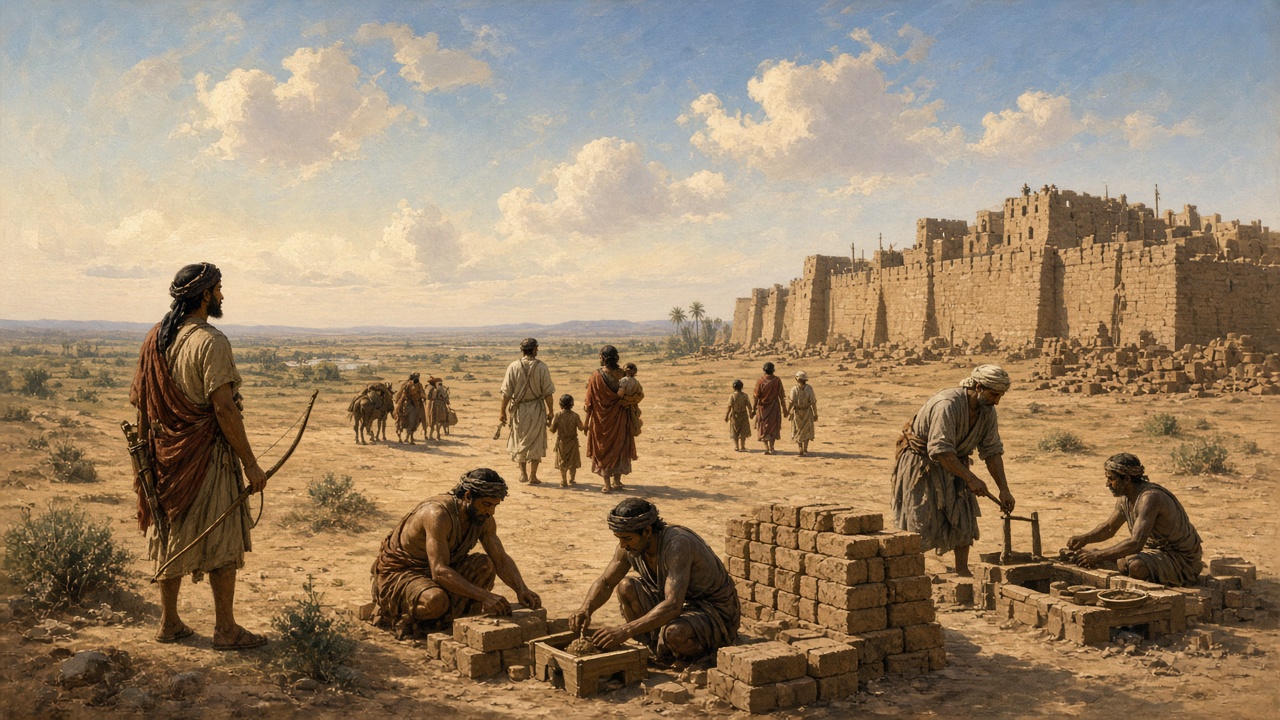
- Cuxe, filho de Cam, foi o pai de Ninrode, lembrado como um poderoso caçador diante do Senhor, cujo reino começou em Babilônia, Ereque, Acade e Calné, na terra de Sinar, provavelmente a Babilônia ou o sul da Mesopotâmia. Daquela terra ele partiu para a Assíria e construiu Nínive, Reobote-Ir, Calá e Resém; o sítio de Calá corresponde provavelmente às ruínas de Nimrud, na margem esquerda do Tigre.Fontes: o próprio texto bíblico · Shinar · Nineveh · Calah
- Mizraim, forma dual de uma palavra hebraica que significa montículo ou fortaleza, pode indicar o Alto e o Baixo Egito e é o nome que os hebreus costumavam dar àquele país; o árabe ainda o chama Muzr. Sem é chamado irmão mais velho de Jafé e antepassado de todos os filhos de Héber, tido como fundador do povo hebreu, enquanto uma tradição árabe lembra Joctã, filho de Héber e Kahtan em árabe, como ancestral de tribos da Arábia central e meridional.Fontes: o próprio texto bíblico · Mizraim · Eber (Heber) · Joktan
Notas escritas com auxílio de IA a partir de fontes abertas (Theographic Bible Metadata, CC BY-SA 4.0; Easton’s Bible Dictionary, domínio público) e revisadas antes de publicar.
Lugares deste capítulo
- Erech · Hoje: Uruk · 31.322, 45.636 · versículo 10
- Shinar · Hoje: Babylonia · 32.543, 44.422 · versículo 10
- Assyria · 36.359, 43.153 · versículo 11
- Calah · Hoje: Nimrud · 36.098, 43.329 · versículos 11, 12
- Nineveh · 36.359, 43.153 · versículos 11, 12
- Canaan · 32.767, 35.333 · versículo 19
- Gaza · Hoje: Tell Harube · 31.504, 34.464 · versículo 19
- Sidon · Hoje: Sandikli archaeological site in Sidon · 33.561, 35.372 · versículo 19
Só aparecem lugares com identificação de alta confiança (90% ou mais segundo as fontes acadêmicas reunidas pelo OpenBible). Mapa da época: DARE (Digital Atlas of the Roman Empire), CC BY 4.0; mapa atual: © colaboradores do OpenStreetMap; lugares: OpenBible.info (CC BY 4.0).
Créditos e licença desta tradução
Targum Onkelos Etheridge
The Targums of Onkelos and Jonathan Ben Uzziel On the Pentateuch With The Fragments of the Jerusalem Targum From the Chaldee by J. W. Etheridge, M.A. First Published 1862-65.
Public Domain
Language: English
2020-12-20
Títulos de seção adaptados da Berean Standard Bible (domínio público); não fazem parte do texto bíblico desta tradução.
Fonte: http://ebible.org/engoke/ · eBible.org