Êxodo 4
Nyangumarta English Bible · Toque num versículo para ver as referências cruzadas.
Sobre este livro
Sobre Êxodo
- O Easton's Bible Dictionary (1897) data a saída de Israel do Egito em cerca de 1490 a.C., quatrocentos e oitenta anos antes da construção do templo de Salomão. A duração da permanência é disputada: Êxodo 12:40 fala em quatrocentos e trinta anos, Gênesis 15 em cerca de quatrocentos, e as versões grega e samaritana incluem também os anos em Canaã, de modo que alguns contam apenas duzentos e quinze anos no Egito.Fontes: Easton: Exodus
- O Easton's Bible Dictionary (1897) não nomeia o autor de Êxodo. O verbete sobre Moisés diz que Jacó e seus filhos desceram ao Egito, provavelmente uns trezentos e cinquenta anos antes do nascimento de Moisés, e que um rei hicso, de um povo semita pastoril da Ásia que então dominava o Egito, os estabeleceu em Gósen. Moisés passou depois quarenta anos em Midiã, onde esse povo apascentava rebanhos na península do Sinai, e tornou-se genro de Jetro, sacerdote de Midiã.Fontes: Moses · Easton: Exodus · Midian · Jethro
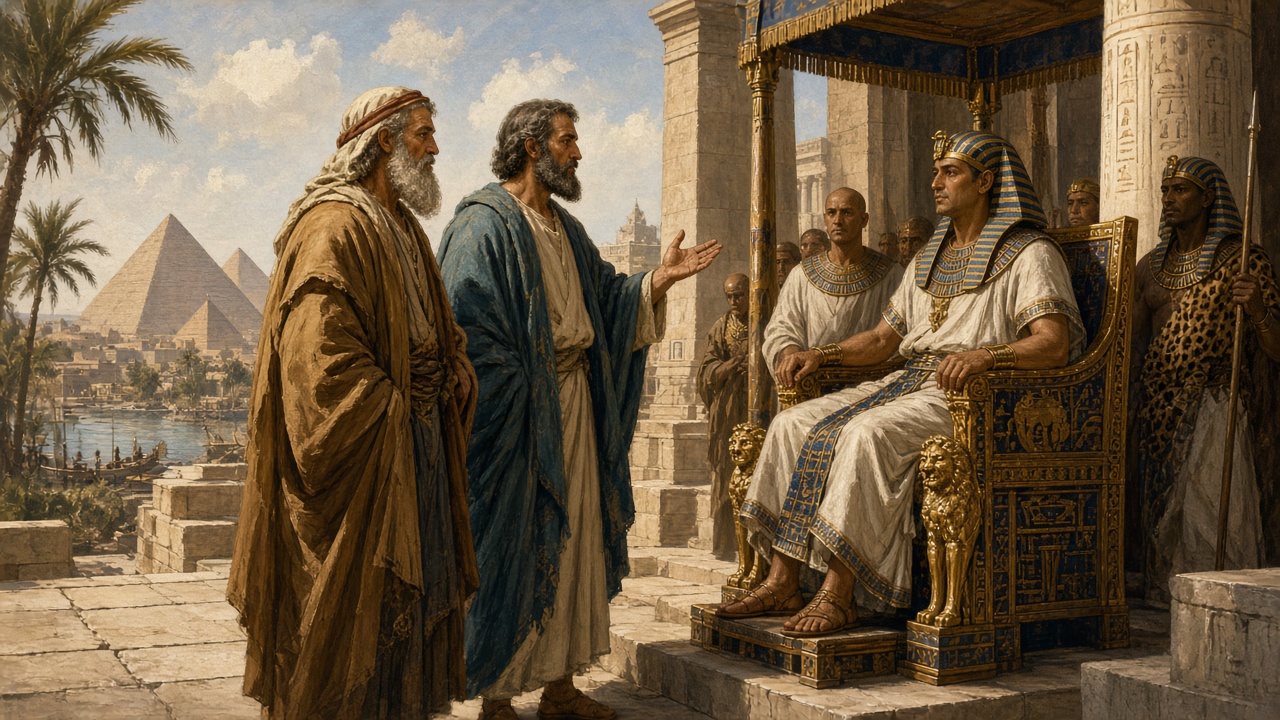
- Também se discute quem era o faraó na época da saída. O Easton's Bible Dictionary (1897) o identifica provavelmente com Menephtah I, o décimo quarto e o mais velho dos filhos sobreviventes de Rameses II, que residia em Zoan e ali se encontrou com Moisés e Arão, mas observa que alguns preferem Seti II, cujo reinado começou em paz e terminou num desastre repentino.Fontes: Pharaoh (of the Exodus)
- As pragas, escreve Easton, afrouxaram o domínio do faraó, e a Páscoa foi instituída como memorial perpétuo, com o sangue do cordeiro aspergido nos umbrais. No terceiro mês o povo chegou ao monte Sinai, também chamado Horebe, a cerca de cento e cinquenta milhas do mar Vermelho, e acampou ali cerca de um ano. Os últimos vinte e dois capítulos de Êxodo registram essa estada, inclusive o tabernáculo, cujo Lugar Santo não tinha abertura para a luz do dia e era iluminado só pelo castiçal de ouro.Fontes: Easton: Exodus · Mount Sinai · Holy Place
- Arão, filho mais velho de Anrão e Joquebede, nasceu no Egito três anos antes de Moisés e foi enviado ao encontro do irmão para que os dois trabalhassem juntos. Em Refidim, Josué, também nascido no Egito, comandou os combatentes de Israel quando os amalequitas, povo pastoril que vivia entre o mar Morto e o mar Vermelho, tentaram barrar-lhes o caminho.Fontes: Aaron · Joshua · Amalek
Notas escritas com auxílio de IA a partir de fontes abertas (Theographic Bible Metadata, CC BY-SA 4.0; Easton’s Bible Dictionary, domínio público) e revisadas antes de publicar.
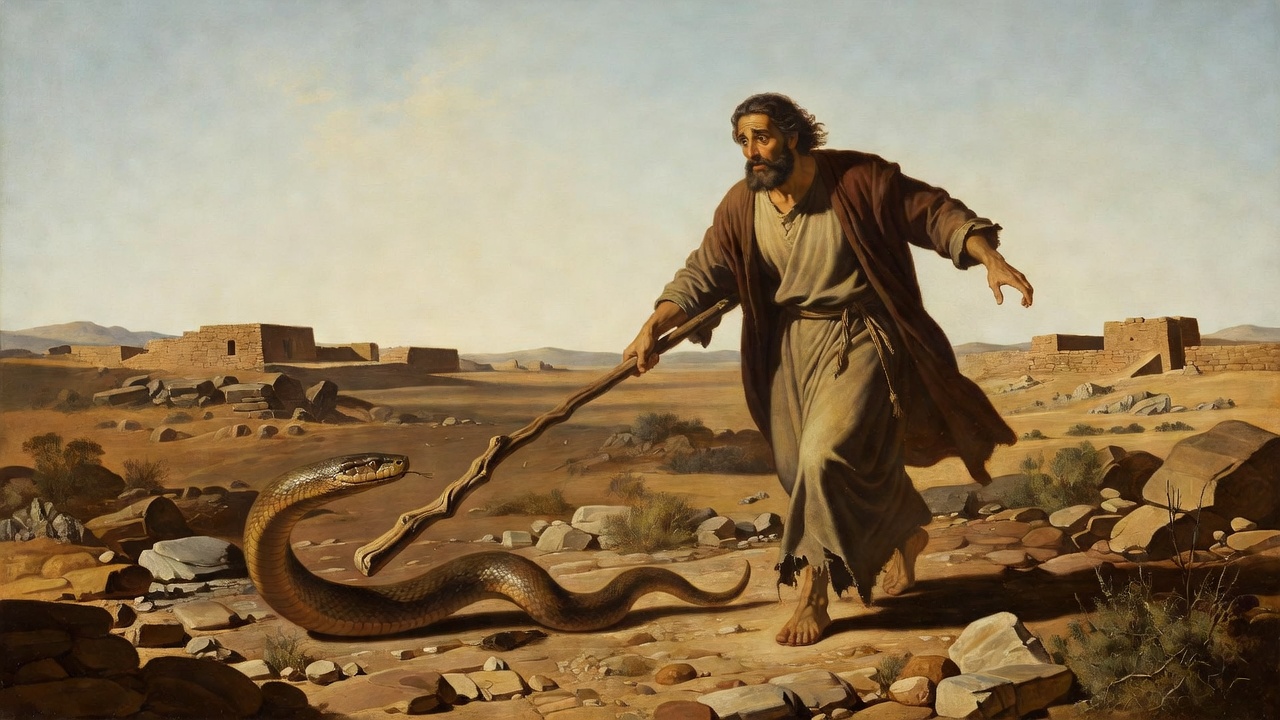
7Then God said to him, “Again put your hand into your shirt.” Again he put his hand in there, then he withdrew it, it was good, it was like his other hand, without sickness. 8God said, “You will show them the stick, they will see, it will become a snake. After seeing that they might not believe your words. Then you will show them your hand, it will become white from sickness, then it will become well again. After that perhaps they will believe I have sent you. 9If they still do not believe you, you shall take some water from the river, from the Nile river. You will pour it on the dry ground, that water will become blood.”
The Appointment of Aaron
10Moses said to him, “I can't go to them, I am a poor speaker. Previously I did not speak well, and still I speak slowly and hesitantly.” 11God said to him, “Who gives people their mouths? I am the one. Who makes some people unable to speak? Who makes some people deaf? I am the one. Who makes some able to see? Who makes some blind? I am the one, Yawayi. 12You will go to Egypt. I will tell you what to say, and I will help you to say it.” 13Moses answered, “Not me, please send another.” 14With this word God became angry with him. He said to Moses, “Your own older brother, Aaron, have you thought about him? I know about him, he is a good speaker. Truly, he is coming now to meet you. When he sees you he will be glad. 15You will speak to him, you will tell him what to say. I will help you two to speak, and I will tell you two what to do. 16He will speak to the people for you. You will tell him my words and he will speak for you. 17Take your stick with you, with it you will do wonderful (things).”
Moses Leaves for Egypt
18Then Moses returned to his father-in-law, to Jethro. He said to him, “Please let me go back to Egypt to see my relatives. Perhaps they are still alive.” Jethro said to him, “Yes, you will go well.”
19While Moses was still in Midian, God said to him, “Long ago those in Egypt wanted to kill you. Now they are all dead. Now you will go back to Egypt.” 20Because of that Moses got his wife and his 2 sons, he put them on a donkey. After that he was going towards Egypt. He was carrying that (previously mentioned) walking stick, God had told him to take that one. 21Again God said to him, “Now you are going back to Egypt. I have showed you the wonderful (things) that you must do. Truly you must do them all, he will see them all, that Egyptian king. But I will make him stubborn, he will not let your people go. 22Then you must tell the king this word of mine: 'I am Yawayi. The Israeli mob are for me like a son, like a first-born male. 23Let my people go free, so that they can pray to me and give gifts to me. Listen to me. If not I will kill your first-born son.' Like that you will speak to the king.”
Você sabia?
Os sinais de Moisés e seu retorno ao Egito
- Arão nasceu no Egito três anos antes de seu irmão mais novo, Moisés. Deus enviou-o para encontrar Moisés no deserto, no monte de Deus; como Arão sabia falar bem, ele seria o porta-voz que transmitiria as palavras do SENHOR ao povo.Fontes: Aaron · o próprio texto bíblico
- Foi dito a Moisés que, se não acreditassem nos dois primeiros sinais, ele deveria tomar água do Nilo e derramá-la na terra seca, onde ela se transformaria em sangue. No Antigo Testamento, esse rio é chamado com frequência de Sihor, “a corrente negra”, ou simplesmente “o rio”.Fontes: Nile · o próprio texto bíblico
- A ordem para retornar chegou a Moisés em Midiã, território de uma tribo árabe nômade no deserto ao norte da península Arábica, onde a península do Sinai servia de pastagem para seus rebanhos. Jetro, sacerdote de Midiã e sogro de Moisés, disse-lhe que fosse em paz; assim, Moisés partiu com a esposa e os filhos, levando o cajado de Deus.Fontes: Midian · Jethro · o próprio texto bíblico
Notas escritas com auxílio de IA a partir de fontes abertas (Theographic Bible Metadata, CC BY-SA 4.0; Easton’s Bible Dictionary, domínio público) e revisadas antes de publicar.
Lugares deste capítulo
- Nile · Hoje: Nile River · 31.465, 30.367 · versículo 9
- Egypt · 30.129, 31.308 · versículos 18, 19, 20, 21, 24, 29
- Midian · 28.495, 35.012 · versículo 19
Só aparecem lugares com identificação de alta confiança (90% ou mais segundo as fontes acadêmicas reunidas pelo OpenBible). Mapa da época: DARE (Digital Atlas of the Roman Empire), CC BY 4.0; mapa atual: © colaboradores do OpenStreetMap; lugares: OpenBible.info (CC BY 4.0).
Créditos e licença desta tradução
Nyangumarta English Bible
Portions of the Holy Bible in English, translated to be a companion to the Nyangumarta Bible
copyright © 1980-2010 Wycliffe Bible Translators, Inc.
Language: English
Bible translation copyright © 1980-2010 Wycliffe Bible Translators, Inc.
Reader Series (book XXC) copyright © 1996 Bible Society Australia. Bible overview (XXA) copyright © 1996 Mission Publications of Australia (PO Box 21, Lawson NSW 2783)
This translation is made available to you under the terms of the
Creative Commons Attribution-Noncommercial-No Derivatives license 4.0.
You may share and redistribute this Bible translation or extracts from it in any format, provided that:
You include the above copyright and source information.
You do not sell this work for a profit.
You do not change any of the words or punctuation of the Scriptures.
Pictures included with Scriptures and other documents on this site are licensed just for use with those Scriptures and documents.
For other uses, please contact the respective copyright owners.
2026-01-06
Títulos de seção adaptados da Berean Standard Bible (domínio público); não fazem parte do texto bíblico desta tradução.
Fonte: http://ebible.org/engnna/ · eBible.org