Exodus 4
Nyangumarta English Bible · Tap a verse to see its cross-references.
About this book
About Exodus
- Easton's Bible Dictionary (1897) dates Israel's departure from Egypt to about 1490 B.C., four hundred and eighty years before Solomon's temple was built. How long they had sojourned there is disputed: Exodus 12:40 gives four hundred and thirty years, Genesis 15 speaks of about four hundred, and the Greek and Samaritan versions also count the years in Canaan, so some reckon only two hundred and fifteen years in Egypt.Sources: Easton: Exodus
- Easton's Bible Dictionary (1897) does not name the author of Exodus. The entry on Moses says Jacob and his sons went down into Egypt, probably about three hundred and fifty years before Moses was born, and that a Hyksos king, from a pastoral Semitic people of Asia who then ruled Egypt, settled them in Goshen. Moses later spent forty years in Midian, where that people pastured flocks on the Sinai peninsula, and became the son-in-law of Jethro, priest of Midian.Sources: Moses · Easton: Exodus · Midian · Jethro
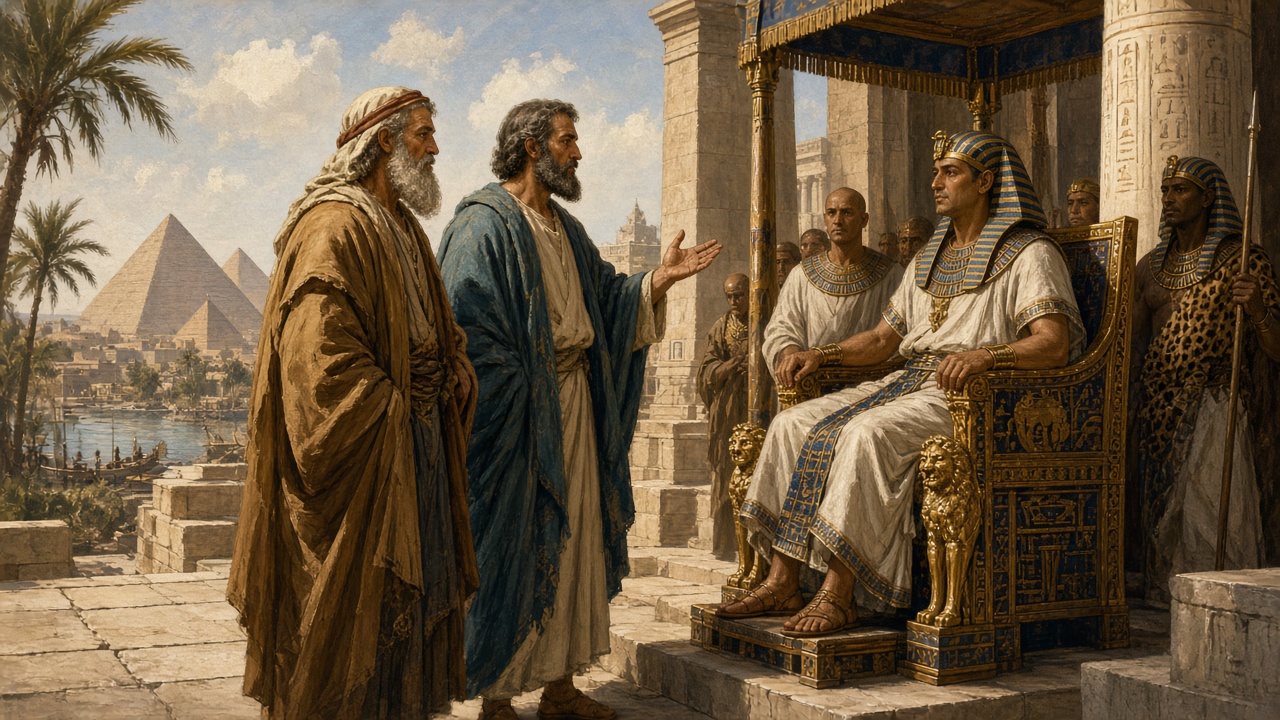
- Who was Pharaoh at the departure is also disputed. Easton's Bible Dictionary (1897) calls him probably Menephtah I, the fourteenth and eldest surviving son of Rameses II, who lived at Zoan and met Moses and Aaron there, while noting that some favor Seti II, whose reign began peacefully and ended in sudden disaster.Sources: Pharaoh (of the Exodus)
- The plagues, Easton writes, loosened Pharaoh's hold, and the Passover was instituted as a perpetual memorial, with the lamb's blood sprinkled on the doorposts. In the third month the people reached Mount Sinai, also called Horeb, about one hundred and fifty miles from the Red Sea, and camped there about a year. The last twenty-two chapters of Exodus record that stay, including the tabernacle, whose Holy Place had no opening for daylight and was lit only by the golden candlestick.Sources: Easton: Exodus · Mount Sinai · Holy Place
- Aaron, eldest son of Amram and Jochebed, was born in Egypt three years before Moses and was sent to meet him so the two could work together. At Rephidim, Joshua, also born in Egypt, commanded Israel's fighters when the Amalekites, a pastoral people living between the Dead Sea and the Red Sea, tried to bar their way.Sources: Aaron · Joshua · Amalek
Notes written with AI assistance from open sources (Theographic Bible Metadata, CC BY-SA 4.0; Easton’s Bible Dictionary, public domain) and reviewed before publishing.
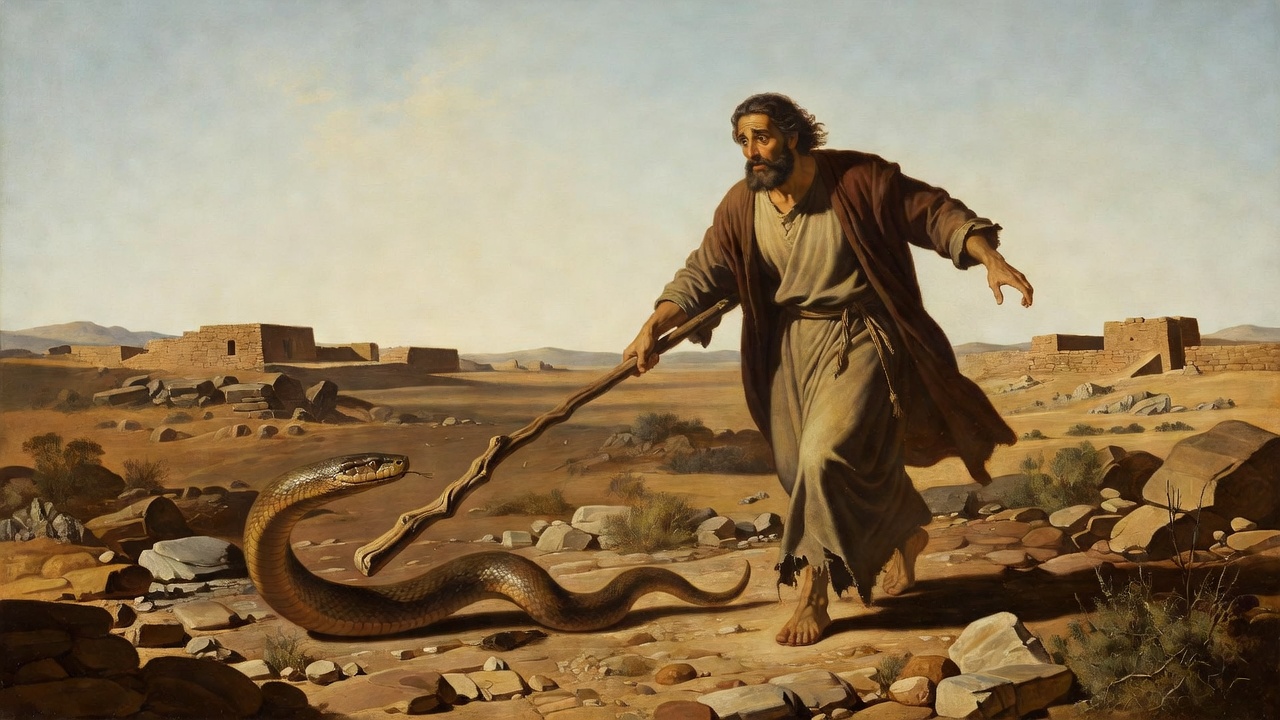
7Then God said to him, “Again put your hand into your shirt.” Again he put his hand in there, then he withdrew it, it was good, it was like his other hand, without sickness. 8God said, “You will show them the stick, they will see, it will become a snake. After seeing that they might not believe your words. Then you will show them your hand, it will become white from sickness, then it will become well again. After that perhaps they will believe I have sent you. 9If they still do not believe you, you shall take some water from the river, from the Nile river. You will pour it on the dry ground, that water will become blood.”
The Appointment of Aaron
10Moses said to him, “I can't go to them, I am a poor speaker. Previously I did not speak well, and still I speak slowly and hesitantly.” 11God said to him, “Who gives people their mouths? I am the one. Who makes some people unable to speak? Who makes some people deaf? I am the one. Who makes some able to see? Who makes some blind? I am the one, Yawayi. 12You will go to Egypt. I will tell you what to say, and I will help you to say it.” 13Moses answered, “Not me, please send another.” 14With this word God became angry with him. He said to Moses, “Your own older brother, Aaron, have you thought about him? I know about him, he is a good speaker. Truly, he is coming now to meet you. When he sees you he will be glad. 15You will speak to him, you will tell him what to say. I will help you two to speak, and I will tell you two what to do. 16He will speak to the people for you. You will tell him my words and he will speak for you. 17Take your stick with you, with it you will do wonderful (things).”
Moses Leaves for Egypt
18Then Moses returned to his father-in-law, to Jethro. He said to him, “Please let me go back to Egypt to see my relatives. Perhaps they are still alive.” Jethro said to him, “Yes, you will go well.”
19While Moses was still in Midian, God said to him, “Long ago those in Egypt wanted to kill you. Now they are all dead. Now you will go back to Egypt.” 20Because of that Moses got his wife and his 2 sons, he put them on a donkey. After that he was going towards Egypt. He was carrying that (previously mentioned) walking stick, God had told him to take that one. 21Again God said to him, “Now you are going back to Egypt. I have showed you the wonderful (things) that you must do. Truly you must do them all, he will see them all, that Egyptian king. But I will make him stubborn, he will not let your people go. 22Then you must tell the king this word of mine: 'I am Yawayi. The Israeli mob are for me like a son, like a first-born male. 23Let my people go free, so that they can pray to me and give gifts to me. Listen to me. If not I will kill your first-born son.' Like that you will speak to the king.”
Did you know?
Moses’ Signs and Return to Egypt
- Aaron was born in Egypt three years before his younger brother Moses. God sent him to meet Moses in the wilderness at the mountain of God; because Aaron could speak well, he was to be the spokesman who relayed the LORD’s words to the people.Sources: Aaron · the Bible text itself
- Moses was told that, if the first two signs were not believed, he should take water from the Nile and pour it on the dry ground, where it would become blood. In the Old Testament that river is frequently called Sihor, “the black stream,” or simply “the river.”Sources: Nile · the Bible text itself
- The command to return reached Moses in Midian, the territory of a nomadic Arabian tribe in the desert north of the Arabian peninsula, where the Sinai peninsula served as pasture for their flocks. Jethro, the priest of Midian and Moses’ father-in-law, told him to go in peace, so Moses set out with his wife and sons, carrying the staff of God.Sources: Midian · Jethro · the Bible text itself
Notes written with AI assistance from open sources (Theographic Bible Metadata, CC BY-SA 4.0; Easton’s Bible Dictionary, public domain) and reviewed before publishing.
Places in this chapter
- Nile · Today: Nile River · 31.465, 30.367 · verse 9
- Egypt · 30.129, 31.308 · verses 18, 19, 20, 21, 24, 29
- Midian · 28.495, 35.012 · verse 19
Only places identified with high confidence are shown (90% or more according to the scholarly sources compiled by OpenBible). Period map: DARE (Digital Atlas of the Roman Empire), CC BY 4.0; modern map: © OpenStreetMap contributors; places: OpenBible.info (CC BY 4.0).
Credits and license for this translation
Nyangumarta English Bible
Portions of the Holy Bible in English, translated to be a companion to the Nyangumarta Bible
copyright © 1980-2010 Wycliffe Bible Translators, Inc.
Language: English
Bible translation copyright © 1980-2010 Wycliffe Bible Translators, Inc.
Reader Series (book XXC) copyright © 1996 Bible Society Australia. Bible overview (XXA) copyright © 1996 Mission Publications of Australia (PO Box 21, Lawson NSW 2783)
This translation is made available to you under the terms of the
Creative Commons Attribution-Noncommercial-No Derivatives license 4.0.
You may share and redistribute this Bible translation or extracts from it in any format, provided that:
You include the above copyright and source information.
You do not sell this work for a profit.
You do not change any of the words or punctuation of the Scriptures.
Pictures included with Scriptures and other documents on this site are licensed just for use with those Scriptures and documents.
For other uses, please contact the respective copyright owners.
2026-01-06
Section headings adapted from the Berean Standard Bible (public domain); they are not part of this translation’s text.
Source: http://ebible.org/engnna/ · eBible.org