Éxodo 4
Nyangumarta English Bible · Toca un versículo para ver sus referencias cruzadas.

Acerca de este libro
Sobre Éxodo
- El Easton's Bible Dictionary (1897) fecha la salida de Israel de Egipto hacia 1490 a.C., cuatrocientos ochenta años antes de la construcción del templo de Salomón. La duración de la estancia se discute: Éxodo 12:40 da cuatrocientos treinta años, Génesis 15 habla de unos cuatrocientos, y las versiones griega y samaritana incluyen también los años en Canaán, de modo que algunos cuentan solo doscientos quince años en Egipto.Fuentes: Easton: Exodus
- El Easton's Bible Dictionary (1897) no nombra al autor de Éxodo. La entrada sobre Moisés dice que Jacob y sus hijos bajaron a Egipto, probablemente unos trescientos cincuenta años antes del nacimiento de Moisés, y que un rey hicsos, de un pueblo semita pastoril de Asia que entonces dominaba Egipto, los estableció en Gosén. Moisés pasó después cuarenta años en Madián, donde ese pueblo apacentaba rebaños en la península del Sinaí, y llegó a ser yerno de Jetro, sacerdote de Madián.Fuentes: Moses · Easton: Exodus · Midian · Jethro
- También se discute quién era el faraón en el momento de la salida. El Easton's Bible Dictionary (1897) lo identifica probablemente con Menephtah I, el decimocuarto y el mayor de los hijos sobrevivientes de Rameses II, que residía en Zoán y allí se entrevistó con Moisés y Aarón, pero señala que algunos favorecen a Seti II, cuyo reinado empezó en paz y terminó en un desastre repentino.Fuentes: Pharaoh (of the Exodus)
- Las plagas, escribe Easton, aflojaron el dominio del faraón, y la Pascua se instituyó como memorial perpetuo, con la sangre del cordero rociada en los postes de las puertas. Al tercer mes el pueblo llegó al monte Sinaí, llamado también Horeb, a unas ciento cincuenta millas del mar Rojo, y acampó allí cerca de un año. Los últimos veintidós capítulos de Éxodo registran esa estancia, incluido el tabernáculo, cuyo Lugar Santo no tenía abertura para la luz del día y se iluminaba solo con el candelabro de oro.Fuentes: Easton: Exodus · Mount Sinai · Holy Place
- Aarón, hijo mayor de Amram y Jocabed, nació en Egipto tres años antes que Moisés y fue enviado a encontrarse con su hermano para que los dos trabajaran juntos. En Refidim, Josué, también nacido en Egipto, mandó a los combatientes de Israel cuando los amalecitas, un pueblo pastoril que vivía entre el mar Muerto y el mar Rojo, intentaron cerrarles el paso.Fuentes: Aaron · Joshua · Amalek
Notas escritas con ayuda de IA a partir de fuentes abiertas (Theographic Bible Metadata, CC BY-SA 4.0; Easton’s Bible Dictionary, dominio público) y revisadas antes de publicarse.
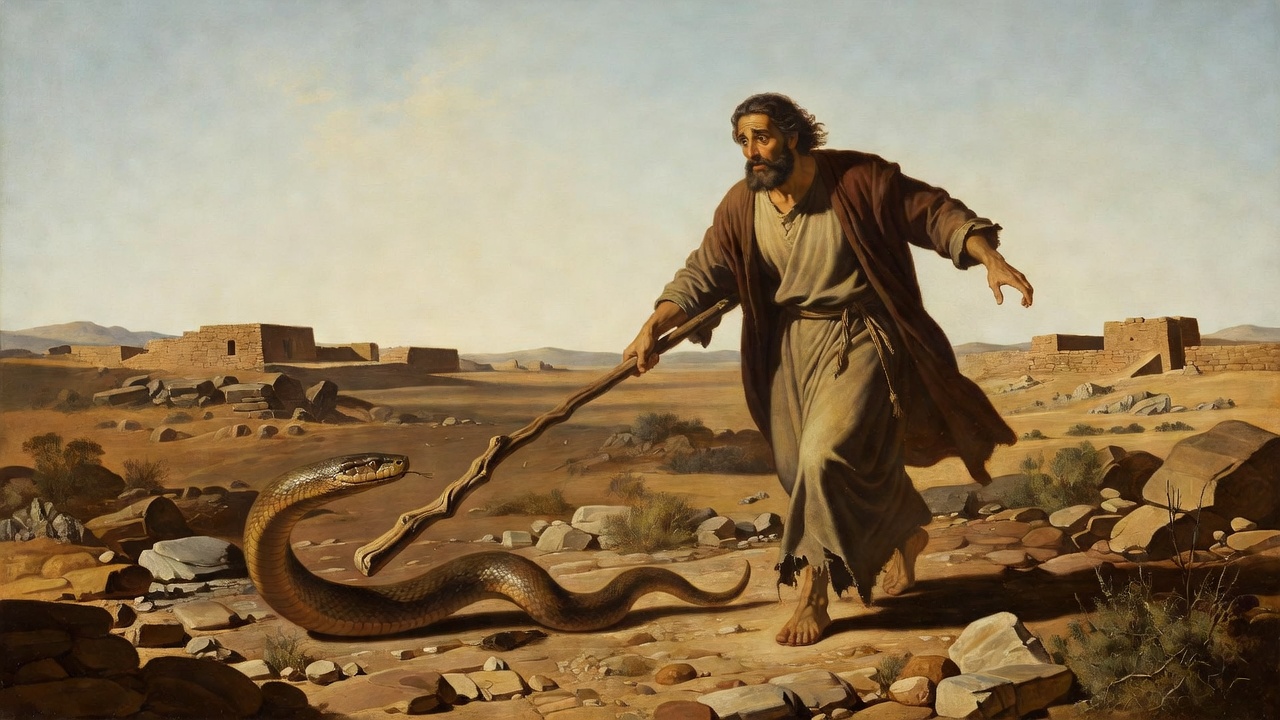
7Then God said to him, “Again put your hand into your shirt.” Again he put his hand in there, then he withdrew it, it was good, it was like his other hand, without sickness. 8God said, “You will show them the stick, they will see, it will become a snake. After seeing that they might not believe your words. Then you will show them your hand, it will become white from sickness, then it will become well again. After that perhaps they will believe I have sent you. 9If they still do not believe you, you shall take some water from the river, from the Nile river. You will pour it on the dry ground, that water will become blood.”
The Appointment of Aaron
10Moses said to him, “I can't go to them, I am a poor speaker. Previously I did not speak well, and still I speak slowly and hesitantly.” 11God said to him, “Who gives people their mouths? I am the one. Who makes some people unable to speak? Who makes some people deaf? I am the one. Who makes some able to see? Who makes some blind? I am the one, Yawayi. 12You will go to Egypt. I will tell you what to say, and I will help you to say it.” 13Moses answered, “Not me, please send another.” 14With this word God became angry with him. He said to Moses, “Your own older brother, Aaron, have you thought about him? I know about him, he is a good speaker. Truly, he is coming now to meet you. When he sees you he will be glad. 15You will speak to him, you will tell him what to say. I will help you two to speak, and I will tell you two what to do. 16He will speak to the people for you. You will tell him my words and he will speak for you. 17Take your stick with you, with it you will do wonderful (things).”
Moses Leaves for Egypt
18Then Moses returned to his father-in-law, to Jethro. He said to him, “Please let me go back to Egypt to see my relatives. Perhaps they are still alive.” Jethro said to him, “Yes, you will go well.”
19While Moses was still in Midian, God said to him, “Long ago those in Egypt wanted to kill you. Now they are all dead. Now you will go back to Egypt.” 20Because of that Moses got his wife and his 2 sons, he put them on a donkey. After that he was going towards Egypt. He was carrying that (previously mentioned) walking stick, God had told him to take that one. 21Again God said to him, “Now you are going back to Egypt. I have showed you the wonderful (things) that you must do. Truly you must do them all, he will see them all, that Egyptian king. But I will make him stubborn, he will not let your people go. 22Then you must tell the king this word of mine: 'I am Yawayi. The Israeli mob are for me like a son, like a first-born male. 23Let my people go free, so that they can pray to me and give gifts to me. Listen to me. If not I will kill your first-born son.' Like that you will speak to the king.”
¿Sabías que…?
Las señales de Moisés y su regreso a Egipto
- Aarón nació en Egipto tres años antes que su hermano menor, Moisés. Dios lo envió a encontrarse con Moisés en el desierto, en el monte de Dios; puesto que Aarón podía hablar bien, sería el portavoz que comunicaría las palabras del SEÑOR al pueblo.Fuentes: Aaron · el propio texto bíblico
- A Moisés se le dijo que, si no creían las dos primeras señales, debía tomar agua del Nilo y derramarla en la tierra seca, donde se convertiría en sangre. En el Antiguo Testamento, ese río recibe con frecuencia el nombre de Sihor, “la corriente negra”, o simplemente “el río”.Fuentes: Nile · el propio texto bíblico
- La orden de regresar le llegó a Moisés en Madián, territorio de una tribu árabe nómada en el desierto al norte de la península arábiga, donde la península del Sinaí servía de pastizal para sus rebaños. Jetro, sacerdote de Madián y suegro de Moisés, le dijo que fuera en paz, de modo que Moisés partió con su esposa y sus hijos llevando la vara de Dios.Fuentes: Midian · Jethro · el propio texto bíblico
Notas escritas con ayuda de IA a partir de fuentes abiertas (Theographic Bible Metadata, CC BY-SA 4.0; Easton’s Bible Dictionary, dominio público) y revisadas antes de publicarse.
Lugares de este capítulo
- Nile · Hoy: Nile River · 31.465, 30.367 · versículo 9
- Egypt · 30.129, 31.308 · versículos 18, 19, 20, 21, 24, 29
- Midian · 28.495, 35.012 · versículo 19
Solo aparecen lugares identificados con alta confianza (90 % o más según las fuentes académicas reunidas por OpenBible). Mapa de la época: DARE (Digital Atlas of the Roman Empire), CC BY 4.0; mapa actual: © colaboradores de OpenStreetMap; lugares: OpenBible.info (CC BY 4.0).
Créditos y licencia de esta traducción
Nyangumarta English Bible
Portions of the Holy Bible in English, translated to be a companion to the Nyangumarta Bible
copyright © 1980-2010 Wycliffe Bible Translators, Inc.
Language: English
Bible translation copyright © 1980-2010 Wycliffe Bible Translators, Inc.
Reader Series (book XXC) copyright © 1996 Bible Society Australia. Bible overview (XXA) copyright © 1996 Mission Publications of Australia (PO Box 21, Lawson NSW 2783)
This translation is made available to you under the terms of the
Creative Commons Attribution-Noncommercial-No Derivatives license 4.0.
You may share and redistribute this Bible translation or extracts from it in any format, provided that:
You include the above copyright and source information.
You do not sell this work for a profit.
You do not change any of the words or punctuation of the Scriptures.
Pictures included with Scriptures and other documents on this site are licensed just for use with those Scriptures and documents.
For other uses, please contact the respective copyright owners.
2026-01-06
Títulos de sección adaptados de la Berean Standard Bible (dominio público); no forman parte del texto bíblico de esta traducción.
Fuente: http://ebible.org/engnna/ · eBible.org