Cântico dos Cânticos 7
Geneva Bible 1599 · Toque num versículo para ver as referências cruzadas.
Admiration by the Bridegroom
1Howe beautifull are thy goings with shooes, O princes daughter! the ioynts of thy thighs are like iewels: the worke of the hande of a cunning workeman. 2Thy nauel is as a round cuppe that wanteth not licour: thy belly is as an heape of wheat compassed about with lilies. 3Thy two breastes are as two young roes that are twinnes. 4Thy necke is like a towre of yuorie: thine eyes are like the fishe pooles in Heshbon by the gate of Bath-rabbim: thy nose is as the towre of Lebanon, that looketh toward Damascus. 5Thine head vpon thee is as skarlet, and the bush of thine head like purple: the King is tyed in the rafters. 6Howe faire art thou, and howe pleasant art thou, O my loue, in pleasures! 7This thy stature is like a palme tree, and thy brestes like clusters. 8I saide, I will goe vp into the palme tree, I will take holde of her boughes: thy breastes shall nowe be like the clusters of the vine: and the sauour of thy nose like apples, 9And the roufe of thy mouth like good wine, which goeth straight to my welbeloued, and causeth the lippes of the ancient to speake.
The Bride
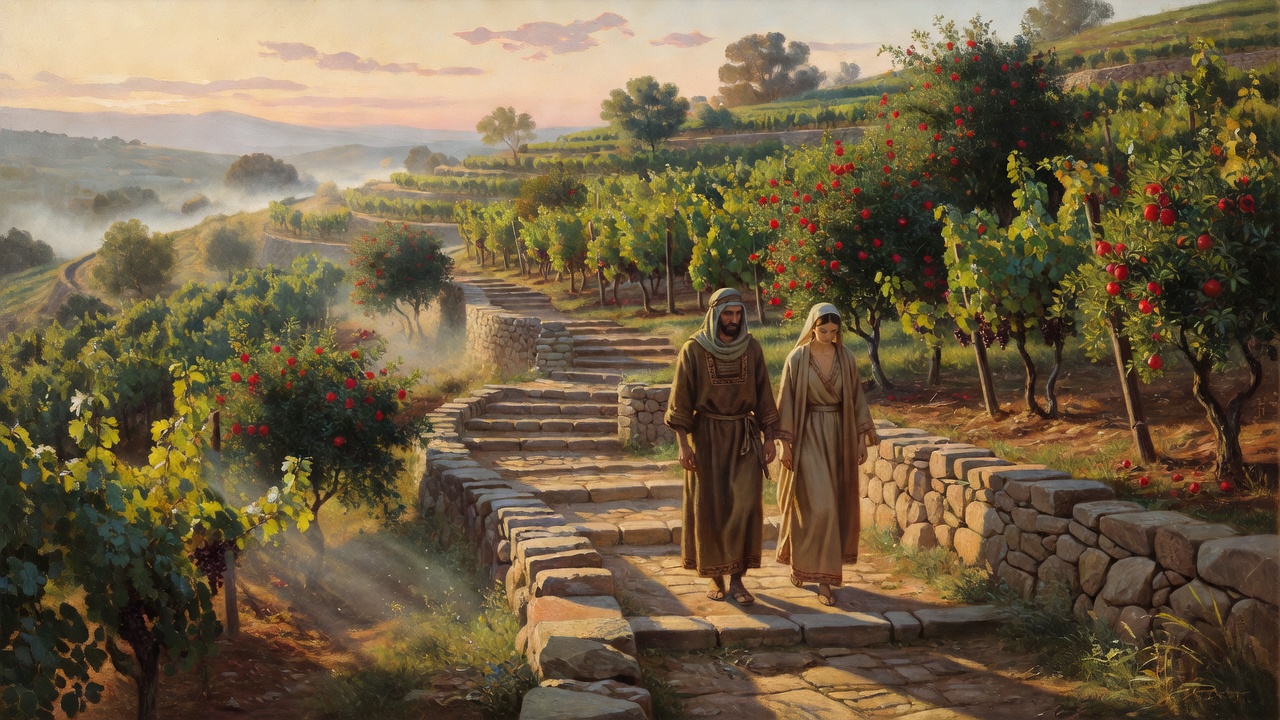
10I am my welbeloueds, and his desire is toward mee. 11Come, my welbeloued, let vs go foorth into the fielde: let vs remaine in the villages. 12Let vs get vp early to the vines, let vs see if the vine florish, whether it hath budded the small grape, or whether the pomegranates florish: there will I giue thee my loue. 13The mandrakes haue giuen a smelll, and in our gates are all sweete things, new and olde: my welbeloued, I haue kept them for thee.
Você sabia?
Poesia de Amor e Paisagem
- O poema descreve a beleza da mulher usando pontos de referência destacados da região. Seus olhos são comparados aos límpidos reservatórios de Hesbom, junto à porta de Bate-Rabim, a leste do Jordão, enquanto seu perfil é comparado a uma torre imponente nas montanhas do Líbano voltada para Damasco.Fontes: o próprio texto bíblico · Heshbon · Bath-rabbim · Lebanon
- O capítulo se encerra com um convite para o campo durante a renovação da primavera. Os amados vão conferir o brotar das videiras, a floração das romãzeiras e o aroma das mandrágoras, refletindo a íntima ligação na poesia hebraica antiga entre o romance e a vitalidade da natureza.Fontes: o próprio texto bíblico
Notas escritas com auxílio de IA a partir de fontes abertas (Theographic Bible Metadata, CC BY-SA 4.0; Easton’s Bible Dictionary, domínio público) e revisadas antes de publicar.
Lugares deste capítulo
- Bath-rabbim · Hoje: in Tell Hesban · 31.801, 35.809 · versículo 4
- Damascus · 33.511, 36.306 · versículo 4
- Lebanon · 33.540, 35.584 · versículo 4
- Mount Carmel · 32.672, 35.023 · versículo 5
Só aparecem lugares com identificação de alta confiança (90% ou mais segundo as fontes acadêmicas reunidas pelo OpenBible). Mapa da época: DARE (Digital Atlas of the Roman Empire), CC BY 4.0; mapa atual: © colaboradores do OpenStreetMap; lugares: OpenBible.info (CC BY 4.0).
Créditos e licença desta tradução
Geneva Bible 1599
The Geneva Bible in Old English of 1599
Public Domain
Language: English
Dialect: Old
This digital copy is freely available world-wide, with no copyright restrictions, courtesy of eBible.org and many others. Note that the spelling used is the original spelling, which is not modern English.
2024-03-16
Títulos de seção adaptados da Berean Standard Bible (domínio público); não fazem parte do texto bíblico desta tradução.
Fonte: http://ebible.org/enggnv/ · eBible.org