Cantares 7
Geneva Bible 1599 · Toca un versículo para ver sus referencias cruzadas.
Admiration by the Bridegroom
1Howe beautifull are thy goings with shooes, O princes daughter! the ioynts of thy thighs are like iewels: the worke of the hande of a cunning workeman. 2Thy nauel is as a round cuppe that wanteth not licour: thy belly is as an heape of wheat compassed about with lilies. 3Thy two breastes are as two young roes that are twinnes. 4Thy necke is like a towre of yuorie: thine eyes are like the fishe pooles in Heshbon by the gate of Bath-rabbim: thy nose is as the towre of Lebanon, that looketh toward Damascus. 5Thine head vpon thee is as skarlet, and the bush of thine head like purple: the King is tyed in the rafters. 6Howe faire art thou, and howe pleasant art thou, O my loue, in pleasures! 7This thy stature is like a palme tree, and thy brestes like clusters. 8I saide, I will goe vp into the palme tree, I will take holde of her boughes: thy breastes shall nowe be like the clusters of the vine: and the sauour of thy nose like apples, 9And the roufe of thy mouth like good wine, which goeth straight to my welbeloued, and causeth the lippes of the ancient to speake.
The Bride
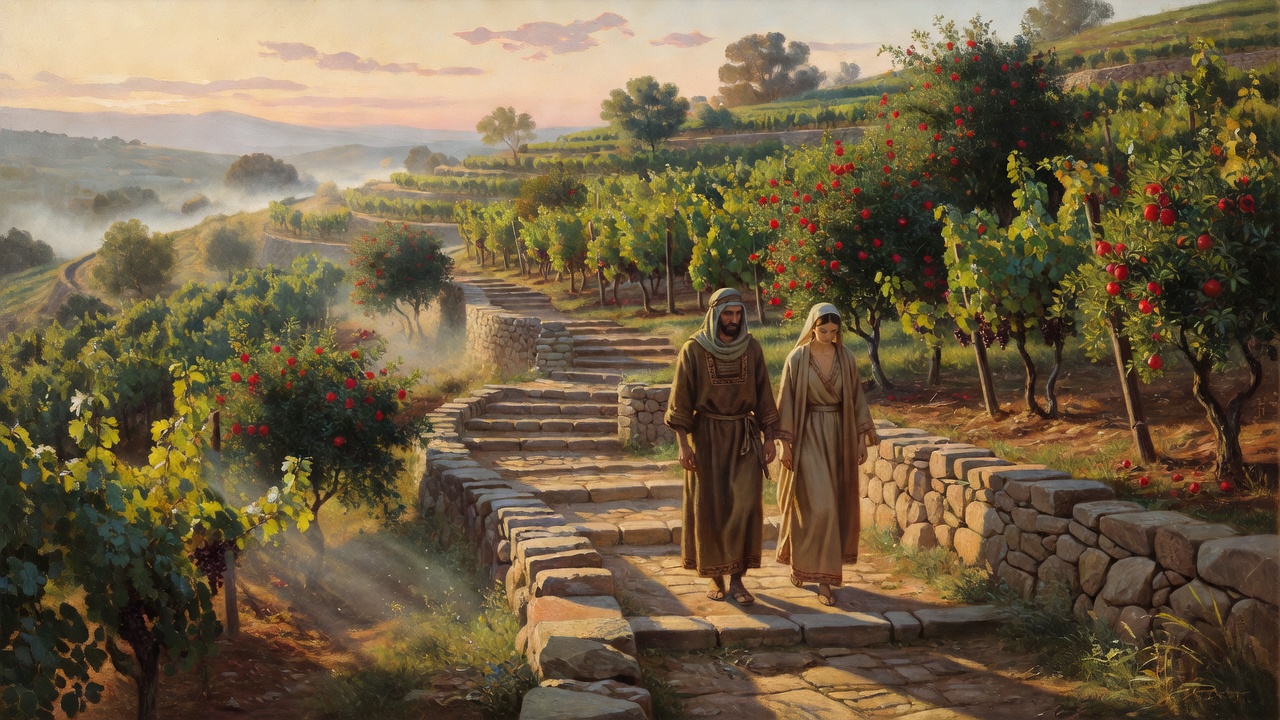
10I am my welbeloueds, and his desire is toward mee. 11Come, my welbeloued, let vs go foorth into the fielde: let vs remaine in the villages. 12Let vs get vp early to the vines, let vs see if the vine florish, whether it hath budded the small grape, or whether the pomegranates florish: there will I giue thee my loue. 13The mandrakes haue giuen a smelll, and in our gates are all sweete things, new and olde: my welbeloued, I haue kept them for thee.
¿Sabías que…?
Poesía de Amor y Paisaje
- El poema describe la belleza de la mujer utilizando destacados puntos geográficos de la región. Sus ojos son comparados con los estanques de Hesbón, cerca de la puerta de Bat-rabim al este del Jordán, mientras que su perfil se asemeja a una torre majestuosa en la cordillera del Líbano que mira hacia Damasco.Fuentes: el propio texto bíblico · Heshbon · Bath-rabbim · Lebanon
- El capítulo concluye con una invitación al campo durante el despertar de la primavera. Los amantes salen a observar los brotes de las vides, la floración de los granados y el aroma de las mandrágoras, reflejando la estrecha relación en la poesía hebrea antigua entre la intimidad romántica y la naturaleza.Fuentes: el propio texto bíblico
Notas escritas con ayuda de IA a partir de fuentes abiertas (Theographic Bible Metadata, CC BY-SA 4.0; Easton’s Bible Dictionary, dominio público) y revisadas antes de publicarse.
Lugares de este capítulo
- Bath-rabbim · Hoy: in Tell Hesban · 31.801, 35.809 · versículo 4
- Damascus · 33.511, 36.306 · versículo 4
- Lebanon · 33.540, 35.584 · versículo 4
- Mount Carmel · 32.672, 35.023 · versículo 5
Solo aparecen lugares identificados con alta confianza (90 % o más según las fuentes académicas reunidas por OpenBible). Mapa de la época: DARE (Digital Atlas of the Roman Empire), CC BY 4.0; mapa actual: © colaboradores de OpenStreetMap; lugares: OpenBible.info (CC BY 4.0).
Créditos y licencia de esta traducción
Geneva Bible 1599
The Geneva Bible in Old English of 1599
Public Domain
Language: English
Dialect: Old
This digital copy is freely available world-wide, with no copyright restrictions, courtesy of eBible.org and many others. Note that the spelling used is the original spelling, which is not modern English.
2024-03-16
Títulos de sección adaptados de la Berean Standard Bible (dominio público); no forman parte del texto bíblico de esta traducción.
Fuente: http://ebible.org/enggnv/ · eBible.org