Song of Songs 7
Geneva Bible 1599 · Tap a verse to see its cross-references.
Admiration by the Bridegroom
1Howe beautifull are thy goings with shooes, O princes daughter! the ioynts of thy thighs are like iewels: the worke of the hande of a cunning workeman. 2Thy nauel is as a round cuppe that wanteth not licour: thy belly is as an heape of wheat compassed about with lilies. 3Thy two breastes are as two young roes that are twinnes. 4Thy necke is like a towre of yuorie: thine eyes are like the fishe pooles in Heshbon by the gate of Bath-rabbim: thy nose is as the towre of Lebanon, that looketh toward Damascus. 5Thine head vpon thee is as skarlet, and the bush of thine head like purple: the King is tyed in the rafters. 6Howe faire art thou, and howe pleasant art thou, O my loue, in pleasures! 7This thy stature is like a palme tree, and thy brestes like clusters. 8I saide, I will goe vp into the palme tree, I will take holde of her boughes: thy breastes shall nowe be like the clusters of the vine: and the sauour of thy nose like apples, 9And the roufe of thy mouth like good wine, which goeth straight to my welbeloued, and causeth the lippes of the ancient to speake.
The Bride
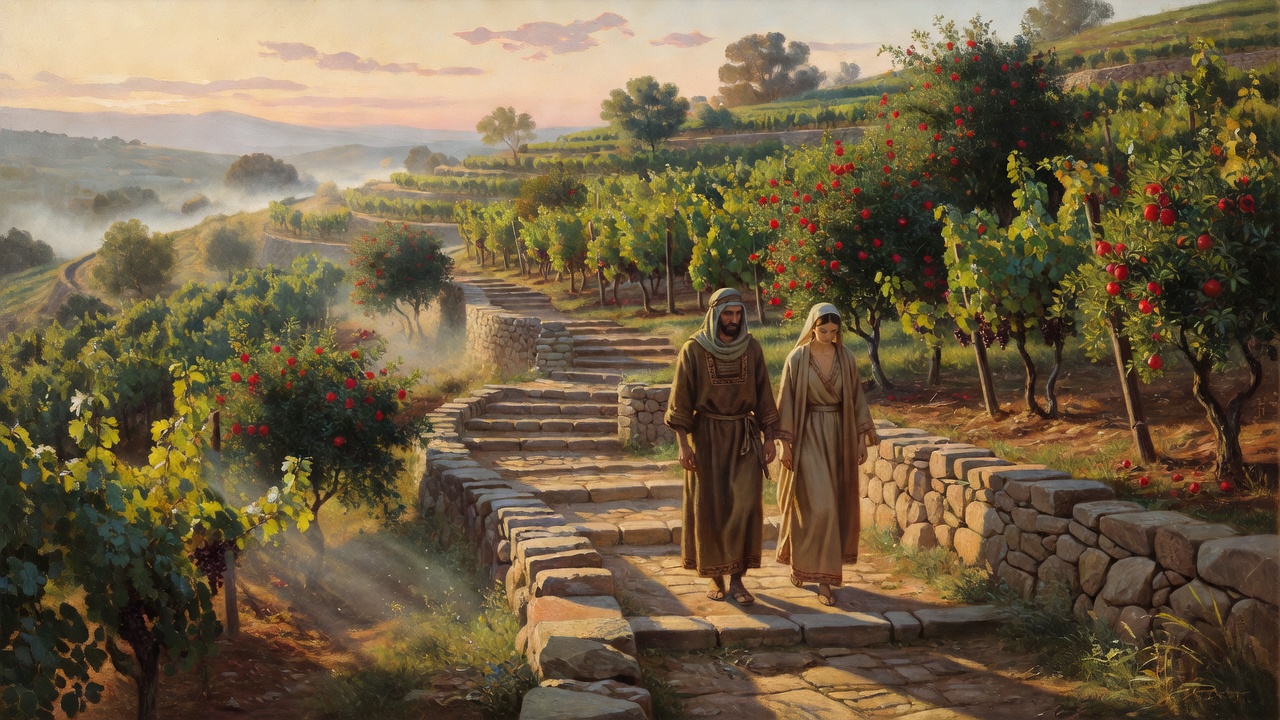
10I am my welbeloueds, and his desire is toward mee. 11Come, my welbeloued, let vs go foorth into the fielde: let vs remaine in the villages. 12Let vs get vp early to the vines, let vs see if the vine florish, whether it hath budded the small grape, or whether the pomegranates florish: there will I giue thee my loue. 13The mandrakes haue giuen a smelll, and in our gates are all sweete things, new and olde: my welbeloued, I haue kept them for thee.
Did you know?
Poetry of Love and Landscape
- The poem describes the woman's beauty using prominent landmarks of the region. Her eyes are compared to the calm pools of Heshbon near the gate of Bath-rabbim east of the Jordan, while her profile is likened to a majestic tower in the mountain range of Lebanon overlooking Damascus.Sources: the Bible text itself · Heshbon · Bath-rabbim · Lebanon
- The chapter concludes with an invitation to the countryside during the renewal of spring. The lovers seek out budding grapevines, blooming pomegranates, and fragrant mandrakes, reflecting the close connection in ancient Hebrew poetry between romantic intimacy and the vitality of the natural world.Sources: the Bible text itself
Notes written with AI assistance from open sources (Theographic Bible Metadata, CC BY-SA 4.0; Easton’s Bible Dictionary, public domain) and reviewed before publishing.
Places in this chapter
- Bath-rabbim · Today: in Tell Hesban · 31.801, 35.809 · verse 4
- Damascus · 33.511, 36.306 · verse 4
- Lebanon · 33.540, 35.584 · verse 4
- Mount Carmel · 32.672, 35.023 · verse 5
Only places identified with high confidence are shown (90% or more according to the scholarly sources compiled by OpenBible). Period map: DARE (Digital Atlas of the Roman Empire), CC BY 4.0; modern map: © OpenStreetMap contributors; places: OpenBible.info (CC BY 4.0).
Credits and license for this translation
Geneva Bible 1599
The Geneva Bible in Old English of 1599
Public Domain
Language: English
Dialect: Old
This digital copy is freely available world-wide, with no copyright restrictions, courtesy of eBible.org and many others. Note that the spelling used is the original spelling, which is not modern English.
2024-03-16
Section headings adapted from the Berean Standard Bible (public domain); they are not part of this translation’s text.
Source: http://ebible.org/enggnv/ · eBible.org