Gênesis 29
Ekajuk Scriptures Bible Portions · Toque num versículo para ver as referências cruzadas.
Jekob rehnge go Padan Aram
1Jekob kehm soro asi go ege eljen tete a ba rehng go ndi nyio nyi anebe ero nfam. 2Owo á kehm nyehne elbing alahb go emahng, a nlong ejoro na era nya noongo o, tibre owo bo jo ka enyam alahb elbing nio. Eltal ni bo ko bulu nnyo elbing alahb nio jolo egburu eltal. 3Ngare nyi bo ma ko ejoro kpee ba wane o, mbaabe ebul kehm bannge eltal nio lennge nnyo elbing alahb, bo ka ejoro alahb, kehm kpe feere a eltal nio bulu. 4Jekob kehm bahbe abaabe ebul re, <<Abonanee, gan wo ń lohng no?>> Bo kehm-e faange re, <<Wahr lohng go Haran.>> 5Á kehm kpe bahb bo re, <<N kpˈkahne Leban ji mmona Nahor jel-e noa?>> Bo kehm faange re, <<Ee, e kp-e kahne.>> 6Owo Jekob kehm bahbe bo re, <<Ye noa nob noba?>> Bo kehm-e faange re, <<Ee, á noa nob nob, nyehn Rasel mmon ewe ga kpˈbake a ejoro. 7Á kehm tongo bo re, <<Njul ga kpeke li ero, ngare ka rehng nyi kehn enyam bahke ba kono edi ajehng, kaan ejoro alahb, wahn feere a bo, bo song li nsol.>> 8Bo kehm-e faange re, <<E nehm ma lim ano, tete bo lˈko atohkondi kpee ba edi ajehng fere bannge eltal nio lennge nnyo elbing alahb. Ngare nyio nyi e bahke ma ka bo alahb.>> 9Ana á kpi mbungu mbungu, ano wo Rasel kehm soro ba rehng a ejoro nde, tibre á jolo mbaabe ebul. 10Eji Jekob nyehne Rasel mmona Leban ji jolo mmonannyehn no nnyehn ewe, a ejoro bi Leban, á kehm song bannge eltal nio lennge nnyo elbing alahb, fere ka ejoro Leban mmonannyehn nnyehn alahb. 11Owo Jekob kehm bingi Rasel, fere kehm kehme ellingi wahre wahre. 12Ngare nyio yebtong Rasel re ye ekunu nde ji, fere tong-e re ye mmon no Rebeka wo. Á kehm beke song tong nde. 13Ana Leban wuku bada Jekob mmona mmonannyehn, á kehm soro be song wan-e. Á kehm-e kake nnyo fere bing-e, kehm-e soro ko ba go ege etahk. Owo Jekob kehm-e tongo nsol kpee bade elkpin ene. 14Owo Leban kehm-e tongo re, <<Wo a me alung amehng ma.>>
Jekob koo Lia a Rasel go elbal
Eji Jekob ma kang a Leban nnyahng kohro kohro, 15Leban kehm bungu tong-e re, <<Anv, a bahk-m lohko loko na loko a na mbol mbol tib esi ji a li ekunu ejama? Tong-m ekun eba, ana m bahk-a jo kpi. 16Leban bele abon abal ba nkal. No nkul bo jo lung-e re Lia, no nse bo jo lung-e re Rasel. 17Lia kpoolo amahr, wo Rasel jolo nkpooda ngbahme, fere nˈnob. 18Rasel wo jo kor Jekob. Á kehm bungu re, <<M bahke limi eltum ka-a go nnya esehma, eji a lˈka-m Rasel, mmon ewa no nse.>> 19Leban kehm bungu re, <<Ga nob re me n ka-a ye, sehnge re me rod-e ka nne nondiki. Jol aname a.>> 20Owo Jekob kehm loko Leban nnya esehma, eji á lˈko Rasel, jolo na are abon afung ba ka Jekob, tib go elkoro ni Rasel jo kor-e. 21Owo Jekob kehm bungu tong Leban re, <<Ka-m nkal ewame. Ngare enyame ebbiingi, n kpˈsebe re me n noongo a ne.>> 22Leban kehm lungu ane ba lene ejahbe re bo ba, kehm ba lim elkak elbal. 23Elgung ba kan a me, á kehm rodo Lia, mmon ewe no nkul ka Jekob, Jekob soro noongo a ne. 24Leban rodo monse nkal no jolo nlokeltum ewe, no bo jo lung-e re Jilpa, ka mmon ewe re á jol nlokeltum ewe. 25Efungfu se kan a me, nyehn Lia nong a Jekobe! Jekob kehm bungu tong Leban re, <<A elkohn ejum ajii á ma-m lim ana? Rasel sang n lok-a no re wo ka-m yea? Jenji wahnge á ma-m nehm?>> 26Owo Leban kehm-e faange re, <<Go egahre eljini, e kpehme gbo mbang rod mmon no nse ka go elbal, kehm tange mmon no nkul. 27Nong erahde ji elkak elbal nia mal, owo e bahk-a kake Rasel a lˈkpe lim eltum go nnya esehma. 28Jekob lohko lim ano. Eji á ma mal erahde ji elkak elbal Lia, owo Leban kehme kake Rasel mmon ewe go elbal. 29Leban rodo monse nkal no jolo nlokeltum ewe, no bo jo lung-e re Bilha ka Rasel mmon re á jol nlokeltum ewe. 30Owo Jekob kehm tob noongo a Rasel, á jo kor-e sehnge Lia. Á kpe lim eltum ka Leban go nnya esehma.
Abon ba Jekob
31Eji Jehova nyehne no re Lia joom kor nlum we, á kehm-e lennge ala njel. Rasel jolo ngum. 32Lia kehm sake ela, jel mmon no nlum. Á gung-e mbing re Ruben, tib á bungu re, <<Jehova ebnyehn erem ebame. Anv, m bahke lohko kor nlum ewame.>> 33Á kehm kpe sa ela. Á jele kan mmon no nlum a, á kehm bungu re, <<tib Jehova wuku re n nehme kor nlum ewame, ji ji wahnge á ma-m kpe ka mmon noa.>> Wahng ka á lung-e re Simion. 34Á kehm kpe sa ela behko. Eji á jele mmon no nlum, á kehm bungu re, <<Anv, nlum ewame bahke jolo bad bad aname, tibre me n jel abon ara ba nlum ka-e.>> Bo gung-e mbing re Levayi. 35Á kehm kpe sa ela. Eji á jele mmon no nlum, á kehm bungu re, <<Anv, m bahke tehke Jehova.>> Owo á kehm-e gungu mbing re Juda. Á kehm rahke njel.
Você sabia?
Os casamentos de Jacó em Harã
- Jacó fugiu para Harã, onde morava seu tio Labão, na terra do povo do Oriente. A cidade, também chamada cidade de Naor e identificada com Harran, ficava junto ao Belik, afluente do Eufrates, cerca de setenta milhas acima da junção do Belik com esse rio, na Alta Mesopotâmia. Labão era filho de Betuel e neto de Naor, irmão de Abraão; a irmã de Labão, Rebeca, era a esposa de Isaque.Fontes: Haran · Laban · Nahor (brother of Abraham) · o próprio texto bíblico
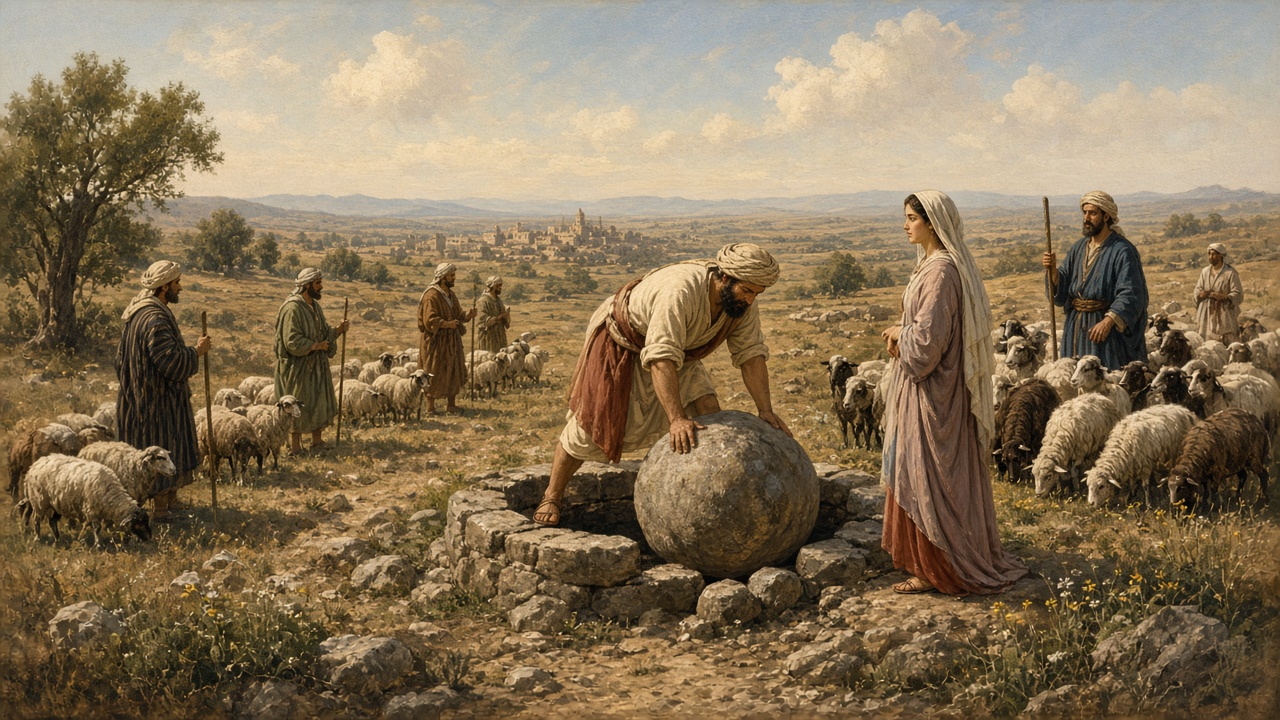
- O poço era fechado por uma grande pedra, que os pastores só rolavam para o lado depois que todos os rebanhos se reuniam, e depois recolocavam no lugar. Raquel, cujo nome é dado como “ovelha”, era pastora e trazia as ovelhas do pai; Jacó, que também vivera como pastor, removeu a pedra e deu de beber ao rebanho do tio.Fontes: Rachel · Jacob (Israel) · o próprio texto bíblico
- Lia, a irmã mais velha, é chamada “cansada”, e é descrita como de olhos fracos, ou tenros; Raquel, a mais nova, era de belo porte e formosa. Jacó serviu sete anos por Raquel, mas, no banquete da noite, Labão lhe deu Lia, dizendo que ali não era costume entregar a filha mais nova em casamento antes da mais velha, e depois lhe deu Raquel por mais sete anos — catorze ao todo. Os primeiros filhos de Lia foram Rúben, cujo nome é dado como “Eis um filho”, e depois Simeão, Levi e Judá; ao nomeá-los, ela falou de o SENHOR ver sua aflição, de ouvir que ela não era amada, de o marido se apegar a ela e de seu louvor ao SENHOR.Fontes: Leah · Rachel · Reuben · o próprio texto bíblico
Notas escritas com auxílio de IA a partir de fontes abertas (Theographic Bible Metadata, CC BY-SA 4.0; Easton’s Bible Dictionary, domínio público) e revisadas antes de publicar.
Lugares deste capítulo
- East · Hoje: region around Amman · 31.955, 35.934 · versículo 1
- Haran · Hoje: Harran · 36.864, 39.033 · versículo 4
Só aparecem lugares com identificação de alta confiança (90% ou mais segundo as fontes acadêmicas reunidas pelo OpenBible). Mapa da época: DARE (Digital Atlas of the Roman Empire), CC BY 4.0; mapa atual: © colaboradores do OpenStreetMap; lugares: OpenBible.info (CC BY 4.0).
Créditos e licença desta tradução
Ekajuk Scriptures Bible Portions
Ekajuk: Ekajuk Scriptures Bible Portions (Bible)
copyright © 2024 Luke Initiative for Scripture Translation and The Seed Company
Language: Ekajuk
Contributor: Luke Initiative for Scripture Translation
This translation is made available to you under the terms of the
Creative Commons Attribution Share-Alike license 4.0.
You have permission to share and redistribute this Bible translation in any format and to make reasonable revisions and adaptations of this translation, provided that:
You include the above copyright and source information.
If you make any changes to the text, you must indicate that you did so in a way that makes it clear that the original licensor is not necessarily endorsing your changes.
If you redistribute this text, you must distribute your contributions under the same license as the original.
Pictures included with Scriptures and other documents on this site are licensed just for use with those Scriptures and documents.
For other uses, please contact the respective copyright owners.
Note that in addition to the rules above, revising and adapting God's Word involves a great responsibility to be true to God's Word. See Revelation 22:18-19.
2025-07-02
Fonte: http://ebible.org/eka/ · eBible.org