Génesis 29
Ekajuk Scriptures Bible Portions · Toca un versículo para ver sus referencias cruzadas.
Jekob rehnge go Padan Aram
1Jekob kehm soro asi go ege eljen tete a ba rehng go ndi nyio nyi anebe ero nfam. 2Owo á kehm nyehne elbing alahb go emahng, a nlong ejoro na era nya noongo o, tibre owo bo jo ka enyam alahb elbing nio. Eltal ni bo ko bulu nnyo elbing alahb nio jolo egburu eltal. 3Ngare nyi bo ma ko ejoro kpee ba wane o, mbaabe ebul kehm bannge eltal nio lennge nnyo elbing alahb, bo ka ejoro alahb, kehm kpe feere a eltal nio bulu. 4Jekob kehm bahbe abaabe ebul re, <<Abonanee, gan wo ń lohng no?>> Bo kehm-e faange re, <<Wahr lohng go Haran.>> 5Á kehm kpe bahb bo re, <<N kpˈkahne Leban ji mmona Nahor jel-e noa?>> Bo kehm faange re, <<Ee, e kp-e kahne.>> 6Owo Jekob kehm bahbe bo re, <<Ye noa nob noba?>> Bo kehm-e faange re, <<Ee, á noa nob nob, nyehn Rasel mmon ewe ga kpˈbake a ejoro. 7Á kehm tongo bo re, <<Njul ga kpeke li ero, ngare ka rehng nyi kehn enyam bahke ba kono edi ajehng, kaan ejoro alahb, wahn feere a bo, bo song li nsol.>> 8Bo kehm-e faange re, <<E nehm ma lim ano, tete bo lˈko atohkondi kpee ba edi ajehng fere bannge eltal nio lennge nnyo elbing alahb. Ngare nyio nyi e bahke ma ka bo alahb.>> 9Ana á kpi mbungu mbungu, ano wo Rasel kehm soro ba rehng a ejoro nde, tibre á jolo mbaabe ebul. 10Eji Jekob nyehne Rasel mmona Leban ji jolo mmonannyehn no nnyehn ewe, a ejoro bi Leban, á kehm song bannge eltal nio lennge nnyo elbing alahb, fere ka ejoro Leban mmonannyehn nnyehn alahb. 11Owo Jekob kehm bingi Rasel, fere kehm kehme ellingi wahre wahre. 12Ngare nyio yebtong Rasel re ye ekunu nde ji, fere tong-e re ye mmon no Rebeka wo. Á kehm beke song tong nde. 13Ana Leban wuku bada Jekob mmona mmonannyehn, á kehm soro be song wan-e. Á kehm-e kake nnyo fere bing-e, kehm-e soro ko ba go ege etahk. Owo Jekob kehm-e tongo nsol kpee bade elkpin ene. 14Owo Leban kehm-e tongo re, <<Wo a me alung amehng ma.>>
Jekob koo Lia a Rasel go elbal
Eji Jekob ma kang a Leban nnyahng kohro kohro, 15Leban kehm bungu tong-e re, <<Anv, a bahk-m lohko loko na loko a na mbol mbol tib esi ji a li ekunu ejama? Tong-m ekun eba, ana m bahk-a jo kpi. 16Leban bele abon abal ba nkal. No nkul bo jo lung-e re Lia, no nse bo jo lung-e re Rasel. 17Lia kpoolo amahr, wo Rasel jolo nkpooda ngbahme, fere nˈnob. 18Rasel wo jo kor Jekob. Á kehm bungu re, <<M bahke limi eltum ka-a go nnya esehma, eji a lˈka-m Rasel, mmon ewa no nse.>> 19Leban kehm bungu re, <<Ga nob re me n ka-a ye, sehnge re me rod-e ka nne nondiki. Jol aname a.>> 20Owo Jekob kehm loko Leban nnya esehma, eji á lˈko Rasel, jolo na are abon afung ba ka Jekob, tib go elkoro ni Rasel jo kor-e. 21Owo Jekob kehm bungu tong Leban re, <<Ka-m nkal ewame. Ngare enyame ebbiingi, n kpˈsebe re me n noongo a ne.>> 22Leban kehm lungu ane ba lene ejahbe re bo ba, kehm ba lim elkak elbal. 23Elgung ba kan a me, á kehm rodo Lia, mmon ewe no nkul ka Jekob, Jekob soro noongo a ne. 24Leban rodo monse nkal no jolo nlokeltum ewe, no bo jo lung-e re Jilpa, ka mmon ewe re á jol nlokeltum ewe. 25Efungfu se kan a me, nyehn Lia nong a Jekobe! Jekob kehm bungu tong Leban re, <<A elkohn ejum ajii á ma-m lim ana? Rasel sang n lok-a no re wo ka-m yea? Jenji wahnge á ma-m nehm?>> 26Owo Leban kehm-e faange re, <<Go egahre eljini, e kpehme gbo mbang rod mmon no nse ka go elbal, kehm tange mmon no nkul. 27Nong erahde ji elkak elbal nia mal, owo e bahk-a kake Rasel a lˈkpe lim eltum go nnya esehma. 28Jekob lohko lim ano. Eji á ma mal erahde ji elkak elbal Lia, owo Leban kehme kake Rasel mmon ewe go elbal. 29Leban rodo monse nkal no jolo nlokeltum ewe, no bo jo lung-e re Bilha ka Rasel mmon re á jol nlokeltum ewe. 30Owo Jekob kehm tob noongo a Rasel, á jo kor-e sehnge Lia. Á kpe lim eltum ka Leban go nnya esehma.
Abon ba Jekob
31Eji Jehova nyehne no re Lia joom kor nlum we, á kehm-e lennge ala njel. Rasel jolo ngum. 32Lia kehm sake ela, jel mmon no nlum. Á gung-e mbing re Ruben, tib á bungu re, <<Jehova ebnyehn erem ebame. Anv, m bahke lohko kor nlum ewame.>> 33Á kehm kpe sa ela. Á jele kan mmon no nlum a, á kehm bungu re, <<tib Jehova wuku re n nehme kor nlum ewame, ji ji wahnge á ma-m kpe ka mmon noa.>> Wahng ka á lung-e re Simion. 34Á kehm kpe sa ela behko. Eji á jele mmon no nlum, á kehm bungu re, <<Anv, nlum ewame bahke jolo bad bad aname, tibre me n jel abon ara ba nlum ka-e.>> Bo gung-e mbing re Levayi. 35Á kehm kpe sa ela. Eji á jele mmon no nlum, á kehm bungu re, <<Anv, m bahke tehke Jehova.>> Owo á kehm-e gungu mbing re Juda. Á kehm rahke njel.
¿Sabías que…?
Los matrimonios de Jacob en Harán
- Jacob huyó a Harán, donde vivía su tío Labán, en la tierra de la gente del oriente. La ciudad, también llamada ciudad de Nacor e identificada con Harran, estaba junto al Belik, afluente del Éufrates, unas setenta millas arriba de la unión del Belik con ese río, en la Alta Mesopotamia. Labán era hijo de Betuel y nieto de Nacor, hermano de Abraham; la hermana de Labán, Rebeca, era la esposa de Isaac.Fuentes: Haran · Laban · Nahor (brother of Abraham) · el propio texto bíblico
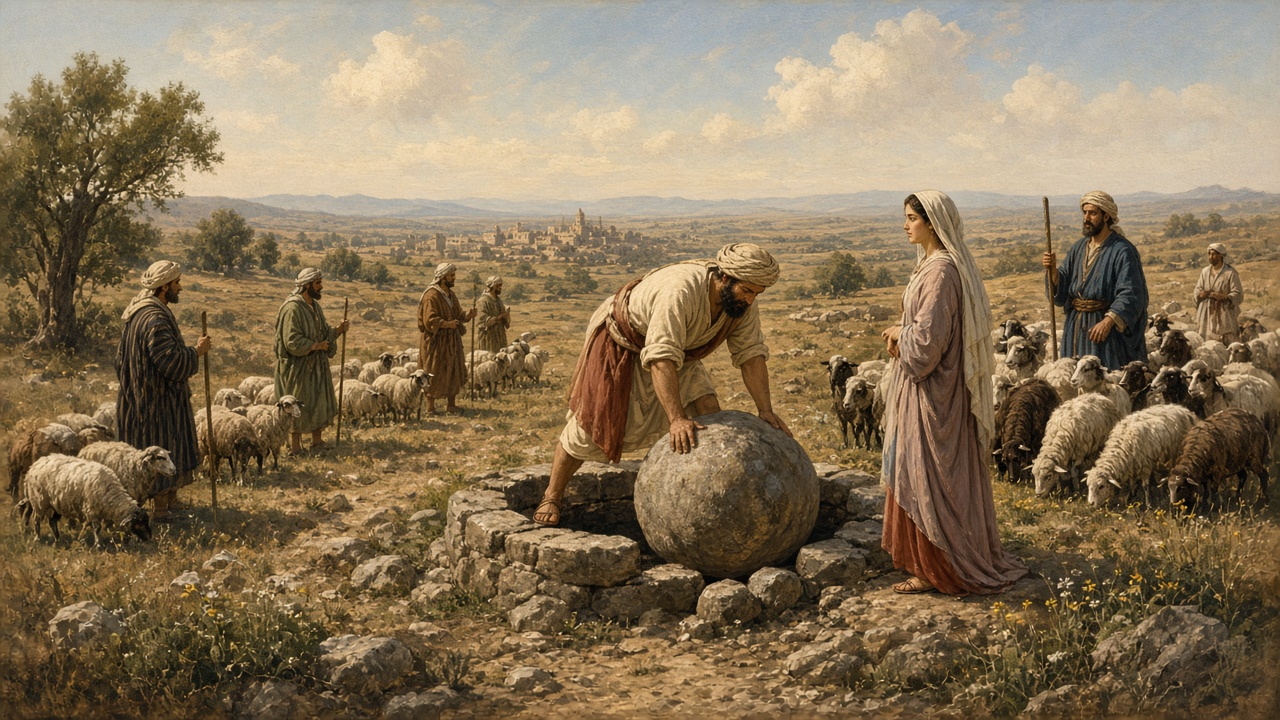
- El pozo estaba cerrado por una gran piedra, que los pastores apartaban solo después de que se habían reunido todos los rebaños, y luego volvían a colocar en su lugar. Raquel, cuyo nombre se da como “oveja”, era pastora y traía las ovejas de su padre; Jacob, que también había vivido como pastor, apartó la piedra y dio de beber al rebaño de su tío.Fuentes: Rachel · Jacob (Israel) · el propio texto bíblico
- Lea, la hermana mayor, es llamada “cansada”, y se la describe como de ojos débiles, o tiernos; Raquel, la menor, era bien formada y hermosa. Jacob sirvió siete años por Raquel, pero en el banquete de la noche Labán le dio a Lea, diciendo que allí no era costumbre entregar en matrimonio a la hija menor antes que a la mayor, y luego le dio a Raquel por otros siete años: catorce en total. Los primeros hijos de Lea fueron Rubén, cuyo nombre se da como “He aquí un hijo”, y después Simeón, Leví y Judá; al nombrarlos, habló de que el SEÑOR veía su aflicción, de que oía que ella no era amada, de que su esposo se apegaría a ella y de su alabanza al SEÑOR.Fuentes: Leah · Rachel · Reuben · el propio texto bíblico
Notas escritas con ayuda de IA a partir de fuentes abiertas (Theographic Bible Metadata, CC BY-SA 4.0; Easton’s Bible Dictionary, dominio público) y revisadas antes de publicarse.
Lugares de este capítulo
- East · Hoy: region around Amman · 31.955, 35.934 · versículo 1
- Haran · Hoy: Harran · 36.864, 39.033 · versículo 4
Solo aparecen lugares identificados con alta confianza (90 % o más según las fuentes académicas reunidas por OpenBible). Mapa de la época: DARE (Digital Atlas of the Roman Empire), CC BY 4.0; mapa actual: © colaboradores de OpenStreetMap; lugares: OpenBible.info (CC BY 4.0).
Créditos y licencia de esta traducción
Ekajuk Scriptures Bible Portions
Ekajuk: Ekajuk Scriptures Bible Portions (Bible)
copyright © 2024 Luke Initiative for Scripture Translation and The Seed Company
Language: Ekajuk
Contributor: Luke Initiative for Scripture Translation
This translation is made available to you under the terms of the
Creative Commons Attribution Share-Alike license 4.0.
You have permission to share and redistribute this Bible translation in any format and to make reasonable revisions and adaptations of this translation, provided that:
You include the above copyright and source information.
If you make any changes to the text, you must indicate that you did so in a way that makes it clear that the original licensor is not necessarily endorsing your changes.
If you redistribute this text, you must distribute your contributions under the same license as the original.
Pictures included with Scriptures and other documents on this site are licensed just for use with those Scriptures and documents.
For other uses, please contact the respective copyright owners.
Note that in addition to the rules above, revising and adapting God's Word involves a great responsibility to be true to God's Word. See Revelation 22:18-19.
2025-07-02
Fuente: http://ebible.org/eka/ · eBible.org