Genesis 29
Ekajuk Scriptures Bible Portions · Tap a verse to see its cross-references.
Jekob rehnge go Padan Aram
1Jekob kehm soro asi go ege eljen tete a ba rehng go ndi nyio nyi anebe ero nfam. 2Owo á kehm nyehne elbing alahb go emahng, a nlong ejoro na era nya noongo o, tibre owo bo jo ka enyam alahb elbing nio. Eltal ni bo ko bulu nnyo elbing alahb nio jolo egburu eltal. 3Ngare nyi bo ma ko ejoro kpee ba wane o, mbaabe ebul kehm bannge eltal nio lennge nnyo elbing alahb, bo ka ejoro alahb, kehm kpe feere a eltal nio bulu. 4Jekob kehm bahbe abaabe ebul re, <<Abonanee, gan wo ń lohng no?>> Bo kehm-e faange re, <<Wahr lohng go Haran.>> 5Á kehm kpe bahb bo re, <<N kpˈkahne Leban ji mmona Nahor jel-e noa?>> Bo kehm faange re, <<Ee, e kp-e kahne.>> 6Owo Jekob kehm bahbe bo re, <<Ye noa nob noba?>> Bo kehm-e faange re, <<Ee, á noa nob nob, nyehn Rasel mmon ewe ga kpˈbake a ejoro. 7Á kehm tongo bo re, <<Njul ga kpeke li ero, ngare ka rehng nyi kehn enyam bahke ba kono edi ajehng, kaan ejoro alahb, wahn feere a bo, bo song li nsol.>> 8Bo kehm-e faange re, <<E nehm ma lim ano, tete bo lˈko atohkondi kpee ba edi ajehng fere bannge eltal nio lennge nnyo elbing alahb. Ngare nyio nyi e bahke ma ka bo alahb.>> 9Ana á kpi mbungu mbungu, ano wo Rasel kehm soro ba rehng a ejoro nde, tibre á jolo mbaabe ebul. 10Eji Jekob nyehne Rasel mmona Leban ji jolo mmonannyehn no nnyehn ewe, a ejoro bi Leban, á kehm song bannge eltal nio lennge nnyo elbing alahb, fere ka ejoro Leban mmonannyehn nnyehn alahb. 11Owo Jekob kehm bingi Rasel, fere kehm kehme ellingi wahre wahre. 12Ngare nyio yebtong Rasel re ye ekunu nde ji, fere tong-e re ye mmon no Rebeka wo. Á kehm beke song tong nde. 13Ana Leban wuku bada Jekob mmona mmonannyehn, á kehm soro be song wan-e. Á kehm-e kake nnyo fere bing-e, kehm-e soro ko ba go ege etahk. Owo Jekob kehm-e tongo nsol kpee bade elkpin ene. 14Owo Leban kehm-e tongo re, <<Wo a me alung amehng ma.>>
Jekob koo Lia a Rasel go elbal
Eji Jekob ma kang a Leban nnyahng kohro kohro, 15Leban kehm bungu tong-e re, <<Anv, a bahk-m lohko loko na loko a na mbol mbol tib esi ji a li ekunu ejama? Tong-m ekun eba, ana m bahk-a jo kpi. 16Leban bele abon abal ba nkal. No nkul bo jo lung-e re Lia, no nse bo jo lung-e re Rasel. 17Lia kpoolo amahr, wo Rasel jolo nkpooda ngbahme, fere nˈnob. 18Rasel wo jo kor Jekob. Á kehm bungu re, <<M bahke limi eltum ka-a go nnya esehma, eji a lˈka-m Rasel, mmon ewa no nse.>> 19Leban kehm bungu re, <<Ga nob re me n ka-a ye, sehnge re me rod-e ka nne nondiki. Jol aname a.>> 20Owo Jekob kehm loko Leban nnya esehma, eji á lˈko Rasel, jolo na are abon afung ba ka Jekob, tib go elkoro ni Rasel jo kor-e. 21Owo Jekob kehm bungu tong Leban re, <<Ka-m nkal ewame. Ngare enyame ebbiingi, n kpˈsebe re me n noongo a ne.>> 22Leban kehm lungu ane ba lene ejahbe re bo ba, kehm ba lim elkak elbal. 23Elgung ba kan a me, á kehm rodo Lia, mmon ewe no nkul ka Jekob, Jekob soro noongo a ne. 24Leban rodo monse nkal no jolo nlokeltum ewe, no bo jo lung-e re Jilpa, ka mmon ewe re á jol nlokeltum ewe. 25Efungfu se kan a me, nyehn Lia nong a Jekobe! Jekob kehm bungu tong Leban re, <<A elkohn ejum ajii á ma-m lim ana? Rasel sang n lok-a no re wo ka-m yea? Jenji wahnge á ma-m nehm?>> 26Owo Leban kehm-e faange re, <<Go egahre eljini, e kpehme gbo mbang rod mmon no nse ka go elbal, kehm tange mmon no nkul. 27Nong erahde ji elkak elbal nia mal, owo e bahk-a kake Rasel a lˈkpe lim eltum go nnya esehma. 28Jekob lohko lim ano. Eji á ma mal erahde ji elkak elbal Lia, owo Leban kehme kake Rasel mmon ewe go elbal. 29Leban rodo monse nkal no jolo nlokeltum ewe, no bo jo lung-e re Bilha ka Rasel mmon re á jol nlokeltum ewe. 30Owo Jekob kehm tob noongo a Rasel, á jo kor-e sehnge Lia. Á kpe lim eltum ka Leban go nnya esehma.
Abon ba Jekob
31Eji Jehova nyehne no re Lia joom kor nlum we, á kehm-e lennge ala njel. Rasel jolo ngum. 32Lia kehm sake ela, jel mmon no nlum. Á gung-e mbing re Ruben, tib á bungu re, <<Jehova ebnyehn erem ebame. Anv, m bahke lohko kor nlum ewame.>> 33Á kehm kpe sa ela. Á jele kan mmon no nlum a, á kehm bungu re, <<tib Jehova wuku re n nehme kor nlum ewame, ji ji wahnge á ma-m kpe ka mmon noa.>> Wahng ka á lung-e re Simion. 34Á kehm kpe sa ela behko. Eji á jele mmon no nlum, á kehm bungu re, <<Anv, nlum ewame bahke jolo bad bad aname, tibre me n jel abon ara ba nlum ka-e.>> Bo gung-e mbing re Levayi. 35Á kehm kpe sa ela. Eji á jele mmon no nlum, á kehm bungu re, <<Anv, m bahke tehke Jehova.>> Owo á kehm-e gungu mbing re Juda. Á kehm rahke njel.
Did you know?
Jacob’s Marriages in Haran
- Jacob fled to Haran, where his uncle Laban lived, in the land of the people of the east. The city, also called the city of Nahor and identified with Harran, stood on the Belik, a tributary of the Euphrates, about seventy miles above the Belik’s junction with that river, in Upper Mesopotamia. Laban was the son of Bethuel and the grandson of Nahor, Abraham’s brother; Laban’s sister Rebekah was Isaac’s wife.Sources: Haran · Laban · Nahor (brother of Abraham) · the Bible text itself
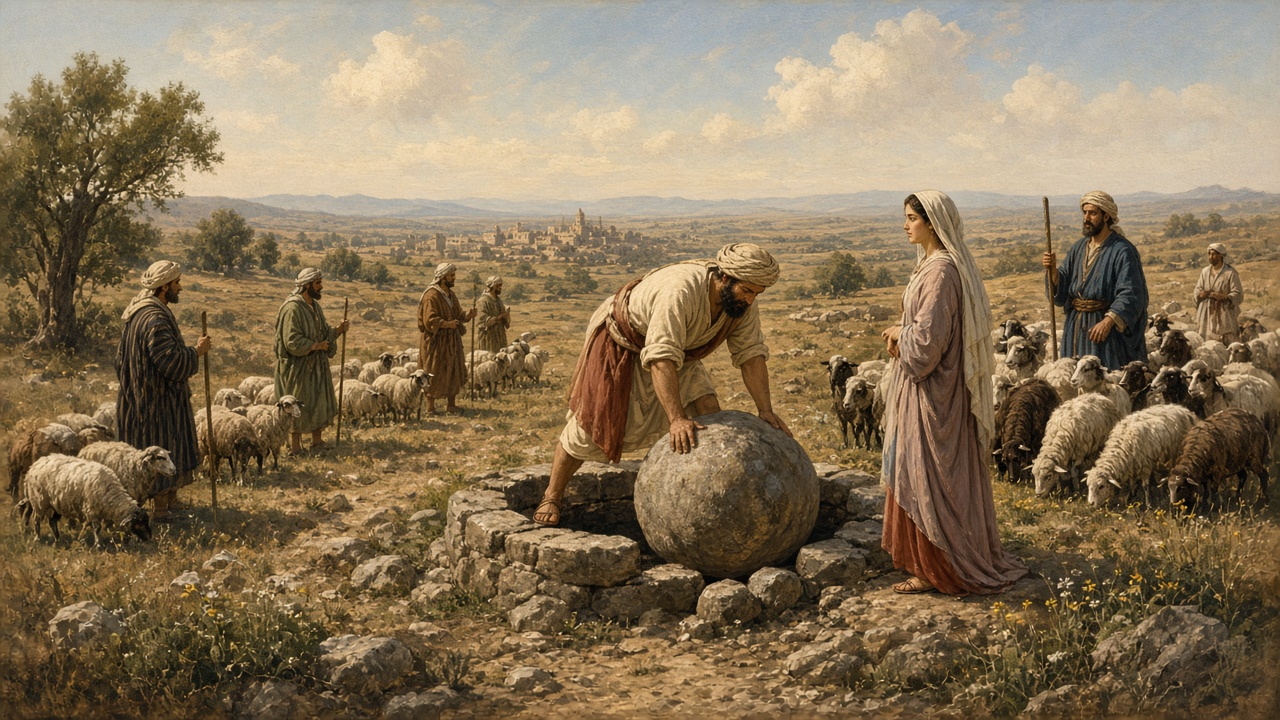
- The well was closed by a large stone that the shepherds rolled away only after all the flocks had gathered, then put back in place. Rachel, whose name is given as “ewe,” was a shepherdess bringing her father’s sheep, and Jacob, who had himself lived as a shepherd, moved the stone and watered his uncle’s flock.Sources: Rachel · Jacob (Israel) · the Bible text itself
- Leah, the elder sister, is called “weary,” and she is described as weak-eyed, or tender-eyed; Rachel, the younger, was shapely and beautiful. Jacob served seven years for Rachel, but at the evening feast Laban gave him Leah, saying it was not the custom there to give the younger daughter in marriage before the older, and then gave him Rachel for another seven years—fourteen in all. Leah’s first sons were Reuben, whose name is given as “Behold a son,” and then Simeon, Levi, and Judah; in naming them she spoke of the LORD seeing her affliction, hearing that she was unloved, her husband becoming attached to her, and her praise of the LORD.Sources: Leah · Rachel · Reuben · the Bible text itself
Notes written with AI assistance from open sources (Theographic Bible Metadata, CC BY-SA 4.0; Easton’s Bible Dictionary, public domain) and reviewed before publishing.
Places in this chapter
- East · Today: region around Amman · 31.955, 35.934 · verse 1
- Haran · Today: Harran · 36.864, 39.033 · verse 4
Only places identified with high confidence are shown (90% or more according to the scholarly sources compiled by OpenBible). Period map: DARE (Digital Atlas of the Roman Empire), CC BY 4.0; modern map: © OpenStreetMap contributors; places: OpenBible.info (CC BY 4.0).
Credits and license for this translation
Ekajuk Scriptures Bible Portions
Ekajuk: Ekajuk Scriptures Bible Portions (Bible)
copyright © 2024 Luke Initiative for Scripture Translation and The Seed Company
Language: Ekajuk
Contributor: Luke Initiative for Scripture Translation
This translation is made available to you under the terms of the
Creative Commons Attribution Share-Alike license 4.0.
You have permission to share and redistribute this Bible translation in any format and to make reasonable revisions and adaptations of this translation, provided that:
You include the above copyright and source information.
If you make any changes to the text, you must indicate that you did so in a way that makes it clear that the original licensor is not necessarily endorsing your changes.
If you redistribute this text, you must distribute your contributions under the same license as the original.
Pictures included with Scriptures and other documents on this site are licensed just for use with those Scriptures and documents.
For other uses, please contact the respective copyright owners.
Note that in addition to the rules above, revising and adapting God's Word involves a great responsibility to be true to God's Word. See Revelation 22:18-19.
2025-07-02
Source: http://ebible.org/eka/ · eBible.org