Isaías 15
LXX2012: Septuagint in British/International English 2012 · Toca un versículo para ver sus referencias cruzadas.
The Burden against Moab
1THE WORD AGAINST THE LAND OF MOAB. By night the land of Moab shall be destroyed; for by night the wall of the land of Moab shall be destroyed. 2Grieve for yourselves; for even Debon, where your altar is, shall be destroyed: there shall you⌃ go up to weep, over Nabau of the land of Moab: howl you⌃: baldness shall be on every head, and all arms shall be wounded. 3Gird yourselves with sackcloth in her streets: and lament upon her roofs, and in her streets, and in her ways; howl all of you with weeping. 4For Esebon and Eleale have cried: their voice was heard to Jassa: therefore the loins of the region of Moab cry aloud; her soul shall know. 5The heart of the region of Moab cries within her to Segor; for it is as a heifer of three years old: and on the ascent of Luith they shall go up to you weeping by the way of Aroniim: she cries, Destruction, and trembling. 6The water of Nemerim shall be desolate, and the grass thereof shall fail: for there shall be no green grass. 7Shall Moab even thus be delivered? for I will bring the Arabians upon the valley, and they shall take it. 8For the cry has reached the border of the region of Moab, even of Agalim; and her howling has gone as far as the well of Aelim. 9And the water of Dimon shall be filled with blood: for I will bring Arabians upon Dimon, and I will take away the seed of Moab, and Ariel, and the remnant of Adama.
¿Sabías que…?
La Profecía sobre Moab
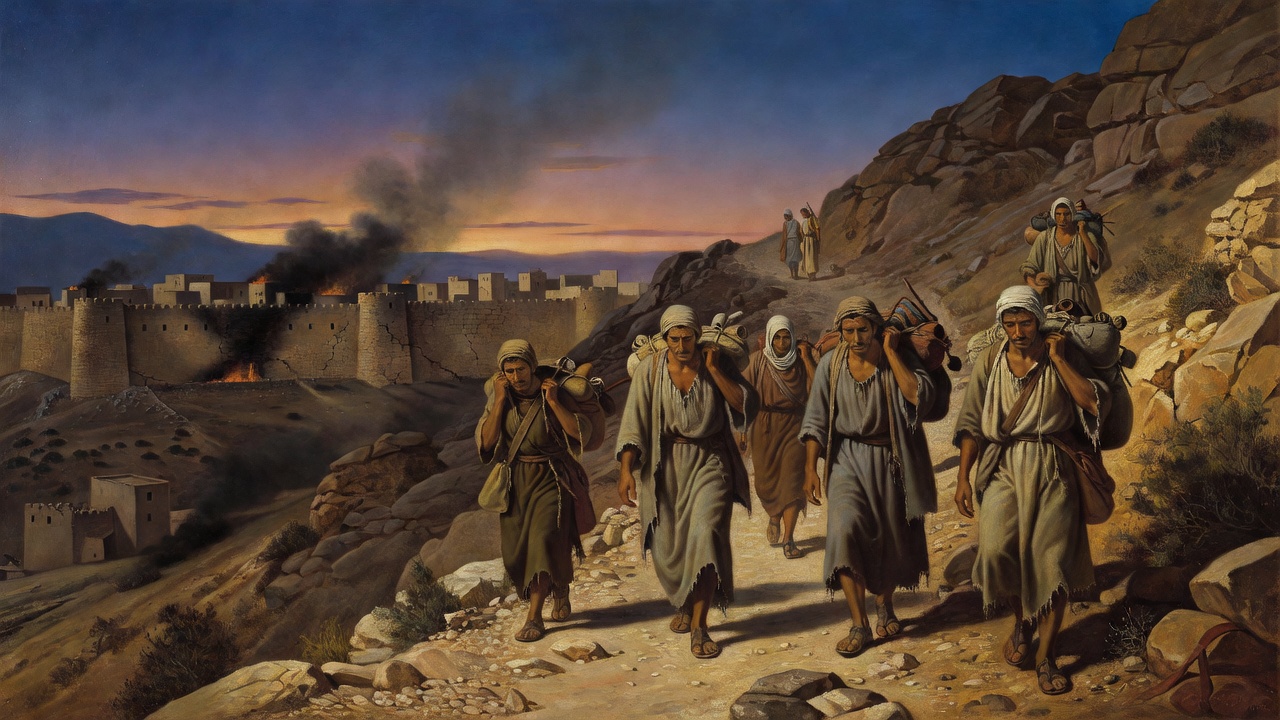
- Moab era una región ubicada al este del Mar Muerto y del río Jordán, que incluía antiguos asentamientos como Ar, Quir y Medeba. En este capítulo, el profeta lamenta la repentina destrucción nocturna y el llanto que recorre las ciudades y los lugares altos moabitas.Fuentes: Moab · Medeba · el propio texto bíblico
- El texto retrata rituales tradicionales de duelo practicados en la región en tiempos de calamidad. Ante la devastación, los habitantes de Moab se rapan la cabeza, se cortan la barba y se visten de cilicio mientras lloran en las plazas y sobre las azoteas.Fuentes: el propio texto bíblico
- La ciudad de Dibón, situada al norte del río Arnón y al este del Mar Muerto, también recibe el nombre de Dimón en Isaías 15:9. El oráculo ilustra la gravedad de la invasión al describir las aguas de Dimón llenas de sangre mientras los fugitivos huyen.Fuentes: Dibon · el propio texto bíblico
Notas escritas con ayuda de IA a partir de fuentes abiertas (Theographic Bible Metadata, CC BY-SA 4.0; Easton’s Bible Dictionary, dominio público) y revisadas antes de publicarse.
Lugares de este capítulo
- Moab · Hoy: Moab 1 · 31.181, 35.701 · versículos 1, 2, 4, 5, 8, 9
- Dibon · Hoy: Tall Dhiban · 31.502, 35.777 · versículo 2
- Medeba · Hoy: Madaba · 31.716, 35.795 · versículo 2
Solo aparecen lugares identificados con alta confianza (90 % o más según las fuentes académicas reunidas por OpenBible). Mapa de la época: DARE (Digital Atlas of the Roman Empire), CC BY 4.0; mapa actual: © colaboradores de OpenStreetMap; lugares: OpenBible.info (CC BY 4.0).
Créditos y licencia de esta traducción
LXX2012: Septuagint in British/International English 2012
The Septuagint with Apocrypha, translated from Greek to English by Sir Lancelot C. L. Brenton and published in 1885, with some language updates (British/International English)
Public Domain
Language: English
Dialect (if applicable): British
Language in English: English
Translation by: Sir Lancelot Charles Lee Breton
LXX2012: Septuagint in English 2012, British/International English Edition
This is a translation of the Old Testament and Apocrypha/Deuterocanon from Hebrew to Greek to 19th Century British English, with some updates of spelling and word usage to contemporary British/International English. The original English translation was done by Sir Lancelot Charles Lee Brenton and published by Samuel Bagster & Sons, Ltd., in London in 1851. It has entered the Public Domain due to the passage of sufficient time. In the process of scanning and typing the text, the original poetry and prose formatting, as well as peripheral material like introductions and notes, have been omitted.
This edition of the Septuagint has some language updates. Brenton's word order and punctuation has been mostly retained, meaning that quotation marks are not used, and sentences within quotes may not start with capital letters, as was standard usage in 1851. Names transliterated from Greek to those transliterated from Hebrew in the common English Bibles often differ. These language updates are dedicated to the Public Domain by the author of those edits, Michael Paul Johnson. Therefore this edition may be freely copied, published, etc.
Before considering making changes to the text of this work, I recommend that you consult with God, because this is really His Book.
If you find errors in the text, please report them so that we can correct them.
Donations to help with the expenses of operating this web site and thus help others have free access to the Word of God may be made to us, but are not required. Please see http://MLJohnson.org/partner/ for more about that.
Títulos de sección adaptados de la Berean Standard Bible (dominio público); no forman parte del texto bíblico de esta traducción.
Fuente: http://ebible.org/eng-uk-lxx2012/ · eBible.org