Isaías 15
LXX2012: Septuagint in British/International English 2012 · Toque num versículo para ver as referências cruzadas.
The Burden against Moab
1THE WORD AGAINST THE LAND OF MOAB. By night the land of Moab shall be destroyed; for by night the wall of the land of Moab shall be destroyed. 2Grieve for yourselves; for even Debon, where your altar is, shall be destroyed: there shall you⌃ go up to weep, over Nabau of the land of Moab: howl you⌃: baldness shall be on every head, and all arms shall be wounded. 3Gird yourselves with sackcloth in her streets: and lament upon her roofs, and in her streets, and in her ways; howl all of you with weeping. 4For Esebon and Eleale have cried: their voice was heard to Jassa: therefore the loins of the region of Moab cry aloud; her soul shall know. 5The heart of the region of Moab cries within her to Segor; for it is as a heifer of three years old: and on the ascent of Luith they shall go up to you weeping by the way of Aroniim: she cries, Destruction, and trembling. 6The water of Nemerim shall be desolate, and the grass thereof shall fail: for there shall be no green grass. 7Shall Moab even thus be delivered? for I will bring the Arabians upon the valley, and they shall take it. 8For the cry has reached the border of the region of Moab, even of Agalim; and her howling has gone as far as the well of Aelim. 9And the water of Dimon shall be filled with blood: for I will bring Arabians upon Dimon, and I will take away the seed of Moab, and Ariel, and the remnant of Adama.
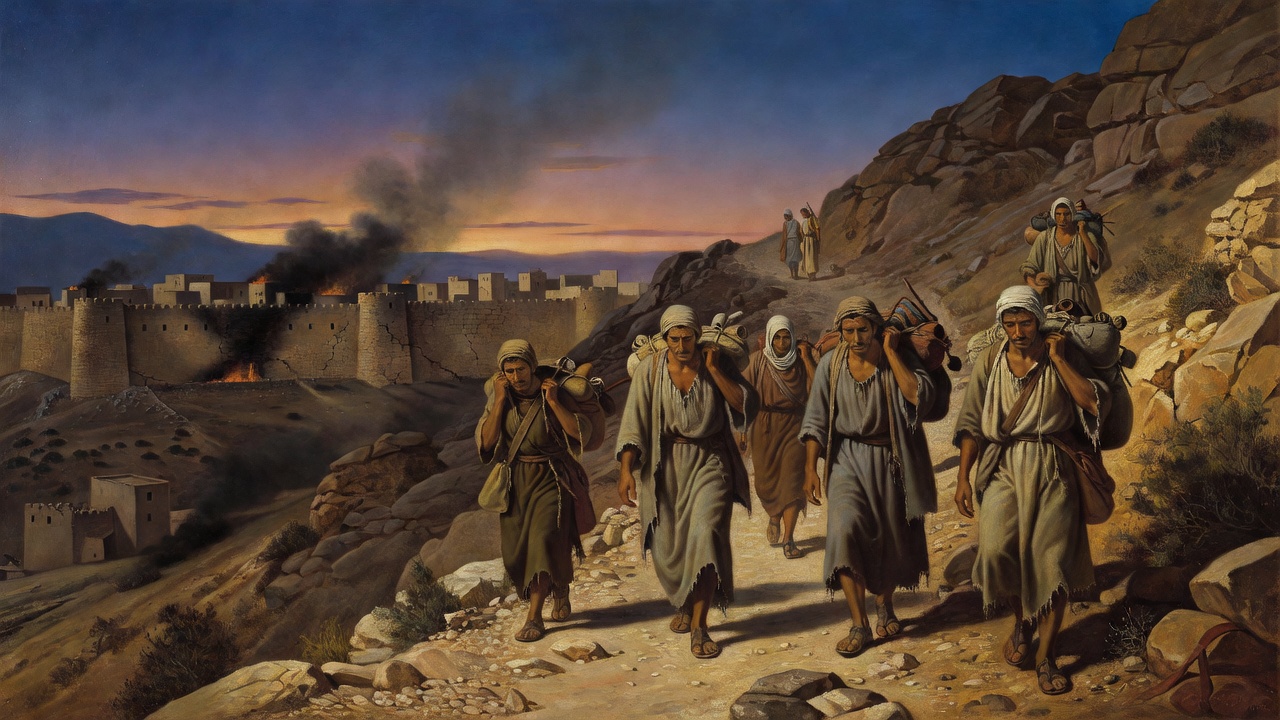
Você sabia?
A Profecia Contra Moabe
- Moabe era um território situado a leste do Mar Morto e do rio Jordão, abrangendo antigos povoados como Ar, Quir e Medeba. Neste capítulo, o profeta lamenta a súbita destruição noturna e o pranto que toma conta dessas cidades e lugares altos moabitas.Fontes: Moab · Medeba · o próprio texto bíblico
- O texto descreve rituais tradicionais de luto praticados na região durante calamidades. Diante da devastação, os moabitas rapam a cabeça, cortam a barba e vestem pano de saco enquanto choram publicamente nas praças e sobre os terraços.Fontes: o próprio texto bíblico
- A cidade de Dibom, situada ao norte do rio Arnom e a leste do Mar Morto, também é chamada de Dimom em Isaías 15:9. O oráculo retrata a gravidade da invasão descrevendo as águas de Dimom cheias de sangue enquanto os fugitivos tentam escapar.Fontes: Dibon · o próprio texto bíblico
Notas escritas com auxílio de IA a partir de fontes abertas (Theographic Bible Metadata, CC BY-SA 4.0; Easton’s Bible Dictionary, domínio público) e revisadas antes de publicar.
Lugares deste capítulo
- Moab · Hoje: Moab 1 · 31.181, 35.701 · versículos 1, 2, 4, 5, 8, 9
- Dibon · Hoje: Tall Dhiban · 31.502, 35.777 · versículo 2
- Medeba · Hoje: Madaba · 31.716, 35.795 · versículo 2
Só aparecem lugares com identificação de alta confiança (90% ou mais segundo as fontes acadêmicas reunidas pelo OpenBible). Mapa da época: DARE (Digital Atlas of the Roman Empire), CC BY 4.0; mapa atual: © colaboradores do OpenStreetMap; lugares: OpenBible.info (CC BY 4.0).
Créditos e licença desta tradução
LXX2012: Septuagint in British/International English 2012
The Septuagint with Apocrypha, translated from Greek to English by Sir Lancelot C. L. Brenton and published in 1885, with some language updates (British/International English)
Public Domain
Language: English
Dialect (if applicable): British
Language in English: English
Translation by: Sir Lancelot Charles Lee Breton
LXX2012: Septuagint in English 2012, British/International English Edition
This is a translation of the Old Testament and Apocrypha/Deuterocanon from Hebrew to Greek to 19th Century British English, with some updates of spelling and word usage to contemporary British/International English. The original English translation was done by Sir Lancelot Charles Lee Brenton and published by Samuel Bagster & Sons, Ltd., in London in 1851. It has entered the Public Domain due to the passage of sufficient time. In the process of scanning and typing the text, the original poetry and prose formatting, as well as peripheral material like introductions and notes, have been omitted.
This edition of the Septuagint has some language updates. Brenton's word order and punctuation has been mostly retained, meaning that quotation marks are not used, and sentences within quotes may not start with capital letters, as was standard usage in 1851. Names transliterated from Greek to those transliterated from Hebrew in the common English Bibles often differ. These language updates are dedicated to the Public Domain by the author of those edits, Michael Paul Johnson. Therefore this edition may be freely copied, published, etc.
Before considering making changes to the text of this work, I recommend that you consult with God, because this is really His Book.
If you find errors in the text, please report them so that we can correct them.
Donations to help with the expenses of operating this web site and thus help others have free access to the Word of God may be made to us, but are not required. Please see http://MLJohnson.org/partner/ for more about that.
Títulos de seção adaptados da Berean Standard Bible (domínio público); não fazem parte do texto bíblico desta tradução.
Fonte: http://ebible.org/eng-uk-lxx2012/ · eBible.org