Isaías 16
LXX2012: Septuagint in British/International English 2012 · Toca un versículo para ver sus referencias cruzadas.
Moab’s Destruction
1I will send as it were reptiles on the land: is not the mount of the daughter of Sion a desolate rock? 2For you shall be as a young bird taken away from a bird that has flown: even you shall be so, daughter of Moab: and then do you, O Arnon, 3take farther counsel, and continually make you a shelter from grief: they flee in darkness at mid-day; they are amazed; be not you led captive. 4The fugitives of Moab shall sojourn with you; they shall be to you a shelter from the face of the pursuer: for your alliance has been taken away, and the oppressing ruler has perished from off the earth. 5And a throne shall be established with mercy; and one shall sit upon it with truth in the tabernacle of David, judging, and earnestly seeking judgements, and hasting righteousness. 6We have heard of the pride of Moab; he is very proud. I have cut off his pride: your prophecy shall not be thus, no not thus. 7Moab shall howl; for all shall howl in the land of Moab: but you shall care for them that dwell in Seth, and you shall not be ashamed. 8The plains of Esebon shall mourn, the vine of Sebama: swallowing up the nations, trample you⌃ her vines, even to Jazer: you⌃ shall not come together; wander you⌃ in the desert: they that were sent are deserted, for they have gone over to the sea. 9Therefore will I weep as with the weeping of Jazer for the vine of Sebama; Esebon and Eleale have cast down your trees; for I will trample on your harvest and on your vintages, and all your plants shall fall. 10And gladness and rejoicing shall be taken away from the vineyards; and they shall not at all tread wine into the vats; for the vintage has ceased. 11Therefore my belly shall sound as a harp for Moab, and you have repaired my inward parts as a wall. 12And it shall be to your shame, (for Moab is wearied at the altars,) that he shall go in to the idols thereof to pray, but they shall not be at all able to deliver him. 13This is the word which the Lord spoke against Moab, when he spoke. 14And now I say, in three years, of the years of an hireling, the glory of Moab shall be dishonoured with all his great wealth; and he shall be left few in number, and not honoured.
¿Sabías que…?
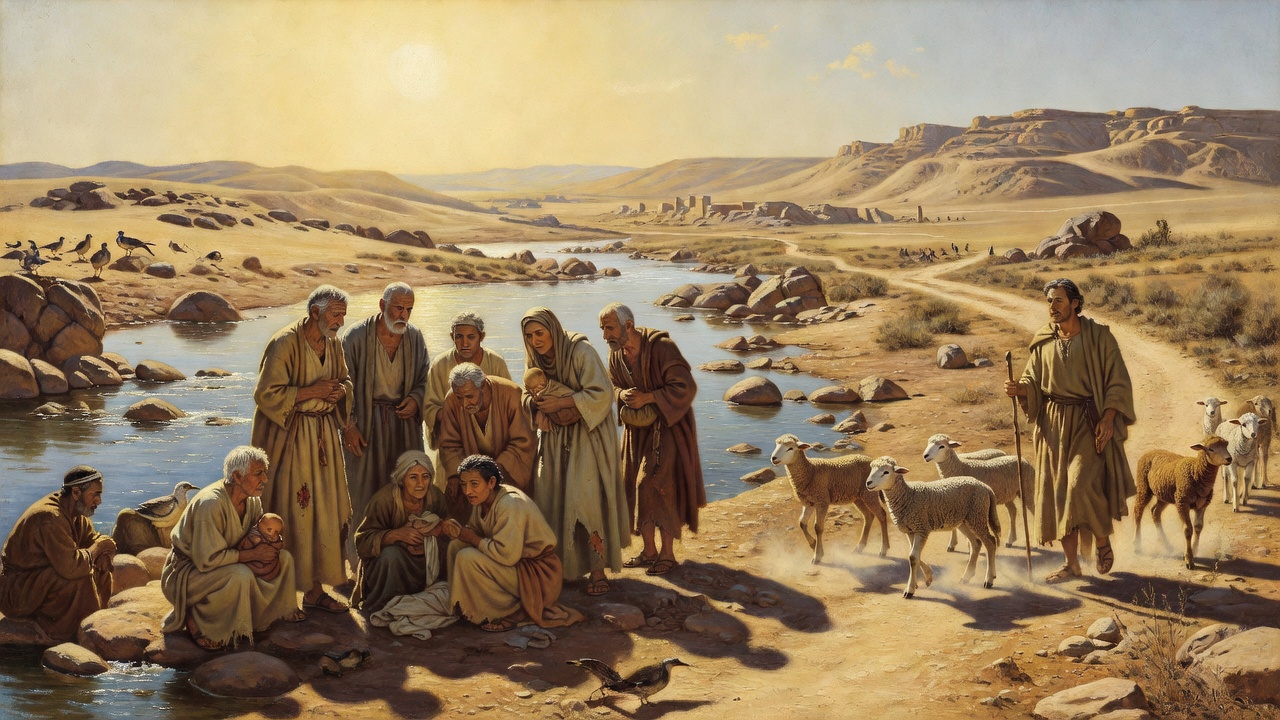
El clamor de Moab y la ruina de sus viñedos
- Se insta a los fugitivos moabitas a buscar refugio enviando corderos de tributo a través del desierto desde Sela hasta el monte Sion en Jerusalén, donde un gobernante justo del linaje de David reina con fidelidad.Fuentes: Sela · Zion · el propio texto bíblico
- El lamento del capítulo se centra en la pérdida de la renombrada viticultura de Moab, llorando las viñas arruinadas y los lagares silenciosos de ciudades como Sibma, Hesbón y Jazer.Fuentes: Sibmah · Heshbon · Jazer · el propio texto bíblico
Notas escritas con ayuda de IA a partir de fuentes abiertas (Theographic Bible Metadata, CC BY-SA 4.0; Easton’s Bible Dictionary, dominio público) y revisadas antes de publicarse.
Lugares de este capítulo
- Zion · Hoy: Jerusalem · 31.777, 35.234 · versículo 1
- Arnon · Hoy: Wadi Mujib · 31.466, 35.573 · versículo 2
- Moab · Hoy: Moab 1 · 31.181, 35.701 · versículos 2, 3, 4, 6, 7, 8, 11, 12, 13, 14
- Salt Sea · Hoy: Dead Sea · 31.500, 35.500 · versículo 8
Solo aparecen lugares identificados con alta confianza (90 % o más según las fuentes académicas reunidas por OpenBible). Mapa de la época: DARE (Digital Atlas of the Roman Empire), CC BY 4.0; mapa actual: © colaboradores de OpenStreetMap; lugares: OpenBible.info (CC BY 4.0).
Créditos y licencia de esta traducción
LXX2012: Septuagint in British/International English 2012
The Septuagint with Apocrypha, translated from Greek to English by Sir Lancelot C. L. Brenton and published in 1885, with some language updates (British/International English)
Public Domain
Language: English
Dialect (if applicable): British
Language in English: English
Translation by: Sir Lancelot Charles Lee Breton
LXX2012: Septuagint in English 2012, British/International English Edition
This is a translation of the Old Testament and Apocrypha/Deuterocanon from Hebrew to Greek to 19th Century British English, with some updates of spelling and word usage to contemporary British/International English. The original English translation was done by Sir Lancelot Charles Lee Brenton and published by Samuel Bagster & Sons, Ltd., in London in 1851. It has entered the Public Domain due to the passage of sufficient time. In the process of scanning and typing the text, the original poetry and prose formatting, as well as peripheral material like introductions and notes, have been omitted.
This edition of the Septuagint has some language updates. Brenton's word order and punctuation has been mostly retained, meaning that quotation marks are not used, and sentences within quotes may not start with capital letters, as was standard usage in 1851. Names transliterated from Greek to those transliterated from Hebrew in the common English Bibles often differ. These language updates are dedicated to the Public Domain by the author of those edits, Michael Paul Johnson. Therefore this edition may be freely copied, published, etc.
Before considering making changes to the text of this work, I recommend that you consult with God, because this is really His Book.
If you find errors in the text, please report them so that we can correct them.
Donations to help with the expenses of operating this web site and thus help others have free access to the Word of God may be made to us, but are not required. Please see http://MLJohnson.org/partner/ for more about that.
Títulos de sección adaptados de la Berean Standard Bible (dominio público); no forman parte del texto bíblico de esta traducción.
Fuente: http://ebible.org/eng-uk-lxx2012/ · eBible.org