Génesis 2
Yak'usda Ooghuni · Toca un versículo para ver sus referencias cruzadas.
1'Awet yak'uz, yun k'ut, 'ink'ez ndai ts'iyawh 'uhoonla, 'i lhaoodinla.
2'Et whulh lht'ak'ant'it dzin suli', 'et Yak'usda (Elohim) be 'ut'en, 'i lhaidinla 'ink'ez whulh lht'ak'ant'it dzin 'et nalyiz. Ndi be 'ut'en 'i ts'iyawh lhaoodinla.
3'Ink'ez Yak'usda (Elohim) whulh lht'ak'ant'it dzin 'et soo hoonzoo-un whulhtsi 'ink'ez 'udun duba neooninla. Njan whulh lht'ak'ant'it dzin 'et nalyiz be 'ut'en 'i ts'iyawh lhaoodinla 'et huwa, Yak'usda (Elohim) ndi 'uyinla 'i lhaoodinla.
4Njan 'et soo 'udechoo whe'whudit'en hukw'elh'az yak'uz 'ink'ez yun k'ut njan dzin Moodihti Yak'usda (Yahweh Elohim) 'en ndi yak'uz 'ink'ez yun k'ut 'uhoonla,
5'awhuz yun whut'an 'ink'ez oomai' hooni-i, 'ink'ez dilht'an-i cha yun k'ut halhusye whe, Moodihti Yak'usda (Yahweh Elohim) nawhulhtih-un 'ink'ez dune yun gha oona' ha hooloh.
6'Et hoonts'i tootsul whuzdli' 'i be yun k'ut naooniltsul.
7'Ink'ez Moodihti Yak'usda (Yahweh Elohim) yun lez 'i dune yulhtsi 'ink'ez be ts'uhuna bulh yuni 'ainyulh 'ink'ez dune khuna suli'.
Yak'usda (Elohim) ba ha'nuyeh k'et 'et dune nenin'az
8Eden huwun ndaz de 'et Moodihti Yak'usda (Yahweh Elohim) 'en ha'nuyeh k'et newhunin'ai. 'Et 'a'nule ink'ez ndun dune yulhtsi, 'en 'et neinilhti.
9Njan yun k'ut Moodihti Yak'usda (Yahweh Elohim) ts'iya-i duchun nul'en huba nzoo-i 'ink'ez ut'alh huba nzoo-i 'ainanla. Duchun oogha ts'ukhuna-i cha whuniz hanuyeh yun 'et 'uyinla. 'Ink'ez ndi duchun be t'eoonudzun ndet hoonzoo 'ink'ez ndet hoontsi' 'et cha.
10'Et ndi took'oh Eden whuts'u hainli, 'i hanuyeh k'et be nawhunultsul, 'et 'ukoh didun lhk'einli whuzdli'.
11Soo 'udechoo whuts'u hainli, 'i Pishon huyulhni, ndi 'i yun k'ut Havilah ndul cho whunadizdli, 'et gold hooni.
12'Ink'ez njan yun k'ut gold 'i unzoo. Bdellium 'ink'ez onyx tse 'i 'et hooni.
13Njan whulhnat took'oh ye dinli, 'i Gihon hiyulhni, 'i 'unt'oh. Yun k'ut Cush, 'et ndulcho whunasuli.
14Bulh ta-i 'ukoh 'i Hiddekel huyulhni, 'i Assyria whanda' ts'e wheinli. Bulh dunghi 'ukoh 'i Euphrates 'unt'oh.
15'Et Moodihti Yak'usda (Yahweh Elohim) hanuyeh k'et Eden 'et dune neninilhti, yughole' 'ink'ez yot'e' ha.
16'Ink'ez Moodihti Yak'usda (Yahweh Elohim) ndun dune khuni yutl'a dan'ai whe nduyulhni, “Ndi duchun ts'iyawh njan hanuyeh 'i on'alh ndet hukwa' ninzin totsuk.
17“Ndi duchun be t'eoonudzun-i, ndet hoonzoo-un, 'ink'ez ndet hoontsi'-un, 'i oomai 'aw lhuzon'al. Ndet dzin in'al-un, 'alha datantsah.”
18'Et Moodihti Yak'usda (Yahweh Elohim) 'utni, “Dune dich'oh 'uhint'oh de 'aw lhe'hoozoo' whe' hoont'oh, yula' tit'elh-un yundult'oh-un ooba 'oosleh si.”
19Ndi yun k'ut 'et Moodihti Yak'usda (Yahweh Elohim) ts'iyai khuna-i, dut'ai ndo yat nudilh, 'i ts'iyawh Adam ts'un nebuninla, 'et nts'en'a hubootazih ha. 'Ink'ez nts'en'a hubonzi', 'i huboozi suli'.
20'Et Adam 'en ndi mudoos, dut'ai ndo yat nudilh, 'ink'ez tl'o k'ut khuna-i, 'i ts'iyawh huboozi' whulhtsi. 'Et 'ink'ez Adam yulh ndult'oh 'en yula 'oot'en hooloh.
21'Ink'ez 'et Moodihti Yak'usda (Yahweh Elohim) Adam bulh cho yuk'edin'ai, 'et Adam nanisti 'ink'ez oocha 'ilhoghi Yak'usda yuts'u haídantan 'ink'ez yutsung lhts'un be naíyunilhni.
22Moodihti Yak'usda (Yahweh Elohim) ndi 'ucha dune ts'u haidantan, 'i ts'eke yulhtsi 'ink'ez dune yughi nilhti.
23'Et Adam 'utni,
“Ndi 'andit sts'un oots'un 'unt'oh
'ink'ez stsung ootsung 'unt'oh,
ts'eke boozi' oole' si,
dune ts'u halti 'et huwa”.
24'Et huwa dune dubá 'ink'ez duloo bulh bula dootnih 'ink'ez du'at bulh 'oot'e 'ink'ez 'ilho yust'e hoole'.
25'Ink'ez nahult'oh 'ust'et, dune 'ink'ez du'at bulh whe 'aw yooya cha lhuhiloh.
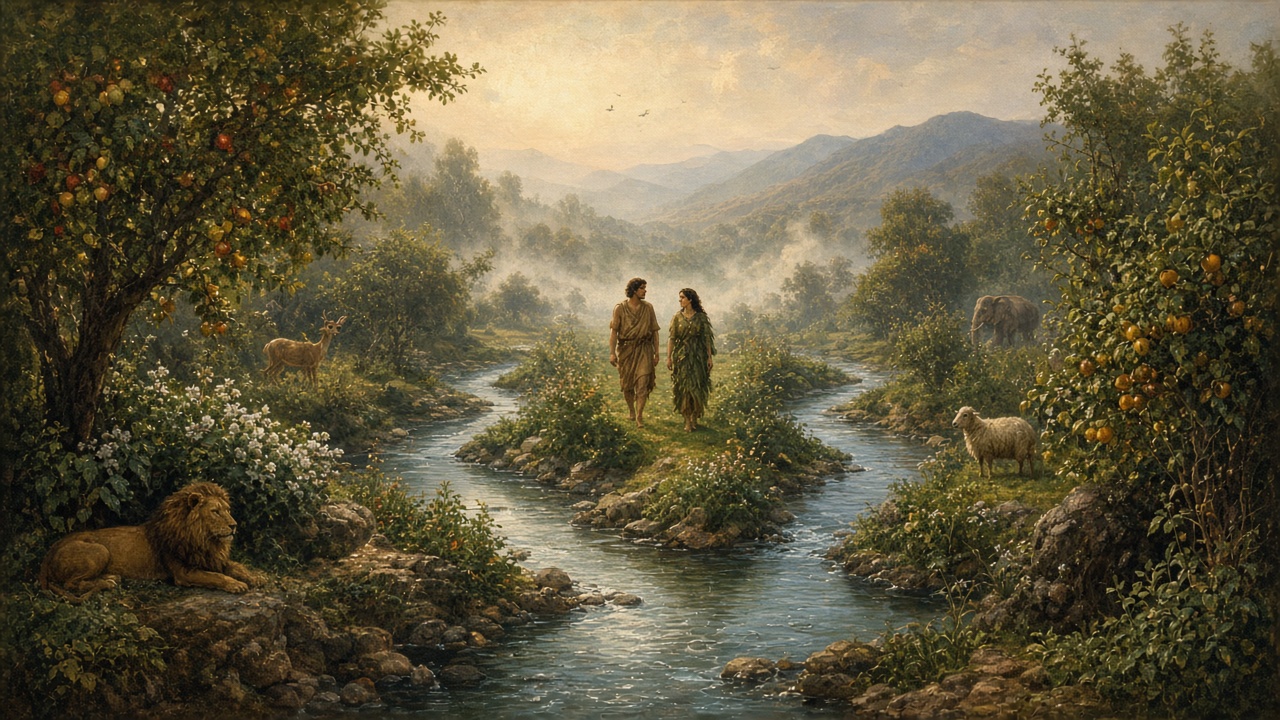
¿Sabías que…?
Adán, el Edén y los cuatro ríos
- Adán, que significa “rojo”, es una palabra babilónica y el nombre común del ser humano, con el mismo sentido en hebreo y en asirio. Se le dio al primer hombre. Fue formado del polvo de la tierra —de ahí el nombre— y Dios sopló en sus narices el aliento de vida.Fuentes: Adam · el propio texto bíblico
- Un río salía del Edén y se dividía en cuatro brazos: el Pisón, el Gihón, el Hidekel y el Éufrates. Algunos identifican el Pisón con el Fasis o el Halis; otros, con el Indo, el Ganges u otros ríos más. El Gihón ha sido identificado con el Nilo, y otros lo consideran el Oxo, el Araxes o el Ganges. El Hidekel es el Tigris, llamado por los acadios el río de Idikla; Gesenius entendió el nombre como “el Tigris rápido”.Fuentes: el propio texto bíblico · Pison · Gihon · Hiddekel
- El sitio del Edén, el jardín en el que vivieron los primeros padres, se ha discutido más que casi cualquier otra cuestión geográfica. Se ha situado en Armenia, en la región al oeste del mar Caspio, en Media, cerca de Damasco, en Palestina, en el sur de Arabia y en Babilonia. El Easton's Bible Dictionary (1897) lo busca a lo largo del Tigris y del Éufrates del Asia occidental, en la tierra de Sinar, o Babilonia.Fuentes: Eden
Notas escritas con ayuda de IA a partir de fuentes abiertas (Theographic Bible Metadata, CC BY-SA 4.0; Easton’s Bible Dictionary, dominio público) y revisadas antes de publicarse.
Lugares de este capítulo
- Assyria · 36.359, 43.153 · versículo 14
- Euphrates · Hoy: Euphrates River · 31.004, 47.442 · versículo 14
- Tigris · Hoy: Tigris River · 31.004, 47.442 · versículo 14
Solo aparecen lugares identificados con alta confianza (90 % o más según las fuentes académicas reunidas por OpenBible). Mapa de la época: DARE (Digital Atlas of the Roman Empire), CC BY 4.0; mapa actual: © colaboradores de OpenStreetMap; lugares: OpenBible.info (CC BY 4.0).
Créditos y licencia de esta traducción
Yak'usda Ooghuni
New Testament in Carrier (CA:crx:Carrier)
copyright © 2011 Wycliffe Bible Translators, Inc.
Language: Carrier
Translation by: Wycliffe Bible Translators, Inc.
Carrier
crx
Canada
Copyright Information
© 2011, Wycliffe Bible Translators, Inc. All rights reserved.
This translation text is made available to you under the
terms of the Creative Commons License: Attribution-Noncommercial-No Derivative Works.
( http://creativecommons.org/licenses/by-nc-nd/3.0/ )
In addition, you have permission to port the text to different file formats, as long as you
do not change any of the text or punctuation of the Bible.
You may share, copy, distribute, transmit, and extract portions
or quotations from this work, provided that you include the above copyright
information:
You must give Attribution to the work.
You do not sell this work for a profit.
You do not make any derivative works that change any of the actual words or punctuation of the Scriptures.
Permissions beyond the scope of this license may be
available if you contact
us with your request.
The New Testament
in Carrier
© 2011, Wycliffe Bible Translators, Inc. All rights reserved.
This translation is made available to you under the terms of the
Creative Commons Attribution-Noncommercial-No Derivatives license 4.0.
You may share and redistribute this Bible translation or extracts from it in any format, provided that:
You include the above copyright and source information.
You do not sell this work for a profit.
You do not change any of the words or punctuation of the Scriptures.
Pictures included with Scriptures and other documents on this site are licensed just for use with those Scriptures and documents.
For other uses, please contact the respective copyright owners.
2014-04-22
Fuente: http://ebible.org/crxNTpo/ · eBible.org