Génesis 3
Yak'usda Ooghuni · Toca un versículo para ver sus referencias cruzadas.
Dune ninta 'ut'ih whuts'unint'i
1'Et tl'ughus 'i lhelhdoh didoh-i Moodihti Yak'usda (Yahweh Elohim) 'uyinla-i unli 'ink'ez ts'eke 'ulhni, “Duchun yun k'ut whuduchun 'aw ts'iyawh lhuzooh'al, ni eh?”
2'Et ts'eke nyoon tl'ughus 'uyulhni, “Nyoo duchun mai' hanuyeh-i, 'i ts'oo'alh huba' hoont'oh,
3'Et hoonts'i hanuyeh k'et whuduchun whuniz nadan'a-i, 'i Yak'usda (Elohim) 'utni, ‘Nyoo duchun mai' 'aw lhuzooh'al, k'us oot'aoohnalh junih, khun si daoohtsah,’” ni.
4'Et ndi tl'ughus, ts'eke 'en 'uyulhni, “'Alha 'aw daoontsah ait'oh.
5Yak'usda (Elohim) t'eooninzun ndet dzin uh'alh-un, hooh'en tihleh 'ink'ez Yak'usda (Elohim) bundutilh'elh, hoonzoo-un 'ink'ez hoontsi'-un cha t'ewhuntahzin.”
6'Et ts'eke duchun ts'u'alh huba unzoo, nul'en huba cha unzoo, duchun ts'uwhunih netilhtselh huba ooka' whuninzun, oomai' yilhchoot 'ink'ez yan'al, duki cha yuloh yutl'a nan'ai 'ink'ez 'en cha yan'al.
7'Et nahult'oh duna be huhon'en suli', 'ink'ez nahult'oh 'ust'et 'uhint'oh t'ehonanzin, mai “fig” huyulhni 'i oot'an lhuna' hidunilhka' 'i be be k'e'uzdla 'uhududulhtsi.
8'Et nawhudunik'az whe Moodihti Yak'usda (Yahweh Elohim) hanuyeh k'et 'oh nuya whe hidits'o 'ink'ez Adam du'at bulh hanuyeh k'et duchun toh Moodihti Yak'usda (Yahweh Elohim) hich'a untilh'i.
9'Et Moodihti Yak'usda (Yahweh Elohim) Adam hahizya 'ink'ez 'uyulhni, “Nts'e 'int'oh”.
10'Et 'utni, “Hanuyeh k'ez nyudasts'o 'ink'ez whenuzjut, 'ust'et 'ust'oh 'et huwa untiz'i.”
11'Ink'ez 'uyulhni, “Mbe 'unyulhni 'ust'et 'int'oh, duchun oomai' uh'alh junih nohdusni-i eh uh'al?”
12'Et dune 'utni, “Ts'eke sgha nilht'i-un duchun oomai' sgha inin'ai 'ink'ez 'i us'al.”
13'Ink'ez Moodihti Yak'usda (Yahweh Elohim) ts'eke 'ulhni, “Dahoont'oh-un dainja?” 'Ink'ez ts'eke 'utni, “Tl'ughus nasunan'a 'ink'ez us'al.”
14'Et Moodihti Yak'usda (Yahweh Elohim) tl'ughus 'ulhni,
“'Et ndinja huwa 'uyoo khuna-i anus nk'ehida whe 'int'oh,
'ink'ez 'uyoo khuna-i chuntoh nulh'as-i anus,
mbut tl'ah whe nukedutanzut,
'ink'ez lhez za tan'ulh, yunka tandalh nduwhulyiz whe.
15'Ink'ez nyun 'ink'ez ts'eke bulh lhazdatni nohtiselh,
'ink'ez nyuzkeh 'ink'ez buzkeh.
Ntsi yayindunta'us 'ink'ez ookentsul duntalhdah.”
16'Et ts'eke 'ulhni,
“Ndzi unduda-un 'ink'ez datant'elh-un 'onus 'uwhulcho whutiselh,
nyulh 'ults'ulh whe nyuzkeh whutaleh,
nki ooka' untanzilh 'ink'ez nyumoodih tileh.”
17'Et Adam 'ulhni,
“N'at oozalhts'ai' 'et huwa 'ink'ez ndi duchun oomai',
‘'On'alh junih,’ nyudusni,
in'al 'et huwa, nyun mba ndi yun 'i ookehida,
'ut'en be oots'u huyukat-i tan'ulh yun ka tandalh ndwhulyiz whe.”
18Whuscho 'ink'ez whusyaz bulh nankilt'oh ook'ut mba hantiyeh,
'ink'ez yun hanuyeh-i tan'ulh.
19Nyunin ts'u halhdzilh whe ut'alh-i on'alh,
yun natandleh whuts'un.
'I oots'u hainzut.
Lhez 'int'oh 'ink'ez lhez 'i ts'un natandleh.”
20'Ink'ez Adam du'at Eve be yoozi, khunane ts'iyawh buloo 'et huwa.
21'Ink'ez Adam oo'at bulh Moodihti Yak'usda (Yahweh Elohim) 'en ndi zuz 'i buba 'uyinla hiye óoke' ha.
22'Et Moodihti Yak'usda (Yahweh Elohim) 'utni, “Nulh'en, dune Neundult'oh suli', hoonzoo-un 'ink'ez hoontsi'-un t'ewhunozin ha. 'Ink'ez 'andit doo ka si dula be ndi duchun oomai' yolhchoot 'ink'ez yoo'alh 'ink'ez 'ilhiz whutinalh.”
23'Et huwa Moodihti Yak'usda (Yahweh Elohim) njan hanuyeh k'et, Eden, 'et tenabunilh'a', 'ink'ez njan yun whut'as tileh 'i oots'u haits'alhti 'et, oot'e' ha.
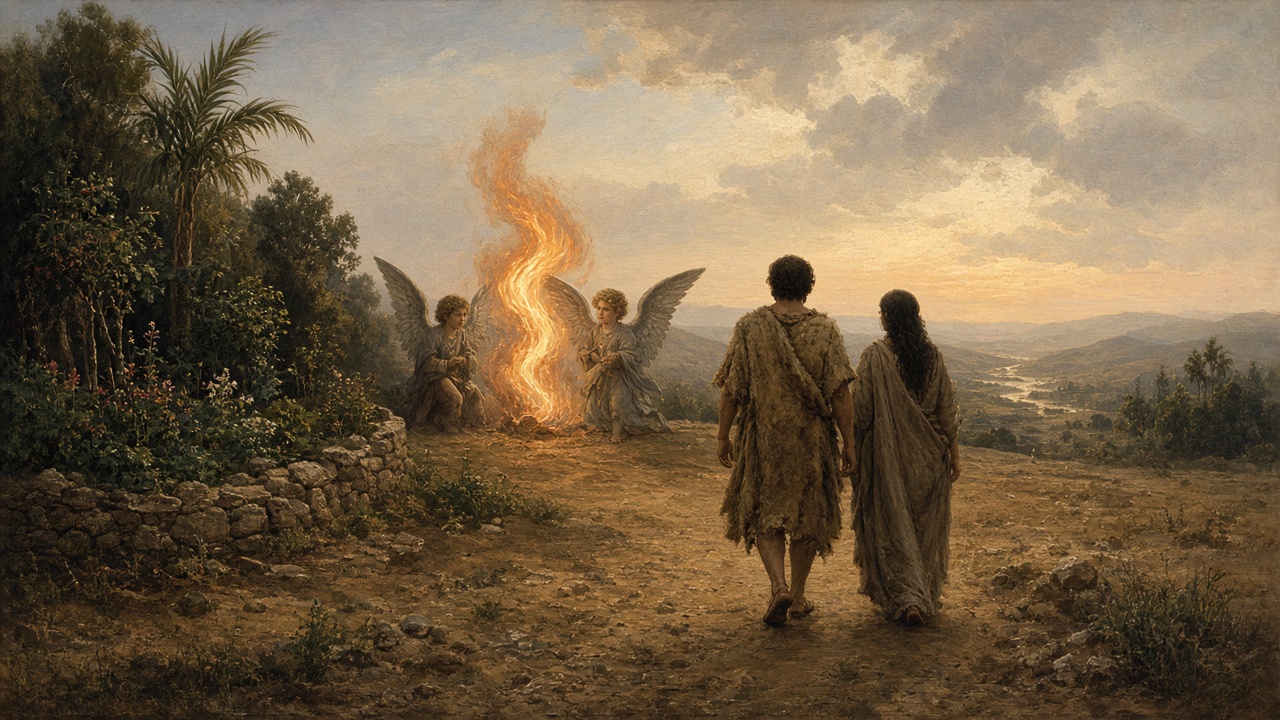
24'Et dune teininyoot 'ink'ez Eden ndaz ts'e 'et lizasne, Cherubne hubulhni, 'et nebunilhti, 'ink'ez saluzti kwun dunukw dot'en lhelhts'un nadighus-i duchun oogha ts'ukhuna-i yughole' ha. none|src="CO00610B.tif" size="col" copy="©1978 David C. Cook" ref="GEN 3.24"
¿Sabías que…?
La caída y el exilio del Edén
- Una referencia tradicional explica Adán como “rojo”, palabra babilónica usada como nombre genérico del hombre, con el mismo sentido en hebreo y en asirio, y relaciona el nombre con el hecho de que fue formado del polvo de la tierra. En este capítulo ese origen reaparece en el juicio: trabajará por su alimento hasta volver al suelo, porque es polvo y al polvo volverá, y es enviado a labrar la tierra de la que fue tomado.Fuentes: Adam · el propio texto bíblico
- En este capítulo Adán da a su mujer el nombre Eva, que significa “vida” o “viviente”, porque ella sería la madre de todos los vivientes.Fuentes: Eve · el propio texto bíblico
- La ubicación del jardín de Edén, del que el hombre es expulsado en este capítulo, se ha discutido mucho: se ha situado en Armenia, al oeste del mar Caspio, en Media, cerca de Damasco, en Palestina, en el sur de Arabia y en Babilonia. Una nota geográfica tradicional lo busca a lo largo del Tigris y el Éufrates, en la tierra de Sinar, o Babilonia.Fuentes: Eden · el propio texto bíblico
Notas escritas con ayuda de IA a partir de fuentes abiertas (Theographic Bible Metadata, CC BY-SA 4.0; Easton’s Bible Dictionary, dominio público) y revisadas antes de publicarse.
Créditos y licencia de esta traducción
Yak'usda Ooghuni
New Testament in Carrier (CA:crx:Carrier)
copyright © 2011 Wycliffe Bible Translators, Inc.
Language: Carrier
Translation by: Wycliffe Bible Translators, Inc.
Carrier
crx
Canada
Copyright Information
© 2011, Wycliffe Bible Translators, Inc. All rights reserved.
This translation text is made available to you under the
terms of the Creative Commons License: Attribution-Noncommercial-No Derivative Works.
( http://creativecommons.org/licenses/by-nc-nd/3.0/ )
In addition, you have permission to port the text to different file formats, as long as you
do not change any of the text or punctuation of the Bible.
You may share, copy, distribute, transmit, and extract portions
or quotations from this work, provided that you include the above copyright
information:
You must give Attribution to the work.
You do not sell this work for a profit.
You do not make any derivative works that change any of the actual words or punctuation of the Scriptures.
Permissions beyond the scope of this license may be
available if you contact
us with your request.
The New Testament
in Carrier
© 2011, Wycliffe Bible Translators, Inc. All rights reserved.
This translation is made available to you under the terms of the
Creative Commons Attribution-Noncommercial-No Derivatives license 4.0.
You may share and redistribute this Bible translation or extracts from it in any format, provided that:
You include the above copyright and source information.
You do not sell this work for a profit.
You do not change any of the words or punctuation of the Scriptures.
Pictures included with Scriptures and other documents on this site are licensed just for use with those Scriptures and documents.
For other uses, please contact the respective copyright owners.
2014-04-22
Fuente: http://ebible.org/crxNTpo/ · eBible.org