Genesis 2
Yak'usda Ooghuni · Tap a verse to see its cross-references.
1'Awet yak'uz, yun k'ut, 'ink'ez ndai ts'iyawh 'uhoonla, 'i lhaoodinla.
2'Et whulh lht'ak'ant'it dzin suli', 'et Yak'usda (Elohim) be 'ut'en, 'i lhaidinla 'ink'ez whulh lht'ak'ant'it dzin 'et nalyiz. Ndi be 'ut'en 'i ts'iyawh lhaoodinla.
3'Ink'ez Yak'usda (Elohim) whulh lht'ak'ant'it dzin 'et soo hoonzoo-un whulhtsi 'ink'ez 'udun duba neooninla. Njan whulh lht'ak'ant'it dzin 'et nalyiz be 'ut'en 'i ts'iyawh lhaoodinla 'et huwa, Yak'usda (Elohim) ndi 'uyinla 'i lhaoodinla.
4Njan 'et soo 'udechoo whe'whudit'en hukw'elh'az yak'uz 'ink'ez yun k'ut njan dzin Moodihti Yak'usda (Yahweh Elohim) 'en ndi yak'uz 'ink'ez yun k'ut 'uhoonla,
5'awhuz yun whut'an 'ink'ez oomai' hooni-i, 'ink'ez dilht'an-i cha yun k'ut halhusye whe, Moodihti Yak'usda (Yahweh Elohim) nawhulhtih-un 'ink'ez dune yun gha oona' ha hooloh.
6'Et hoonts'i tootsul whuzdli' 'i be yun k'ut naooniltsul.
7'Ink'ez Moodihti Yak'usda (Yahweh Elohim) yun lez 'i dune yulhtsi 'ink'ez be ts'uhuna bulh yuni 'ainyulh 'ink'ez dune khuna suli'.
Yak'usda (Elohim) ba ha'nuyeh k'et 'et dune nenin'az
8Eden huwun ndaz de 'et Moodihti Yak'usda (Yahweh Elohim) 'en ha'nuyeh k'et newhunin'ai. 'Et 'a'nule ink'ez ndun dune yulhtsi, 'en 'et neinilhti.
9Njan yun k'ut Moodihti Yak'usda (Yahweh Elohim) ts'iya-i duchun nul'en huba nzoo-i 'ink'ez ut'alh huba nzoo-i 'ainanla. Duchun oogha ts'ukhuna-i cha whuniz hanuyeh yun 'et 'uyinla. 'Ink'ez ndi duchun be t'eoonudzun ndet hoonzoo 'ink'ez ndet hoontsi' 'et cha.
10'Et ndi took'oh Eden whuts'u hainli, 'i hanuyeh k'et be nawhunultsul, 'et 'ukoh didun lhk'einli whuzdli'.
11Soo 'udechoo whuts'u hainli, 'i Pishon huyulhni, ndi 'i yun k'ut Havilah ndul cho whunadizdli, 'et gold hooni.
12'Ink'ez njan yun k'ut gold 'i unzoo. Bdellium 'ink'ez onyx tse 'i 'et hooni.
13Njan whulhnat took'oh ye dinli, 'i Gihon hiyulhni, 'i 'unt'oh. Yun k'ut Cush, 'et ndulcho whunasuli.
14Bulh ta-i 'ukoh 'i Hiddekel huyulhni, 'i Assyria whanda' ts'e wheinli. Bulh dunghi 'ukoh 'i Euphrates 'unt'oh.
15'Et Moodihti Yak'usda (Yahweh Elohim) hanuyeh k'et Eden 'et dune neninilhti, yughole' 'ink'ez yot'e' ha.
16'Ink'ez Moodihti Yak'usda (Yahweh Elohim) ndun dune khuni yutl'a dan'ai whe nduyulhni, “Ndi duchun ts'iyawh njan hanuyeh 'i on'alh ndet hukwa' ninzin totsuk.
17“Ndi duchun be t'eoonudzun-i, ndet hoonzoo-un, 'ink'ez ndet hoontsi'-un, 'i oomai 'aw lhuzon'al. Ndet dzin in'al-un, 'alha datantsah.”
18'Et Moodihti Yak'usda (Yahweh Elohim) 'utni, “Dune dich'oh 'uhint'oh de 'aw lhe'hoozoo' whe' hoont'oh, yula' tit'elh-un yundult'oh-un ooba 'oosleh si.”
19Ndi yun k'ut 'et Moodihti Yak'usda (Yahweh Elohim) ts'iyai khuna-i, dut'ai ndo yat nudilh, 'i ts'iyawh Adam ts'un nebuninla, 'et nts'en'a hubootazih ha. 'Ink'ez nts'en'a hubonzi', 'i huboozi suli'.
20'Et Adam 'en ndi mudoos, dut'ai ndo yat nudilh, 'ink'ez tl'o k'ut khuna-i, 'i ts'iyawh huboozi' whulhtsi. 'Et 'ink'ez Adam yulh ndult'oh 'en yula 'oot'en hooloh.
21'Ink'ez 'et Moodihti Yak'usda (Yahweh Elohim) Adam bulh cho yuk'edin'ai, 'et Adam nanisti 'ink'ez oocha 'ilhoghi Yak'usda yuts'u haídantan 'ink'ez yutsung lhts'un be naíyunilhni.
22Moodihti Yak'usda (Yahweh Elohim) ndi 'ucha dune ts'u haidantan, 'i ts'eke yulhtsi 'ink'ez dune yughi nilhti.
23'Et Adam 'utni,
“Ndi 'andit sts'un oots'un 'unt'oh
'ink'ez stsung ootsung 'unt'oh,
ts'eke boozi' oole' si,
dune ts'u halti 'et huwa”.
24'Et huwa dune dubá 'ink'ez duloo bulh bula dootnih 'ink'ez du'at bulh 'oot'e 'ink'ez 'ilho yust'e hoole'.
25'Ink'ez nahult'oh 'ust'et, dune 'ink'ez du'at bulh whe 'aw yooya cha lhuhiloh.
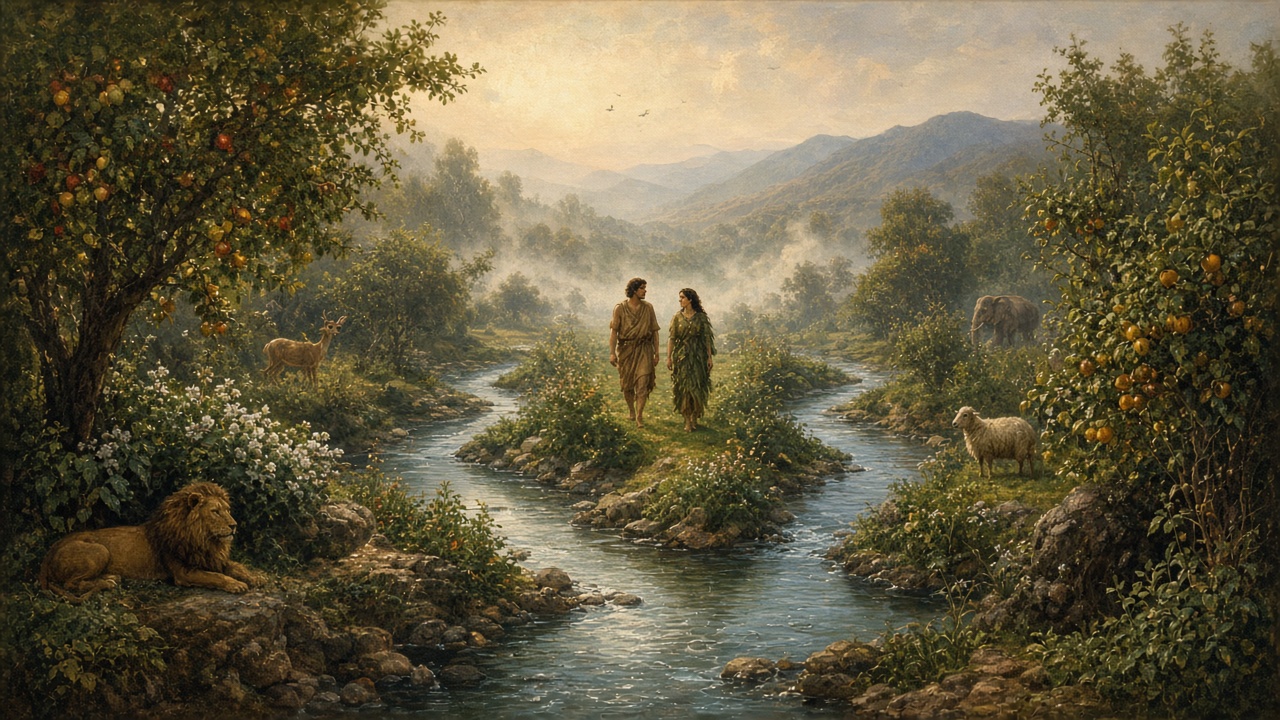
Did you know?
Adam, Eden, and the Four Rivers
- Adam, meaning “red,” is a Babylonian word and the ordinary name for a human being, with the same sense in Hebrew and in Assyrian. It was given to the first man. He was formed from the dust of the ground—hence the name—and God breathed into his nostrils the breath of life.Sources: Adam · the Bible text itself
- A river flowed out of Eden and divided into four headwaters: the Pishon, the Gihon, the Hiddekel, and the Euphrates. Some identify the Pishon with the Phasis or the Halys, others with the Indus, the Ganges, or still other rivers; the Gihon has been identified with the Nile, and others regard it as the Oxus, the Araxes, or the Ganges. The Hiddekel is the Tigris, called by the Accadians the river of Idikla; Gesenius understood the name as “the rapid Tigris.”Sources: the Bible text itself · Pison · Gihon · Hiddekel
- The site of Eden, the garden in which the first parents lived, has been discussed more than almost any other geographical question. It has been placed in Armenia, in the region west of the Caspian Sea, in Media, near Damascus, in Palestine, in southern Arabia, and in Babylonia. Easton's Bible Dictionary (1897) seeks it along the Tigris and the Euphrates of western Asia, in the land of Shinar, or Babylonia.Sources: Eden
Notes written with AI assistance from open sources (Theographic Bible Metadata, CC BY-SA 4.0; Easton’s Bible Dictionary, public domain) and reviewed before publishing.
Places in this chapter
- Assyria · 36.359, 43.153 · verse 14
- Euphrates · Today: Euphrates River · 31.004, 47.442 · verse 14
- Tigris · Today: Tigris River · 31.004, 47.442 · verse 14
Only places identified with high confidence are shown (90% or more according to the scholarly sources compiled by OpenBible). Period map: DARE (Digital Atlas of the Roman Empire), CC BY 4.0; modern map: © OpenStreetMap contributors; places: OpenBible.info (CC BY 4.0).
Credits and license for this translation
Yak'usda Ooghuni
New Testament in Carrier (CA:crx:Carrier)
copyright © 2011 Wycliffe Bible Translators, Inc.
Language: Carrier
Translation by: Wycliffe Bible Translators, Inc.
Carrier
crx
Canada
Copyright Information
© 2011, Wycliffe Bible Translators, Inc. All rights reserved.
This translation text is made available to you under the
terms of the Creative Commons License: Attribution-Noncommercial-No Derivative Works.
( http://creativecommons.org/licenses/by-nc-nd/3.0/ )
In addition, you have permission to port the text to different file formats, as long as you
do not change any of the text or punctuation of the Bible.
You may share, copy, distribute, transmit, and extract portions
or quotations from this work, provided that you include the above copyright
information:
You must give Attribution to the work.
You do not sell this work for a profit.
You do not make any derivative works that change any of the actual words or punctuation of the Scriptures.
Permissions beyond the scope of this license may be
available if you contact
us with your request.
The New Testament
in Carrier
© 2011, Wycliffe Bible Translators, Inc. All rights reserved.
This translation is made available to you under the terms of the
Creative Commons Attribution-Noncommercial-No Derivatives license 4.0.
You may share and redistribute this Bible translation or extracts from it in any format, provided that:
You include the above copyright and source information.
You do not sell this work for a profit.
You do not change any of the words or punctuation of the Scriptures.
Pictures included with Scriptures and other documents on this site are licensed just for use with those Scriptures and documents.
For other uses, please contact the respective copyright owners.
2014-04-22
Source: http://ebible.org/crxNTpo/ · eBible.org