Exodus 7
I tnalù dwata · Tap a verse to see its cross-references.
1Na Dwata i Amu talù di ku Mosis, manan, “Fanbalingta ge gambet deg di fandam Faraon, du ge tmulen i flanekam Aron ku tan i manan di harì ani. 2Tnulenam Aron i kdee dad dekgu ge ani, na kenen i tmulen di ku Faraon toon faloh i dad bel Israél lamwà di banwen Idyif. 3Kabay fgalgu i ulun, na balù fa ku mimò agu i dee tnikeng, 4knean laan flinge ge. Kafnge én, toogu fanlayam i dad to Idyif, na agu sa falwà i dad togu dad bel Israél di banwe Idyif, fagu i dad flayamgu di dad to Idyif. 5Na di kaflayamgu i dad to Idyif, na di kebegu i dad bel Israél lamwà di banwela, gadèla agu sa Dwata i Amu.”
Én man Dwata.
6Na kafnge én, nimen Mosis na Aron i dek Dwata i Amu dale. 7Di bang ktalùla di harì di Idyif, tawalu falò fali Mosis na Aron tawalu falò tlu fali.
I tugad Aron mbaling ulad
8Na man Dwata i Amu di ku Mosis na Aron, 9“Ku fni Faraon kadang i gamtikeng di gamu, dekam ku Aron batan i tugadan di tanà di muna Faraon na mbaling ulad.”
10Kafnge én, salu Mosis na Aron di ku Faraon, na nimenla i dek Dwata i Amu dale. Bat Aron i tugadan di muna Faraon na di dad ganlalan, na tì mbaling ulad. 11Kafnge én, fatlo Faraon i kdee dad to nun gnadè, na dad dademe fulung mimò tnikeng, na fagu di dad gnadèla gamgimò ale salngad nimò Aron. 12Hae, di kbatla i dad tugadla mgimò dad ulad. Kabay i tugad Aron i mbaling ulad gine, fanlon i dademe dad ulad. 13Kabay glut i gman Dwata i Amu, du balù ani tnikeng teenan, mgal fa ulu harì, na laan fanlinge ale Mosis.
I katbù i kaflayam Dwata i dad to Idyif
14Na lêman man Dwata i Amu di ku Mosis, “I ulu Faraon too mgal, na laan faloh i dad bel Israél lamwà di banwe ani. 15Taman fayah flafus salu gamu di kenen di slaan salu di yéél Nilu. Na déén di kilil gufatanyu kenen, na nebeyu i tugad i tambaling ulad. 16Na manyu di kenen, manyu, ‘Dwata i Amu, i Dwata fnangamfù dad to Hibru, mdek gami dini di ge, du stulen di ge, fye faloham lamwà dini i dad ton, fye mangamfù ale di kenen di banwe gulandè to. Kabay kel ani là ge mayè flinge. 17Na man Dwata i Amu, fagu di fanan nimò, gadeam kadang kenen sa Dwata i Amu. Taman bunalgu i tugad ani di tah i yéél ani, na mbaling litè. 18Na di kimògu ani, i dad nalaf mti mati, na i yéél kadang mbaling bun balok, na i dad to Idyif là ale kadang gamginum i yéél ani.’ ”
19Na fadlug talù Dwata i Amu di ku Mosis, manan, “Tnulenam Aron tdoan kadang i tugadan di kdee dad yéél, i dad yéél maloh di gusambang i tanà, i dad ktufa, na dad tunà di Idyif ani, na i dad yéél ani mbaling litè. Maloh i litè ani kadang di klamang Idyif, balù i yéél di gumusekla mbaling litè.”
Yéél Nilu mbaling litè
20Di kafnge talù Dwata, nimen Mosis na Aron i kdee dek Dwata i Amu dale. Di muna i harì na dad ganlalan bunal Aron i tugad di tah i yéél Nilu, na tì mbaling litè. 21Mti mati i dad nalaf, na i yéél ani mbaling litè gine too bun balok, taman i dad to Idyif talà gamginum i yéélan. Na maloh litè di klamang Idyif. 22Kabay i dad to nun gnadè di Idyif, fagu di dale gnadè, gamgimò ale salngad nimò Aron. Taman glut i gman Dwata i Amu, du mgal fa ulu Faraon, na laan flinge ku Mosis na Aron. 23Baling samfulê i harì di bong gumnean, na fbayaan i mgimò ale Mosis gine. 24Na i dad to Idyif makol ale i dad ktufa di kilil i yéél Nilu, du fye gamwè ale yéél ninumla, du talà ginum sa i yéél mdà di laweh i yéél ani.
I kagsut dad fak
25Takubu i fitu duh, kafnge Dwata i Amu fbalingan litè i yéél.
Did you know?
Moses and Aaron before Pharaoh
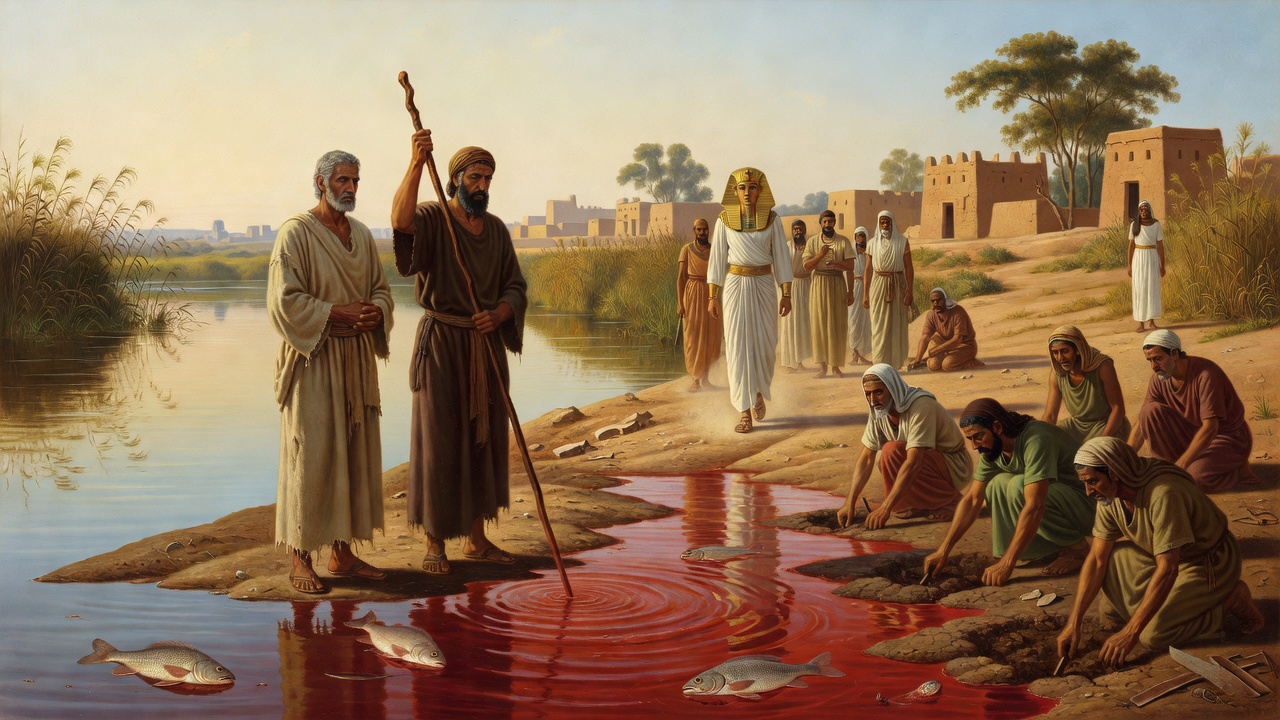
- Moses was eighty years old and Aaron eighty-three when they spoke to Pharaoh. Easton's Bible Dictionary (1897) notes that Aaron, the eldest son of Amram and Jochebed, was born in Egypt three years before his brother Moses. In this chapter the LORD says he has made Moses "like God to Pharaoh," with Aaron as his prophet: Moses is to speak all that he is commanded, and Aaron is to tell Pharaoh to let the Israelites leave his land.Sources: the Bible text itself · Aaron
- Easton's Bible Dictionary (1897) notes that the name Nile is not found in Scripture; the Old Testament calls that river Sihor, "the black stream," or simply "the river," and also "the flood of Egypt." The Nile is formed by the White Nile and the Blue Nile, which meet at Khartoum, and it is the water Aaron strikes in this chapter. The fish died, the river stank, the Egyptians could not drink it and dug around the Nile for water, and seven full days passed.Sources: Nile · the Bible text itself
- Easton's Bible Dictionary (1897) says the Pharaoh of the Exodus was probably Menephtah I, the fourteenth and eldest surviving son of Rameses II, and that he resided at Zoan, where he had the interviews with Moses and Aaron recorded in Exodus. The same entry leaves the identification open: it is still a question whether Seti II or his father Menephtah was that Pharaoh, and some think the evidence favors Seti II.Sources: Pharaoh (of the Exodus) · the Bible text itself
Notes written with AI assistance from open sources (Theographic Bible Metadata, CC BY-SA 4.0; Easton’s Bible Dictionary, public domain) and reviewed before publishing.
Places in this chapter
- Egypt · 30.129, 31.308 · verses 3, 4, 5, 11, 19, 21, 22
- Nile · Today: Nile River · 31.465, 30.367 · verses 15, 17, 18, 20, 21, 24, 25
Only places identified with high confidence are shown (90% or more according to the scholarly sources compiled by OpenBible). Period map: DARE (Digital Atlas of the Roman Empire), CC BY 4.0; modern map: © OpenStreetMap contributors; places: OpenBible.info (CC BY 4.0).
Credits and license for this translation
I tnalù dwata
New Testament in Blaan, Sarangani
copyright © 1998 Wycliffe Bible Translators, Inc.
Language: Sarangani Blaan (Blaan, Sarangani)
Translation by: Wycliffe Bible Translators
Contributor: Wycliffe Bible Translators, Inc.
Copyright Information
© 1998, Wycliffe Bible Translators, Inc. All rights reserved.
This translation text is made available to you under the
terms of the Creative Commons License: Attribution-Noncommercial-No Derivative Works.
( http://creativecommons.org/licenses/by-nc-nd/3.0/ )
In addition, you have permission to port the text to different file formats, as long as you
do not change any of the text or punctuation of the Bible.
You may share, copy, distribute, transmit, and extract portions
or quotations from this work, provided that you include the above copyright
information:
You must give Attribution to the work.
You do not sell this work for a profit.
You do not make any derivative works that change any of the actual words or punctuation of the Scriptures.
Permissions beyond the scope of this license may be
available if you contact
us with your request.
The New Testament
in Blaan, Sarangani
© 1998, Wycliffe Bible Translators, Inc. All rights reserved.
This translation is made available to you under the terms of the
Creative Commons Attribution-Noncommercial-No Derivatives license 4.0.
You may share and redistribute this Bible translation or extracts from it in any format, provided that:
You include the above copyright and source information.
You do not sell this work for a profit.
You do not change any of the words or punctuation of the Scriptures.
Pictures included with Scriptures and other documents on this site are licensed just for use with those Scriptures and documents.
For other uses, please contact the respective copyright owners.
2015-03-17
Source: http://ebible.org/bps/ · eBible.org