Philemon 1
Biblica® Open Nueva Biblia Viva 2008 · Tap a verse to see its cross-references.
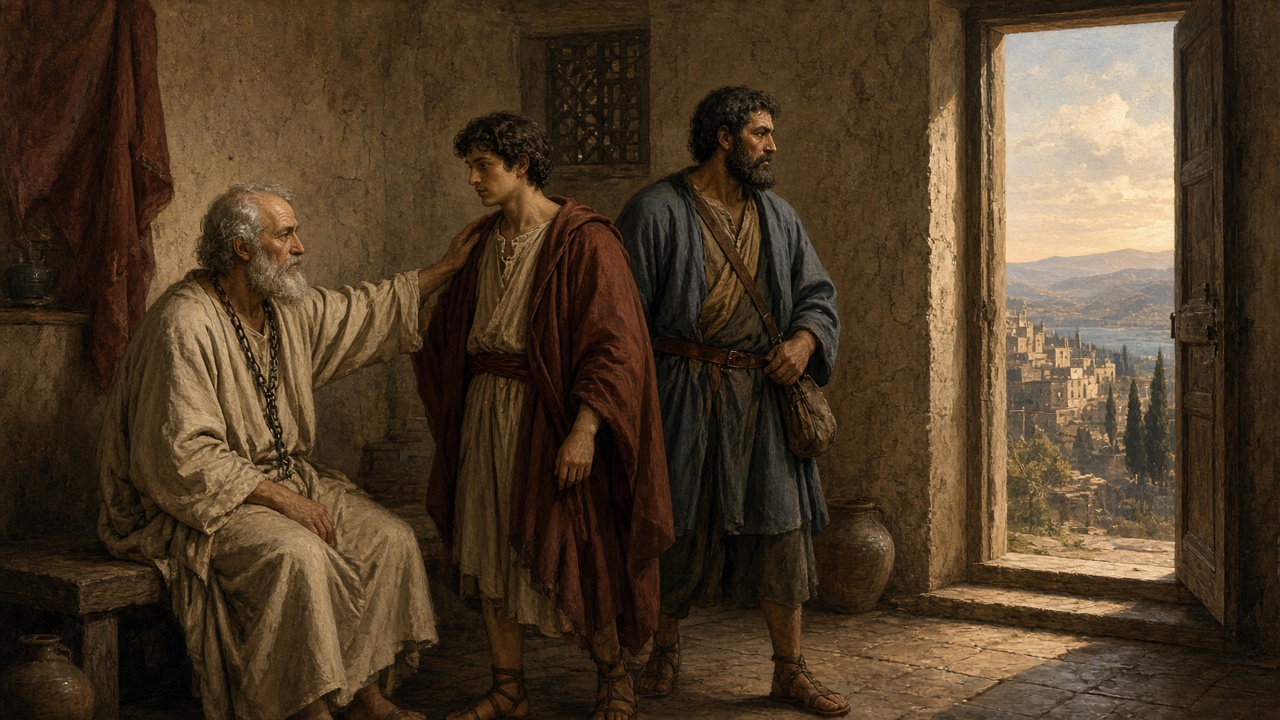
About this book
About Philemon
- Easton's Bible Dictionary (1897) presents the Letter to Philemon as written by Paul from Rome, at the same time as the letters to the Colossians and the Ephesians, and sent by Onesimus.Sources: Easton: Philemon, Epistle to
- It is addressed to Philemon, an inhabitant of Colosse described as a person of some note, whom Paul had brought to the gospel, and to the members of his family. Apphia, a Christian woman at Colosse, is supposed by some to have been his wife, and Archippus, called Paul's "fellow-soldier," is described as a member of the household, probably his son. Philemon is called a "fellow-labourer," a title that at least marks his part in spreading the gospel, and he held a prominent place in the Christian community for his piety and generosity.Sources: Easton: Philemon, Epistle to · Philemon · Apphia · Archippus
- The letter intercedes for Onesimus, whose name the dictionary renders "Useful": a slave who robbed his master Philemon at Colosse and fled to Rome, having deserted him and been "unprofitable" to him. There Paul found him and converted him, then sent him back with this letter. Paul asks that Philemon receive him as a "faithful and beloved brother," and offers to repay anything taken and to bear the wrong done.Sources: Easton: Philemon, Epistle to · Onesimus
- Easton calls this a strictly private letter, the only one of its kind preserved, and says that in it Paul throws off, as far as possible, his apostolic dignity and his fatherly authority over his converts, speaking simply as Christian to Christian. Onesimus was accompanied on his return by Tychicus, bearer of the letter to the Colossians. The same dictionary presents the fugitive's story as evidence that visitors were freely allowed to see Paul in his imprisonment at Rome, where Epaphras and Aristarchus are also named as his fellow-prisoners.Sources: Easton: Philemon, Epistle to · Onesimus · Epaphras · Aristarchus
Notes written with AI assistance from open sources (Theographic Bible Metadata, CC BY-SA 4.0; Easton’s Bible Dictionary, public domain) and reviewed before publishing.
1Pablo, prisionero por amor de Jesucristo, y el hermano Timoteo, a ti, Filemón, amado colaborador, 2y a la iglesia que se reúne en tu casa, a la hermana Apia y a Arquipo, compañero de lucha:
3Que Dios nuestro Padre y el Señor Jesucristo derramen en ustedes amor y paz.
Acción de gracias y petición
4Siempre doy gracias a mi Dios cuando te recuerdo en mis oraciones, 5porque me han hablado del amor y de la fidelidad que profesas al Señor Jesús y a todos los que son del pueblo santo de Dios. 6Ruego a Dios que la fe que tenemos en común te lleve a darte cuenta de cuántas cosas buenas podemos hacer por amor a Cristo. 7Yo mismo he hallado gran gozo y consuelo en tu amor, hermano mío, porque los corazones de los que pertenecen al pueblo santo de Dios han hallado refrigerio en tu bondad.
Intercesión de Pablo por Onésimo
8Por eso, aunque podría ordenarte lo que debes hacer en el nombre de Cristo, 9prefiero rogártelo en nombre del amor. Yo, Pablo, anciano ya y preso por la causa de Cristo, 10te suplico por mi hijo Onésimo, el cual llegó a ser hijo mío en mis prisiones.
11Él no te ha sido útil en el pasado, pero ahora nos es útil a ti y a mí. 12Te lo mando de regreso y con él te envío mi propio corazón. 13Hubiera querido retenerlo conmigo en esta prisión en la que estoy por predicar el evangelio, pues así me habría ayudado en lugar tuyo. 14Pero preferí no hacerlo sin tu consentimiento, pues no me gustan los favores forzados.
15Quizás Onésimo huyó de ti precisamente para que lo recuperaras para siempre, 16y ya no como esclavo sino como algo mucho mejor: como hermano amado. Para mí, él es muy especial. Ahora tienes razón para apreciarlo mucho más, no sólo como persona sino también como tu hermano en el Señor.
17Si de veras me consideras tu amigo, recíbelo con el mismo afecto con que me recibirías a mí. 18Si te hizo algún mal o si te robó algo, cárgalo a mi cuenta. 19Yo, Pablo, lo pagaré; y para constancia escribo esto con mi puño y letra. ¡No creo que sea necesario recordarte que tú a mí me debes lo que eres!
20Sí, hermano, alegra mi corazón en Cristo con este gesto de amor que te pido en el Señor. 21Te he escrito esta carta porque estoy seguro de que harás lo que te pido y mucho más. 22Ten una habitación lista para mí, pues espero que Dios contestará las oraciones de ustedes y permitirá que pronto vaya a verlos.
23Epafras, mi compañero de prisión por amor a Cristo Jesús te saluda. 24Marcos, Aristarco, Demas y Lucas, mis colaboradores, te envían saludos también.
25Que el amor del Señor Jesucristo se derrame sobre ustedes.
Did you know?
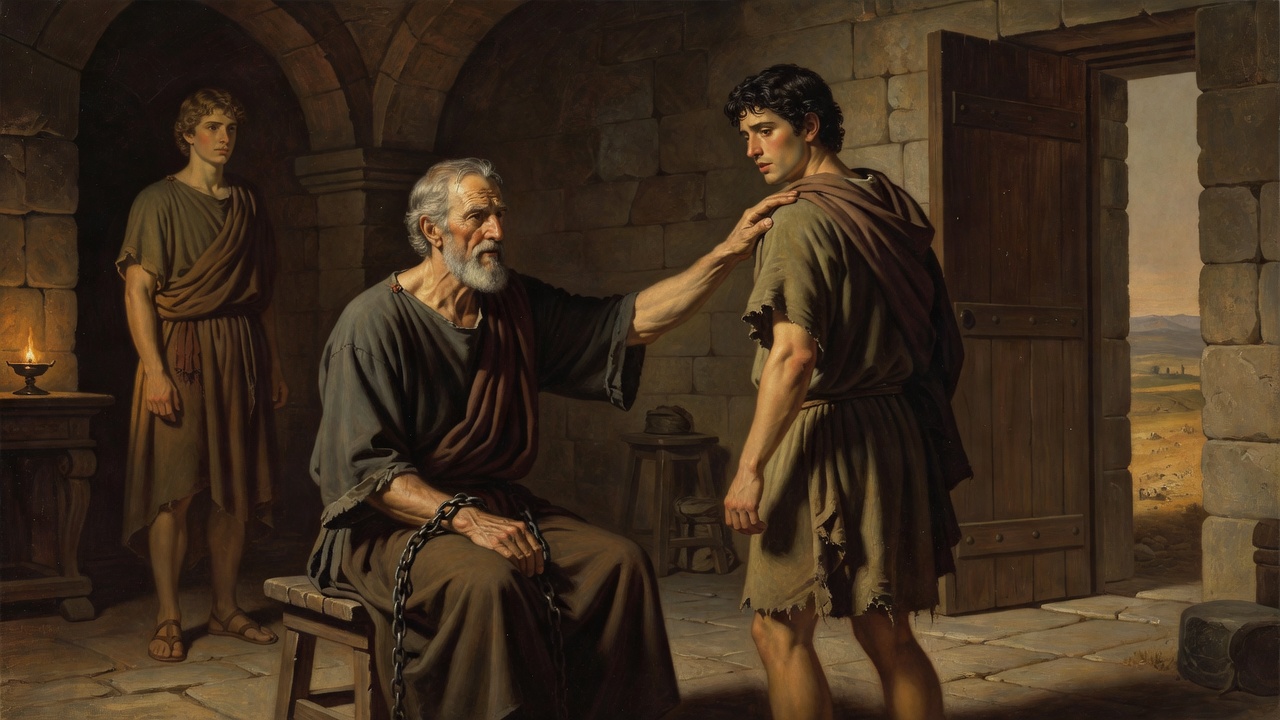
Paul’s Appeal for Onesimus
- Onesimus, whose name means Useful, was a slave of Philemon at Colosse. After robbing his master he fled to Rome, where Paul, then a prisoner, became his father in the faith and sent him back with this letter. Paul asks that he be received no longer as a slave but as a beloved brother, offers to repay anything owed, and, echoing a name that means Useful, says he was once useless but is now useful to both of them.Sources: Onesimus · Philemon · the Bible text itself
- Besides Philemon, whom Paul calls a beloved fellow worker, the letter greets Apphia, Archippus, and the church that meets in the house. Apphia was a Christian woman at Colosse, supposed by some to have been Philemon’s wife. Archippus, called a fellow soldier, belonged to Philemon’s family and was probably his son.Sources: Apphia · Archippus · Philemon · the Bible text itself
- Paul writes as an aged prisoner of Christ Jesus, still in chains, and says he is recording the promise of repayment in his own hand. Greetings come from Epaphras, his fellow prisoner, who was with him at Rome, and from Mark, Aristarchus, Demas, and Luke. Aristarchus is also described as Paul’s fellow prisoner at Rome, and Onesimus’s access to Paul shows the freedom visitors had to approach the prisoner.Sources: Epaphras · Aristarchus · Onesimus · the Bible text itself
Notes written with AI assistance from open sources (Theographic Bible Metadata, CC BY-SA 4.0; Easton’s Bible Dictionary, public domain) and reviewed before publishing.
Credits and license for this translation
Biblica® Open Nueva Biblia Viva 2008
The Holy Bible in Spanish: Biblica® Open Nueva Biblia Viva 2008 (Bible)
copyright © 2008 Biblica, Inc.
Language: Español
Contributor: Biblica, Inc.
Biblica® Open Nueva Biblia Viva™
Copyright © 2006, 2008 by Biblica, Inc.
“Biblica” es una marca registrada en la oficina de Patentes y Marcas de los Estados Unidos por Biblica, Inc. Usado con permiso.
“Biblica” is a trademark registered in the United States Patent and Trademark Office by Biblica, Inc. Used with permission.
Creative Commons license
This work is made available under the Creative Commons Attribution-ShareAlike 4.0 International License (CC BY-SA). To view a copy of this license, visit https://creativecommons.org/licenses/by-sa/4.0 or send a letter to Creative Commons, PO Box 1866, Mountain View, CA 94042, USA.
You have permission to copy and distribute this Work, as long as you do not change it and you keep the title as it is. Changing or translating this Work will create a derivative work. When you publish this derivative work, you must list what changes you have made where people can see them, such as on a website. You must also show where the original Work is from: “The original Work by its copyright holders is available for free at www.biblica.com and open.bible .”
Notice of copyright must appear on the title or copyright page of the work as follows:
Biblica® Open Nueva Biblia Viva™
Copyright © 2006, 2008 by Biblica, Inc.
“Biblica” es una marca registrada en la oficina de Patentes y Marcas de los Estados Unidos por Biblica, Inc. Usado con permiso.
“Biblica” is a trademark registered in the United States Patent and Trademark Office by Biblica, Inc. Used with permission.
You must also make your derivative work available under the same license (CC BY-SA).
If you would like to notify Biblica, Inc. regarding your translation of this work, please contact us at https://open.bible/#feedback .
This translation is made available to you under the terms of the
Creative Commons Attribution Share-Alike license 4.0.
You have permission to share and redistribute this Bible translation in any format and to make reasonable revisions and adaptations of this translation, provided that:
You include the above copyright and source information.
If you make any changes to the text, you must indicate that you did so in a way that makes it clear that the original licensor is not necessarily endorsing your changes.
If you redistribute this text, you must distribute your contributions under the same license as the original.
Pictures included with Scriptures and other documents on this site are licensed just for use with those Scriptures and documents.
For other uses, please contact the respective copyright owners.
Note that in addition to the rules above, revising and adapting God's Word involves a great responsibility to be true to God's Word. See Revelation 22:18-19.
2025-05-21
Source: http://ebible.org/spaonbv/ · eBible.org