Genesis 29
Biblica® Open Nueva Biblia Viva 2008 · Tap a verse to see its cross-references.
Jacob llega a Padán Aram
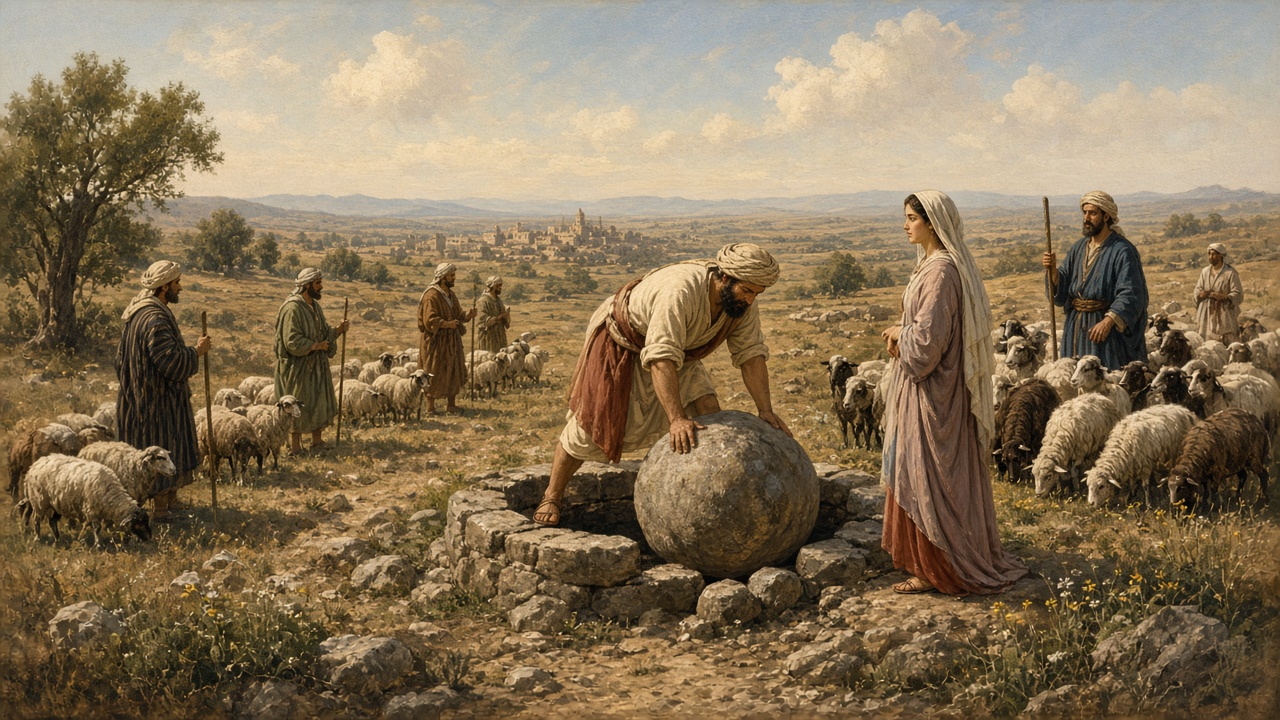
1Jacob continuó el viaje hasta que llegó finalmente a la tierra ubicada al este del río Jordán. 2Allí en el campo vio un pozo. Junto al pozo se encontraban tres rebaños de ovejas, pues era de allí que bebían agua. El pozo estaba tapado con una piedra muy grande. 3Sólo cuando se reunían todos los pastores con sus rebaños era que quitaban la piedra. Una vez que las ovejas bebían, los pastores volvían a colocar la piedra sobre la boca del pozo. 4Jacob se acercó a los pastores y les preguntó:
―Amigos, ¿dónde viven ustedes?
―Vivimos en Jarán —dijeron.
5―¿Conocen a un tal Labán hijo de Najor? —les volvió a preguntar.
―¡Claro que sí lo conocemos! —le contestaron.
6Jacob continuó preguntando:
―¿Cómo está?
―Está bien y ha prosperado. Mira, allí viene su hija Raquel con las ovejas —le dijeron los pastores.
7―Falta mucho para que se oculte el sol, y todavía es muy temprano para que encierren sus rebaños. ¿Por qué no le dan de beber al ganado para que sigan pastando antes de llevarlos a dormir? —preguntó Jacob.
8―Porque tenemos un acuerdo de que sólo quitaremos la piedra cuando ya estén juntos todos los rebaños. Sólo hasta ese momento podremos darles de beber a las ovejas —contestaron.
9Mientras conversaban, llegó Raquel con las ovejas de su padre, porque ella era la pastora. 10Cuando Jacob vio a Raquel, la hija de su tío Labán, se apresuró a quitar la piedra que estaba sobre el pozo, para que bebieran las ovejas que ella pastoreaba. 11Luego Jacob besó a Raquel y se echó a llorar. 12Jacob le contó a Raquel que él era sobrino de Labán, ya que era hijo de Rebeca. Entonces Raquel salió corriendo a darle la noticia a su padre.
13Cuando Labán supo que su sobrino Jacob estaba allí, salió corriendo a recibirlo. Al verlo, lo abrazó, lo besó y lo llevó a su casa. Entonces Jacob le contó su historia. 14Por eso, Labán le dijo: «¡No hay duda de que eres de mi familia!».
Jacob se casa con Lea y Raquel
Cuando Jacob ya llevaba un mes viviendo en la casa de Labán, 15este le dijo:
―No hay razón para que trabajes para mí sin recibir pago por el hecho de ser parientes. ¿Cuánto quieres que te pague?
16Ahora bien, Labán tenía dos hijas: Lea, la mayor, y Raquel, la menor. 17Lea tenía hermosos ojos, pero Raquel era hermosa en todo sentido. 18Jacob estaba enamorado de Raquel. Por lo tanto, le dijo a Labán:
―Trabajaré para ti siete años si me das a Raquel para que sea mi esposa.
19―¡De acuerdo! —replicó Labán—. Prefiero dártela a ti antes que a alguien que no sea de la familia.
20Así fue que Jacob trabajó los siete años siguientes para quedarse con Raquel. Sin embargo, le parecieron pocos días, porque estaba muy enamorado de ella. 21Finalmente, llegó el día en que Jacob podía casarse con Raquel.
―Cumplí mi parte del contrato —le dijo Jacob a Labán. Ahora dame a Raquel para que sea mi esposa.
22Entonces, Labán invitó a toda la gente de ese lugar e hizo una gran fiesta. 23Ya entrada la noche, Labán tomó a su hija Lea y se la llevó a Jacob. Y Jacob durmió con Lea, sin saber que era ella. 24Como regalo de bodas, Labán le dio a Lea una esclava llamada Zilpá, para que la atendiera.
25Al levantarse en la mañana, Jacob descubrió que era Lea con quien había dormido. Por eso, fue donde Labán y le reclamó:
―¿Qué clase de engaño es este? ¿Acaso no trabajé siete años para que me dieras a Raquel? ¿Qué es lo que pretendes al engañarme de este modo?
26Labán respondió en tono conciliador:
―No es costumbre entre nosotros que la hija menor se case antes que la mayor. 27Espera a que termine la semana de la fiesta de boda de Lea y te daré también a Raquel, siempre y cuando me prometas que trabajarás para mí otros siete años.
28Jacob aceptó el trato. Entonces, cuando se cumplió la semana que le correspondía a Lea, Labán le dio a Jacob a Raquel por esposa. 29Labán le dio también a Raquel una esclava llamada Bilhá, para que la ayudara. 30Jacob durmió con Raquel y la amó más que a Lea; y se quedó trabajando los siete años adicionales.
Los hijos de Jacob
31Jacob no amaba a Lea, y cuando vio esto el Señor permitió que Lea tuviera hijos; pero a Raquel no se lo permitió. 32De modo que Lea quedó embarazada y tuvo un hijo al que llamó Rubén, porque dijo: «El Señor ha visto mi sufrimiento; ahora sí me amará mi marido». 33Poco tiempo después volvió a quedar embarazada y tuvo otro hijo. A este le puso Simeón (el Señor oyó), porque dijo. «El Señor ha oído que no soy amada, y por eso me dio este otro hijo».
34Nuevamente quedó embarazada y dio a luz un tercer hijo, al que llamó Leví (unido), porque dijo: «Seguramente ahora sí me amará mi marido, puesto que le he dado tres hijos».
35Por cuarta vez quedó embarazada y tuvo un hijo al que llamó Judá (alabanza), porque dijo: «Ahora alabaré al Señor». Entonces dejó de tener hijos.
Did you know?
Jacob’s Marriages in Haran
- Jacob fled to Haran, where his uncle Laban lived, in the land of the people of the east. The city, also called the city of Nahor and identified with Harran, stood on the Belik, a tributary of the Euphrates, about seventy miles above the Belik’s junction with that river, in Upper Mesopotamia. Laban was the son of Bethuel and the grandson of Nahor, Abraham’s brother; Laban’s sister Rebekah was Isaac’s wife.Sources: Haran · Laban · Nahor (brother of Abraham) · the Bible text itself
- The well was closed by a large stone that the shepherds rolled away only after all the flocks had gathered, then put back in place. Rachel, whose name is given as “ewe,” was a shepherdess bringing her father’s sheep, and Jacob, who had himself lived as a shepherd, moved the stone and watered his uncle’s flock.Sources: Rachel · Jacob (Israel) · the Bible text itself
- Leah, the elder sister, is called “weary,” and she is described as weak-eyed, or tender-eyed; Rachel, the younger, was shapely and beautiful. Jacob served seven years for Rachel, but at the evening feast Laban gave him Leah, saying it was not the custom there to give the younger daughter in marriage before the older, and then gave him Rachel for another seven years—fourteen in all. Leah’s first sons were Reuben, whose name is given as “Behold a son,” and then Simeon, Levi, and Judah; in naming them she spoke of the LORD seeing her affliction, hearing that she was unloved, her husband becoming attached to her, and her praise of the LORD.Sources: Leah · Rachel · Reuben · the Bible text itself
Notes written with AI assistance from open sources (Theographic Bible Metadata, CC BY-SA 4.0; Easton’s Bible Dictionary, public domain) and reviewed before publishing.
Places in this chapter
- East · Today: region around Amman · 31.955, 35.934 · verse 1
- Haran · Today: Harran · 36.864, 39.033 · verse 4
Only places identified with high confidence are shown (90% or more according to the scholarly sources compiled by OpenBible). Period map: DARE (Digital Atlas of the Roman Empire), CC BY 4.0; modern map: © OpenStreetMap contributors; places: OpenBible.info (CC BY 4.0).
Credits and license for this translation
Biblica® Open Nueva Biblia Viva 2008
The Holy Bible in Spanish: Biblica® Open Nueva Biblia Viva 2008 (Bible)
copyright © 2008 Biblica, Inc.
Language: Español
Contributor: Biblica, Inc.
Biblica® Open Nueva Biblia Viva™
Copyright © 2006, 2008 by Biblica, Inc.
“Biblica” es una marca registrada en la oficina de Patentes y Marcas de los Estados Unidos por Biblica, Inc. Usado con permiso.
“Biblica” is a trademark registered in the United States Patent and Trademark Office by Biblica, Inc. Used with permission.
Creative Commons license
This work is made available under the Creative Commons Attribution-ShareAlike 4.0 International License (CC BY-SA). To view a copy of this license, visit https://creativecommons.org/licenses/by-sa/4.0 or send a letter to Creative Commons, PO Box 1866, Mountain View, CA 94042, USA.
You have permission to copy and distribute this Work, as long as you do not change it and you keep the title as it is. Changing or translating this Work will create a derivative work. When you publish this derivative work, you must list what changes you have made where people can see them, such as on a website. You must also show where the original Work is from: “The original Work by its copyright holders is available for free at www.biblica.com and open.bible .”
Notice of copyright must appear on the title or copyright page of the work as follows:
Biblica® Open Nueva Biblia Viva™
Copyright © 2006, 2008 by Biblica, Inc.
“Biblica” es una marca registrada en la oficina de Patentes y Marcas de los Estados Unidos por Biblica, Inc. Usado con permiso.
“Biblica” is a trademark registered in the United States Patent and Trademark Office by Biblica, Inc. Used with permission.
You must also make your derivative work available under the same license (CC BY-SA).
If you would like to notify Biblica, Inc. regarding your translation of this work, please contact us at https://open.bible/#feedback .
This translation is made available to you under the terms of the
Creative Commons Attribution Share-Alike license 4.0.
You have permission to share and redistribute this Bible translation in any format and to make reasonable revisions and adaptations of this translation, provided that:
You include the above copyright and source information.
If you make any changes to the text, you must indicate that you did so in a way that makes it clear that the original licensor is not necessarily endorsing your changes.
If you redistribute this text, you must distribute your contributions under the same license as the original.
Pictures included with Scriptures and other documents on this site are licensed just for use with those Scriptures and documents.
For other uses, please contact the respective copyright owners.
Note that in addition to the rules above, revising and adapting God's Word involves a great responsibility to be true to God's Word. See Revelation 22:18-19.
2025-05-21
Source: http://ebible.org/spaonbv/ · eBible.org