Genesis 30
Biblica® Open Nueva Biblia Viva 2008 · Tap a verse to see its cross-references.
1Cuando Raquel se dio cuenta de que no podía tener hijos, sintió envidia de su hermana, y le dijo a Jacob:
―¡Dame un hijo, o me muero!
2Jacob se enojó y le respondió:
―¿Acaso soy yo Dios? Él es el que no te ha permitido tener hijos.
3Entonces Raquel le dijo:
―Acuéstate con mi sierva Bilhá. Así cuando ella vaya a dar a luz, sus hijos nacerán sobre mis rodillas. De ese modo será como si yo misma los hubiera tenido, y serán mis hijos.
4Entonces Raquel le entregó a Jacob a su sierva Bilhá para que tuviera hijos con ella. Y Jacob tuvo relaciones sexuales con ella, y 5Bilhá quedó embarazada y le dio un hijo a Jacob. 6Raquel lo llamó Dan (justicia), porque dijo: «Dios me hizo justicia y oyó la voz de mis ruegos, y me dio un hijo».
7Después Bilhá, la sierva de Raquel, quedó nuevamente embarazada y le dio a Jacob un segundo hijo. 8Raquel lo llamo Neftalí (lucha), porque dijo: «He tenido una dura lucha con mi hermana y he vencido».
9Cuando Lea vio que no podía tener más hijos, tomó a su sierva Zilpá y se la entregó a Jacob para que tuviera hijos con ella. 10Zilpá, entonces, le dio un hijo a Jacob. 11Lea lo llamó Gad (ha vuelto mi suerte), porque dijo: «¡Me ha regresado la buena suerte!».
12Después Zilpá le dio un segundo hijo a Jacob. 13Lea lo llamó Aser (feliz), porque dijo: «¡Qué gozo tengo! Ahora las demás mujeres me van a felicitar».
14Un día, durante la época de la cosecha del trigo, Rubén encontró algunas mandrágoras que crecían en el campo y se las llevó a Lea, su madre. Raquel le dijo a Lea:
―Por favor, regálame algunas de las mandrágoras que te trajo tu hijo.
15Pero Lea, disgustada, le respondió:
―¿No crees que es suficiente con que me hayas robado a mi marido, para que ahora quieras quedarte con las mandrágoras que me ha traído mi hijo?
Raquel entonces le dijo con tristeza:
―Si me das las mandrágoras, te prometo que Jacob dormirá contigo esta noche.
16Aquella tarde cuando Jacob regresaba al hogar desde el campo, Lea le salió al encuentro y le dijo:
―Tienes que dormir conmigo esta noche, pues te alquilé por unas mandrágoras que encontró mi hijo.
Y Jacob durmió con ella esa noche.
17Dios contestó las oraciones de Lea, pues esta quedó embarazada y le dio a Jacob un quinto hijo. 18Lea lo llamó Isacar (recompensa), porque dijo: «Dios me ha recompensado por haberle dado a mi sierva mi marido».
19Lea quedó otra vez embarazada, y le dio a Jacob un sexto hijo. 20Lo llamó Zabulón (obsequios), porque dijo: «Dios me ha dado un buen regalo. Ahora mi marido se quedará conmigo, porque le he dado seis hijos». 21Después dio a luz una hija, y la llamó Dina.
22Entonces Dios tuvo compasión de Raquel, y le respondió sus oraciones, pues le permitió tener hijos. 23Así que ella quedó embarazada, y dio a luz un hijo. A este hijo, Raquel le puso por nombre José (que añada otro), porque dijo: «Dios ha quitado la humillación que había sobre mí». Luego añadió: «¡Qué bueno sería que el Señor me diera otro hijo».
Jacob se enriquece
25Poco después de que José nació, Jacob le dijo a Labán:
26―Quiero volver a mi tierra. Permíteme llevarme a mis esposas y a mis hijos, porque yo los gané con mi trabajo. Tú sabes que te los he pagado con mis servicios.
27―No me dejes, por favor —respondió Labán—. Por adivinación me he enterado de que el Señor me ha bendecido a través de ti. 28Dime qué salario quieres recibir, y yo te lo pagaré.
29Jacob contestó:
―Tú sabes con cuánta fidelidad te he servido durante todos estos años, y cómo, debido a mis cuidados, han aumentado tus rebaños. 30De lo poco que tenías has pasado a tener un rebaño inmenso. El Señor te ha bendecido desde que yo llegué. Pero ya es tiempo de que yo trabaje para mi propia familia.
31―¿Qué salario quieres que te pague? —volvió a preguntarle Labán.
Jacob respondió:
―Si aceptas lo que te voy a decir, volveré a trabajar para ti. Déjame revisar tu ganado y apartar todos los corderos manchados, rayados y negros, lo mismo que todas las cabras manchadas y rayadas. Dame eso como salario. 33Entonces, si alguna vez encuentras alguna cabra u oveja blanca entre mi rebaño, sabrás que te la he robado.
34―De acuerdo —respondió Labán—. Se hará como has dicho.
35Ese mismo día Labán salió al campo y puso aparte todos los chivos que tenían pintas o manchas y las cabras que tenían algo de color o que tenían manchas o listas blancas, y todos los corderos negros. Labán entregó este ganado a sus hijos para que lo cuidaran. Después Labán se llevó el rebaño a unos sesenta kilómetros de distancia para alejarlos de Jacob, mientras este seguía cuidando el resto de los rebaños de Labán.
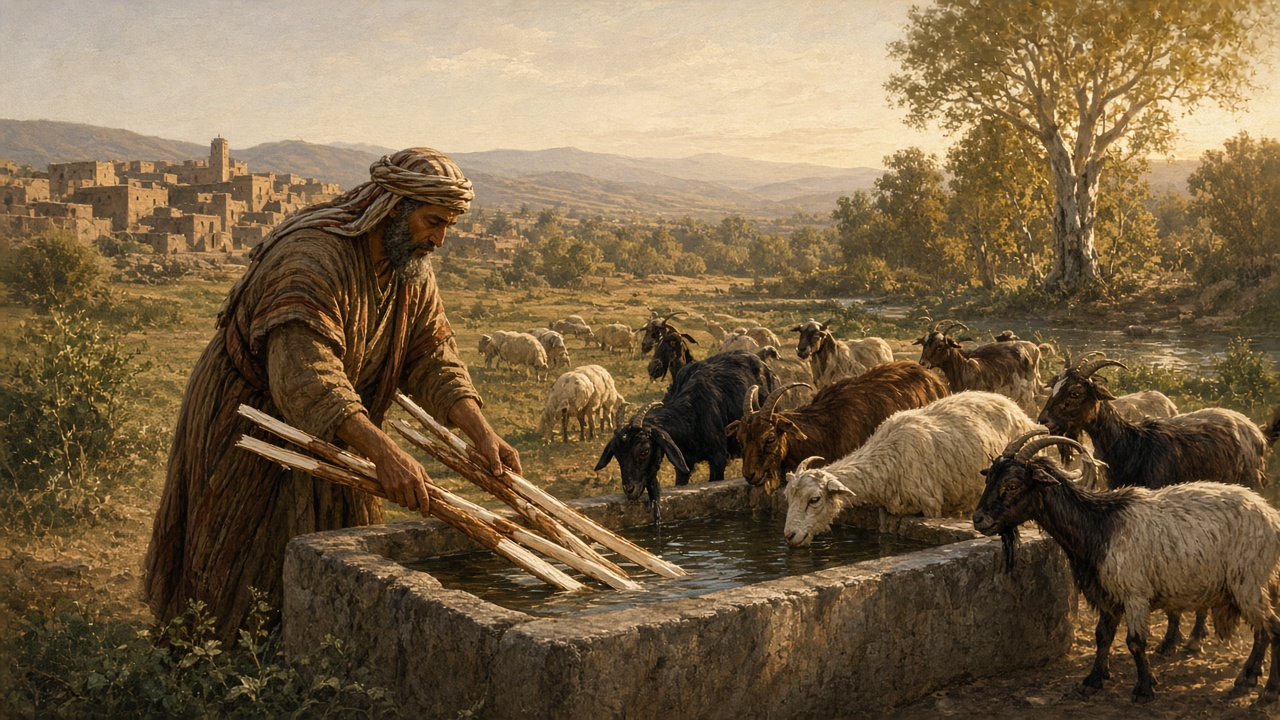
37Por su parte, Jacob tomó varas verdes de álamo, de avellano y de castaño y las descortezó para dejar al descubierto las franjas blancas. 38Enseguida colocó las varas en los bebederos, para que el ganado las viera cuando venían a beber, porque era allí donde se apareaban. 39De modo que se apareaban delante de las varas y así las hembras parían ejemplares manchados, negros o rayados. Jacob apartaba estas crías y las colocaba frente a los animales rayados y negros del ganado de Labán. 41Además, cada vez que los animales más fuertes estaban en celo, Jacob colocaba las varas en los bebederos, de modo que los animales, al unirse, lo hacían mirando las ramas. 42Sin embargo, cuando los animales más débiles se unían, Jacob no colocaba las ramas. De este modo los corderos más débiles eran de Labán, mientras que los fuertes eran para Jacob. 43Como resultado, Jacob se enriqueció mucho, pues llegó a tener muchas ovejas, muchos esclavos, esclavas, camellos y burros.
Did you know?
Rivalry, births, and Hebrew names
- Still without children, Rachel gave her maidservant Bilhah to Jacob as a wife, so that Bilhah might bear children for her and Rachel could build a family. Leah later did the same with her maidservant Zilpah. Bilhah became the mother of Dan and Naphtali, and Zilpah the mother of Gad and Asher.Sources: the Bible text itself · Bilhah · Zilpah
- The sons' names take up what the mothers said. Easton's Bible Dictionary (1897) links Dan with Hebrew dananni, "God hath judged me," and gives Naphtali as "my wrestling," which Rachel chose after saying she had wrestled with her sister and won. That dictionary also prefers "Fortunate" or "Fortune" for Gad, rather than the older English "A troop cometh," in keeping with Leah's "How fortunate!"Sources: the Bible text itself · Dan · Naphtali · Gad
- Easton's Bible Dictionary (1897) gives Rachel's name as "ewe." At the birth of her son it records her words, "God hath taken away [Hebrew asaph] my reproach," and "The Lord shall add [Hebrew yoseph] to me another son," the saying from which he was named Joseph.Sources: the Bible text itself · Rachel · Joseph (son of Jacob)
Notes written with AI assistance from open sources (Theographic Bible Metadata, CC BY-SA 4.0; Easton’s Bible Dictionary, public domain) and reviewed before publishing.
Credits and license for this translation
Biblica® Open Nueva Biblia Viva 2008
The Holy Bible in Spanish: Biblica® Open Nueva Biblia Viva 2008 (Bible)
copyright © 2008 Biblica, Inc.
Language: Español
Contributor: Biblica, Inc.
Biblica® Open Nueva Biblia Viva™
Copyright © 2006, 2008 by Biblica, Inc.
“Biblica” es una marca registrada en la oficina de Patentes y Marcas de los Estados Unidos por Biblica, Inc. Usado con permiso.
“Biblica” is a trademark registered in the United States Patent and Trademark Office by Biblica, Inc. Used with permission.
Creative Commons license
This work is made available under the Creative Commons Attribution-ShareAlike 4.0 International License (CC BY-SA). To view a copy of this license, visit https://creativecommons.org/licenses/by-sa/4.0 or send a letter to Creative Commons, PO Box 1866, Mountain View, CA 94042, USA.
You have permission to copy and distribute this Work, as long as you do not change it and you keep the title as it is. Changing or translating this Work will create a derivative work. When you publish this derivative work, you must list what changes you have made where people can see them, such as on a website. You must also show where the original Work is from: “The original Work by its copyright holders is available for free at www.biblica.com and open.bible .”
Notice of copyright must appear on the title or copyright page of the work as follows:
Biblica® Open Nueva Biblia Viva™
Copyright © 2006, 2008 by Biblica, Inc.
“Biblica” es una marca registrada en la oficina de Patentes y Marcas de los Estados Unidos por Biblica, Inc. Usado con permiso.
“Biblica” is a trademark registered in the United States Patent and Trademark Office by Biblica, Inc. Used with permission.
You must also make your derivative work available under the same license (CC BY-SA).
If you would like to notify Biblica, Inc. regarding your translation of this work, please contact us at https://open.bible/#feedback .
This translation is made available to you under the terms of the
Creative Commons Attribution Share-Alike license 4.0.
You have permission to share and redistribute this Bible translation in any format and to make reasonable revisions and adaptations of this translation, provided that:
You include the above copyright and source information.
If you make any changes to the text, you must indicate that you did so in a way that makes it clear that the original licensor is not necessarily endorsing your changes.
If you redistribute this text, you must distribute your contributions under the same license as the original.
Pictures included with Scriptures and other documents on this site are licensed just for use with those Scriptures and documents.
For other uses, please contact the respective copyright owners.
Note that in addition to the rules above, revising and adapting God's Word involves a great responsibility to be true to God's Word. See Revelation 22:18-19.
2025-05-21
Source: http://ebible.org/spaonbv/ · eBible.org