Genesis 12
Biblica® Open Nueva Biblia Viva 2008 · Tap a verse to see its cross-references.
Llamamiento de Abram
1El Señor le dijo a Abram: «Deja tu tierra, tus familiares y la casa de tu padre, y vete a la región que te voy a mostrar. 2Te voy a convertir en una nación muy grande; te voy a bendecir, y te haré un hombre muy famoso. ¡Serás de bendición para muchas personas! 3A los que te bendigan, yo los bendeciré; pero a quienes te maldigan, yo los maldeciré. ¡Por medio de ti, yo bendeciré a todos los pueblos del mundo!».
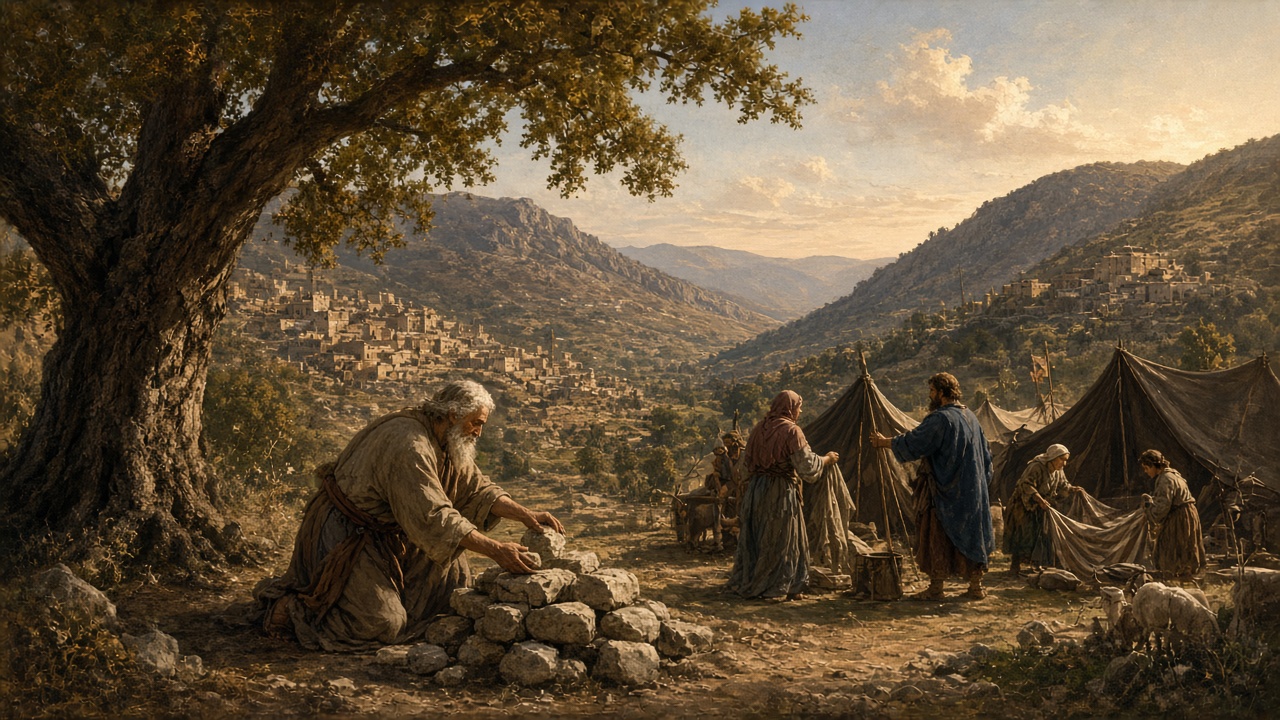
4Tal como el Señor se lo había ordenado, Abram salió de Jarán, y con él también se fue Lot. En aquel tiempo Abram tenía setenta y cinco años. 5Cuando Abram salió hacia la región de Canaán se llevó a su esposa Saray, a su sobrino Lot y a toda la gente que había comprado en Jarán. También se llevó todas las cosas y animales que había conseguido. 6Abram atravesó toda la región de Canaán hasta que llegó a Siquén, donde está la encina sagrada de Moré. En ese tiempo, los cananeos eran los que vivían en aquella región. 7El Señor se le apareció allí a Abram y le dijo: «Esta tierra se la voy a dar a tus descendientes». Entonces Abram construyó un altar para adorar al Señor, porque se le había aparecido allí. 8Después, Abram salió de aquel lugar y viajó hacia el sur, a la región montañosa que queda entre Betel por el oeste y Hai por el este. Allí estableció su campamento e hizo un altar al Señor, e invocó su nombre. 9Luego, Abram continuó su viaje hacia el sur, deteniéndose en varios lugares, hasta que llegó a la región del Néguev.
Abram en Egipto
10En ese tiempo hubo mucha hambre en aquella región; así que Abram se fue a vivir a Egipto. 11Cuando ya estaban cerca de Egipto, Abram le dijo a su esposa Saray: «¡Eres una mujer muy hermosa, y 12tan pronto te vean los egipcios y sepan que eres mi esposa, me matarán para quedarse contigo! 13Pero si dices que eres mi hermana, los egipcios me tratarán bien debido a su interés por ti, y me dejarán con vida».
14Y así fue. Cuando llegaron a Egipto, todos hablaban de la belleza de Saray. 15Los funcionarios del faraón también la vieron. Entonces fueron y le contaron al faraón que aquella mujer era muy hermosa. Luego, la llevaron a vivir al palacio. 16Para congraciarse con Saray, el faraón trató muy bien a Abram y le regaló ovejas, vacas, esclavos y esclavas, burros y burras, y camellos.
17Pero, debido a que el faraón llevó a Saray a su palacio, el Señor lo castigó a él y a su familia con terribles enfermedades. 18Entonces el faraón mandó a llamar a Abram, y le dijo: «¿Por qué me has hecho esto? ¿Por qué no me dijiste que Saray es tu esposa? 19Casi la tomo como esposa, confiado en que dijiste que era tu hermana. ¡Aquí está! ¡Tómala y vete!». 20Luego, el faraón ordenó a sus servidores que sacaran de Egipto a Abram y a su esposa, junto con todas sus posesiones.
Did you know?
Abram's Call and Journey to Canaan
- Easton's Bible Dictionary treats the call that opens this chapter as a second, more definite summons. An earlier call, noted in Acts but not narrated in the Old Testament, and only implied here, had already taken Abram from Ur of the Chaldees some three hundred miles north to Haran, where he stayed until his father Terah died. Genesis says he was seventy-five when he left Haran with his wife Sarai, his nephew Lot, and the people and possessions gathered there.Sources: Abraham · Haran · the Bible text itself
- Abram's first halt in the land was at the Oak of Moreh, by Shechem, in the narrow valley between Mount Ebal and Mount Gerizim, whose bases stand only some five hundred yards apart. Easton's Bible Dictionary says Moreh was probably a Canaanite who gave the place its name, and that here Abram pitched his tent, built his first altar, and received the promise of the land for his offspring, even though the Canaanites were then in the land. What some older versions call a plain, the Revised Version calls an oak.Sources: Shechem · Moreh (Shechem) · the Bible text itself
- A severe famine then led Abram down to Egypt, where he asked Sarai to say that she was his sister. Easton's Bible Dictionary (1897) identifies Sarai as both his wife and his half-sister; the name Sarah, it notes, was given only later, when it was announced to Abraham that she would be the mother of the promised child. It suggests that the Pharaoh of this visit was probably one of the Hyksos, or shepherd kings, rulers of Semitic origin whose capital was Zoan, also called Tanis.Sources: Sarah · Pharaoh (during Abraham's Journey) · the Bible text itself
Notes written with AI assistance from open sources (Theographic Bible Metadata, CC BY-SA 4.0; Easton’s Bible Dictionary, public domain) and reviewed before publishing.
Places in this chapter
- Haran · Today: Harran · 36.864, 39.033 · verses 4, 5
- Canaan · 32.767, 35.333 · verses 5, 10
- Moreh · Today: within 1 km of Tell Balatah · 32.214, 35.282 · verse 6
- Shechem · Today: Tell Balatah · 32.214, 35.282 · verse 6
- Negeb · 31.245, 34.841 · verse 9
- Egypt · 30.129, 31.308 · verses 10, 11, 14
Only places identified with high confidence are shown (90% or more according to the scholarly sources compiled by OpenBible). Period map: DARE (Digital Atlas of the Roman Empire), CC BY 4.0; modern map: © OpenStreetMap contributors; places: OpenBible.info (CC BY 4.0).
Credits and license for this translation
Biblica® Open Nueva Biblia Viva 2008
The Holy Bible in Spanish: Biblica® Open Nueva Biblia Viva 2008 (Bible)
copyright © 2008 Biblica, Inc.
Language: Español
Contributor: Biblica, Inc.
Biblica® Open Nueva Biblia Viva™
Copyright © 2006, 2008 by Biblica, Inc.
“Biblica” es una marca registrada en la oficina de Patentes y Marcas de los Estados Unidos por Biblica, Inc. Usado con permiso.
“Biblica” is a trademark registered in the United States Patent and Trademark Office by Biblica, Inc. Used with permission.
Creative Commons license
This work is made available under the Creative Commons Attribution-ShareAlike 4.0 International License (CC BY-SA). To view a copy of this license, visit https://creativecommons.org/licenses/by-sa/4.0 or send a letter to Creative Commons, PO Box 1866, Mountain View, CA 94042, USA.
You have permission to copy and distribute this Work, as long as you do not change it and you keep the title as it is. Changing or translating this Work will create a derivative work. When you publish this derivative work, you must list what changes you have made where people can see them, such as on a website. You must also show where the original Work is from: “The original Work by its copyright holders is available for free at www.biblica.com and open.bible .”
Notice of copyright must appear on the title or copyright page of the work as follows:
Biblica® Open Nueva Biblia Viva™
Copyright © 2006, 2008 by Biblica, Inc.
“Biblica” es una marca registrada en la oficina de Patentes y Marcas de los Estados Unidos por Biblica, Inc. Usado con permiso.
“Biblica” is a trademark registered in the United States Patent and Trademark Office by Biblica, Inc. Used with permission.
You must also make your derivative work available under the same license (CC BY-SA).
If you would like to notify Biblica, Inc. regarding your translation of this work, please contact us at https://open.bible/#feedback .
This translation is made available to you under the terms of the
Creative Commons Attribution Share-Alike license 4.0.
You have permission to share and redistribute this Bible translation in any format and to make reasonable revisions and adaptations of this translation, provided that:
You include the above copyright and source information.
If you make any changes to the text, you must indicate that you did so in a way that makes it clear that the original licensor is not necessarily endorsing your changes.
If you redistribute this text, you must distribute your contributions under the same license as the original.
Pictures included with Scriptures and other documents on this site are licensed just for use with those Scriptures and documents.
For other uses, please contact the respective copyright owners.
Note that in addition to the rules above, revising and adapting God's Word involves a great responsibility to be true to God's Word. See Revelation 22:18-19.
2025-05-21
Source: http://ebible.org/spaonbv/ · eBible.org