Genesis 10
Biblica® Open Nueva Biblia Viva 2008 · Tap a verse to see its cross-references.
Las naciones de la tierra
1Después del diluvio, Sem, Cam y Jafet, los hijos de Noé, tuvieron sus propios hijos. Estos son sus descendientes:
2Los hijos de Jafet fueron:
Gómer, Magog, Maday, Javán, Tubal, Mésec, Tirás.
3Los hijos de Gómer fueron:
Asquenaz, Rifat y Togarma.
4Los hijos de Javán fueron:
Elisá, Tarsis, Quitín y Rodanín.
5Estos se fueron a vivir en las islas y costas, y fundaron naciones en diversos lugares, con sus propios idiomas.
6Los hijos de Cam fueron:
Cus, Misrayin, Fut y Canaán.
7Los hijos de Cus fueron:
Seba, Javilá, Sabtá, Ragama y Sabteca.
Los hijos de Ragama fueron:
Sabá y Dedán.
8Cus fue el padre de Nimrod, que llegó a ser el primer guerrero muy famoso. 9Con la ayuda del Señor llegó a ser un cazador muy valiente. Por eso, se hizo popular decir: «Tan valiente como Nimrod, quien llegó a ser un excelente cazador porque el Señor lo ayudó». 10Las ciudades más importantes de su reino fueron Babel, Érec, Acad y Calné. Todas estas ciudades estaban en la región de Sinar. 11De allí salió para Asur, donde edificó las ciudades de Nínive, Rejobot Ir, Cala y la importante ciudad de Resén, que estaba situada entre Nínive y Cala.
13Misrayin fue el antepasado de los ludeos, los anameos, los leabitas, los naftuitas, los patruseos, los caslujitas y los caftoritas, que son los antepasados de los filisteos.
15Canaán fue el padre de Sidón, su hijo mayor, y de Het.
16Además, de Canaán descienden los jebuseos, los amorreos, los gergeseos, los heveos, los araceos, los sineos, los arvadeos, los zemareos y los jamatitas.
Después de algún tiempo todas estas familias de los cananeos se separaron y se dispersaron por la tierra. 19Su territorio abarcaba desde Sidón hasta Guerar y Gaza, y pasaba por Sodoma, Gomorra, Admá y Zeboyín, y llegaba hasta Lasa.
20Estos fueron, pues, los descendientes de Cam. Se hallaban dispersos en muchas tierras y naciones y hablaban muchas lenguas.
21Sem, el hermano mayor de Jafet, también tuvo hijos, y fue el antepasado de todos los descendientes de Éber. 22Los hijos de Sem fueron:
Elam, Asur, Arfaxad, Lud y Aram.
23Los hijos de Aram fueron:
Uz, Hul, Guéter y Mas.
24Arfaxad fue el padre de Selaj, y Selaj fue el padre de Éber.
25Éber tuvo dos hijos:
El primero se llamó Péleg, porque fue durante su vida que la gente del mundo se dividió.
El otro hijo de Éber fue Joctán.
26Joctán fue el padre de Almodad, Sélef, Jazar Mávet, Yeraj, Hadorán, Uzal, Diclá, Obal, Abimael, Sabá, Ofir, Javilá y Jobab.
Todos estos fueron los descendientes de Joctán, quienes ocuparon la región que va desde Mesá hasta Sefar, es decir, la región montañosa que queda al oriente.
31Así que estos fueron los descendientes de Sem, según sus familias, sus regiones, sus países y sus idiomas.
32En resumen, todos estas son las familias que descienden de Noé, según sus pueblos y naciones. Después del diluvio, todas estas familias se esparcieron por todas partes y formaron las naciones que hay en el mundo.
Did you know?
The Nations after the Flood
- Genesis 10 follows the families of Noah’s three sons, Shem, Ham, and Japheth, and says that after the flood the nations of the earth spread out from them, grouped by clans, languages, lands, and nations. Japheth’s line is linked with peoples of eastern Europe and northern Asia: Gomer is generally regarded as an ancestor of the Celts and the Cimmerians, who in early times settled north of the Black Sea, and Javan became the Hebrew name that the peoples of the East used for the Greeks, especially those of Ionia.Sources: the Bible text itself · Japheth · Gomer (son of Japheth) · Javan
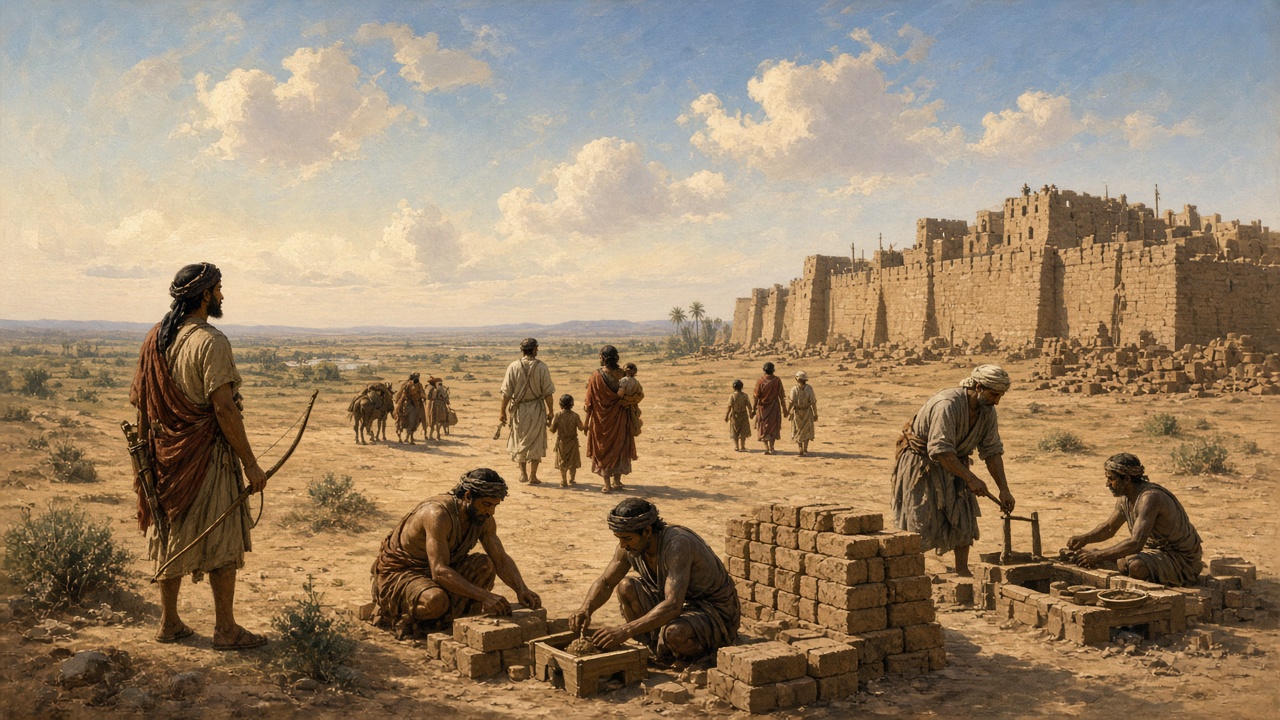
- Cush, a son of Ham, was the father of Nimrod, remembered as a mighty hunter before the Lord, whose kingdom began at Babylon, Erech, Accad, and Calneh in the land of Shinar, probably Babylonia or southern Mesopotamia. From that land he went into Assyria and built Nineveh, Rehoboth-Ir, Calah, and Resen; Calah’s site is probably the Nimrud ruins on the left bank of the Tigris.Sources: the Bible text itself · Shinar · Nineveh · Calah
- Mizraim, the dual form of a Hebrew word for a mound or fortress, may point to Upper and Lower Egypt and is the name the Hebrews usually gave that country; Arabic still calls it Muzr. Shem is called the older brother of Japheth and the forefather of all the sons of Eber, regarded as the founder of the Hebrew people, while an Arab tradition remembers Eber’s son Joktan, Kahtan in Arabic, as the ancestor of tribes of central and southern Arabia.Sources: the Bible text itself · Mizraim · Eber (Heber) · Joktan
Notes written with AI assistance from open sources (Theographic Bible Metadata, CC BY-SA 4.0; Easton’s Bible Dictionary, public domain) and reviewed before publishing.
Places in this chapter
- Erech · Today: Uruk · 31.322, 45.636 · verse 10
- Shinar · Today: Babylonia · 32.543, 44.422 · verse 10
- Assyria · 36.359, 43.153 · verse 11
- Calah · Today: Nimrud · 36.098, 43.329 · verses 11, 12
- Nineveh · 36.359, 43.153 · verses 11, 12
- Canaan · 32.767, 35.333 · verse 19
- Gaza · Today: Tell Harube · 31.504, 34.464 · verse 19
- Sidon · Today: Sandikli archaeological site in Sidon · 33.561, 35.372 · verse 19
Only places identified with high confidence are shown (90% or more according to the scholarly sources compiled by OpenBible). Period map: DARE (Digital Atlas of the Roman Empire), CC BY 4.0; modern map: © OpenStreetMap contributors; places: OpenBible.info (CC BY 4.0).
Credits and license for this translation
Biblica® Open Nueva Biblia Viva 2008
The Holy Bible in Spanish: Biblica® Open Nueva Biblia Viva 2008 (Bible)
copyright © 2008 Biblica, Inc.
Language: Español
Contributor: Biblica, Inc.
Biblica® Open Nueva Biblia Viva™
Copyright © 2006, 2008 by Biblica, Inc.
“Biblica” es una marca registrada en la oficina de Patentes y Marcas de los Estados Unidos por Biblica, Inc. Usado con permiso.
“Biblica” is a trademark registered in the United States Patent and Trademark Office by Biblica, Inc. Used with permission.
Creative Commons license
This work is made available under the Creative Commons Attribution-ShareAlike 4.0 International License (CC BY-SA). To view a copy of this license, visit https://creativecommons.org/licenses/by-sa/4.0 or send a letter to Creative Commons, PO Box 1866, Mountain View, CA 94042, USA.
You have permission to copy and distribute this Work, as long as you do not change it and you keep the title as it is. Changing or translating this Work will create a derivative work. When you publish this derivative work, you must list what changes you have made where people can see them, such as on a website. You must also show where the original Work is from: “The original Work by its copyright holders is available for free at www.biblica.com and open.bible .”
Notice of copyright must appear on the title or copyright page of the work as follows:
Biblica® Open Nueva Biblia Viva™
Copyright © 2006, 2008 by Biblica, Inc.
“Biblica” es una marca registrada en la oficina de Patentes y Marcas de los Estados Unidos por Biblica, Inc. Usado con permiso.
“Biblica” is a trademark registered in the United States Patent and Trademark Office by Biblica, Inc. Used with permission.
You must also make your derivative work available under the same license (CC BY-SA).
If you would like to notify Biblica, Inc. regarding your translation of this work, please contact us at https://open.bible/#feedback .
This translation is made available to you under the terms of the
Creative Commons Attribution Share-Alike license 4.0.
You have permission to share and redistribute this Bible translation in any format and to make reasonable revisions and adaptations of this translation, provided that:
You include the above copyright and source information.
If you make any changes to the text, you must indicate that you did so in a way that makes it clear that the original licensor is not necessarily endorsing your changes.
If you redistribute this text, you must distribute your contributions under the same license as the original.
Pictures included with Scriptures and other documents on this site are licensed just for use with those Scriptures and documents.
For other uses, please contact the respective copyright owners.
Note that in addition to the rules above, revising and adapting God's Word involves a great responsibility to be true to God's Word. See Revelation 22:18-19.
2025-05-21
Source: http://ebible.org/spaonbv/ · eBible.org