Genesis 12
Biblica® Open Nova Bíblia Viva 2007 · Tap a verse to see its cross-references.
O Chamado de Abrão
1Então o Senhor disse a Abrão: “Deixa a sua terra, os seus parentes e a casa de seu pai, e vá para a terra que eu lhe mostrar.
2“Farei de você o pai de uma grande nação. Abençoarei você e tornarei o seu nome famoso. E você será uma bênção para muitos. 3Abençoarei aqueles que abençoarem você. Amaldiçoarei aqueles que amaldiçoarem você. E por seu intermédio serão abençoados todos os povos da terra”.
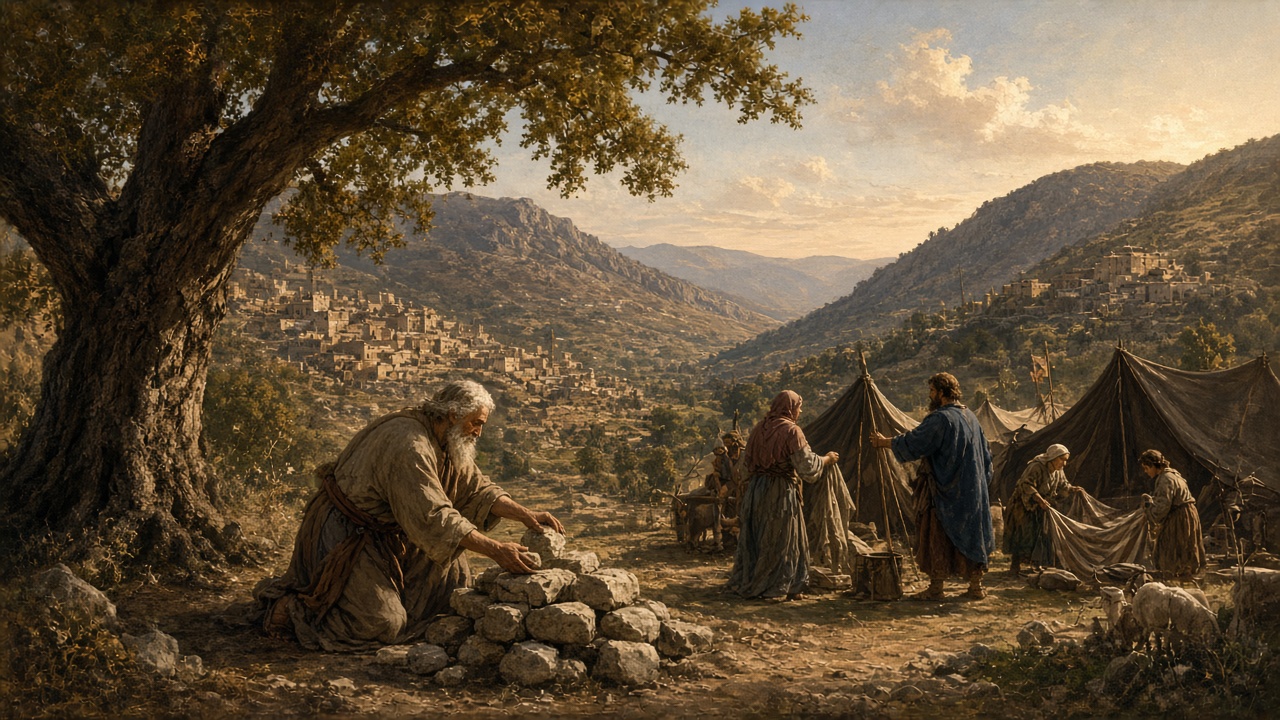
4Então Abrão partiu, como o Senhor lhe havia ordenado. E Ló também foi com ele. Abrão tinha 75 anos quando partiu de Harã. 5Abrão levou sua mulher Sarai, seu sobrinho Ló, e todos os bens e escravos que tinha acumulado em Harã. Partiram para Canaã e lá chegaram. 6Abrão percorreu a terra de Canaã e chegou perto de Siquém, onde acampou junto de um carvalho em Moré. Naquela época os cananeus habitavam aquela terra.
7Então o Senhor apareceu a Abrão e disse: “Vou dar esta terra aos seus descendentes”. E Abrão construiu ali um altar para lembrar o aparecimento do Senhor. 8Depois saiu daquele lugar e prosseguiu em direção à região montanhosa a leste de Betel e ali montou seu acampamento, ficando Betel a oeste e Ai a leste. Ali edificou um altar ao Senhor e orou a ele. 9Mais tarde saiu dali e seguiu viagem, indo sempre em direção ao Neguebe.
Abrão e Sarai no Egito
10Naquela época houve uma fome terrível em toda a região, e Abrão desceu ao Egito, ficando algum tempo ali, pois a fome era grande. 11Quando estava chegando ao Egito, Abrão disse a Sarai, sua mulher: “Você é muito bonita. 12Quando os egípcios virem você, vão dizer: ‘Esta é a mulher dele. Vamos matar o marido e ficar com ela’. 13Por isso, diga que é a minha irmã, para que me tratem bem por sua causa e a minha vida seja poupada”.
14Mal chegaram ao Egito, os egípcios repararam na grande beleza de Sarai. 15Os homens da corte do faraó viram Sarai e lhe falaram da beleza dela, e ela foi levada ao seu palácio. 16O Faraó tratou bem a Abrão por causa dela, dando-lhe ovelhas e bois, jumentos, servos e servas, e camelos.
17No entanto, o Senhor puniu o faraó e a sua casa com pragas terríveis, por causa de Sarai, mulher de Abrão. 18Por isso o faraó mandou chamar Abrão e perguntou: “O que você fez comigo? Por que não disse que ela era a sua mulher? 19Por que disse que era a sua irmã? Foi por isso que tomei Sarai como esposa. Aqui está a sua mulher. Leve-a embora com você!” 20Em seguida o faraó deu ordens para que providenciassem a partida de Abrão. Assim saíram Abrão e sua mulher com tudo o que possuíam.
Did you know?
Abram's Call and Journey to Canaan
- Easton's Bible Dictionary treats the call that opens this chapter as a second, more definite summons. An earlier call, noted in Acts but not narrated in the Old Testament, and only implied here, had already taken Abram from Ur of the Chaldees some three hundred miles north to Haran, where he stayed until his father Terah died. Genesis says he was seventy-five when he left Haran with his wife Sarai, his nephew Lot, and the people and possessions gathered there.Sources: Abraham · Haran · the Bible text itself
- Abram's first halt in the land was at the Oak of Moreh, by Shechem, in the narrow valley between Mount Ebal and Mount Gerizim, whose bases stand only some five hundred yards apart. Easton's Bible Dictionary says Moreh was probably a Canaanite who gave the place its name, and that here Abram pitched his tent, built his first altar, and received the promise of the land for his offspring, even though the Canaanites were then in the land. What some older versions call a plain, the Revised Version calls an oak.Sources: Shechem · Moreh (Shechem) · the Bible text itself
- A severe famine then led Abram down to Egypt, where he asked Sarai to say that she was his sister. Easton's Bible Dictionary (1897) identifies Sarai as both his wife and his half-sister; the name Sarah, it notes, was given only later, when it was announced to Abraham that she would be the mother of the promised child. It suggests that the Pharaoh of this visit was probably one of the Hyksos, or shepherd kings, rulers of Semitic origin whose capital was Zoan, also called Tanis.Sources: Sarah · Pharaoh (during Abraham's Journey) · the Bible text itself
Notes written with AI assistance from open sources (Theographic Bible Metadata, CC BY-SA 4.0; Easton’s Bible Dictionary, public domain) and reviewed before publishing.
Places in this chapter
- Haran · Today: Harran · 36.864, 39.033 · verses 4, 5
- Canaan · 32.767, 35.333 · verses 5, 10
- Moreh · Today: within 1 km of Tell Balatah · 32.214, 35.282 · verse 6
- Shechem · Today: Tell Balatah · 32.214, 35.282 · verse 6
- Negeb · 31.245, 34.841 · verse 9
- Egypt · 30.129, 31.308 · verses 10, 11, 14
Only places identified with high confidence are shown (90% or more according to the scholarly sources compiled by OpenBible). Period map: DARE (Digital Atlas of the Roman Empire), CC BY 4.0; modern map: © OpenStreetMap contributors; places: OpenBible.info (CC BY 4.0).
Credits and license for this translation
Biblica® Open Nova Bíblia Viva 2007
Portuguese: Biblica® Open Nova Bíblia Viva 2007 (Bible)
copyright © 2007, 2010 Biblica, Inc.
Language: Português
Dialect: Brazil
Contributor: Biblica, Inc.
Biblica® Open Nova Bíblia Viva™
Copyright © 2007, 2010 by Biblica, Inc.
“Biblica” é uma marca registrada na Oficina de Patentes e Marcas dos Estados Unidos por Biblica, Inc. Usado com permissão.
“Biblica” is a trademark registered in the United States Patent and Trademark Office by Biblica, Inc. Used with permission.
――――――
Creative Commons license
This work is made available under the Creative Commons Attribution-ShareAlike 4.0 International License (CC BY-SA). To view a copy of this license, visit https://creativecommons.org/licenses/by-sa/4.0 or send a letter to Creative Commons, PO Box 1866, Mountain View, CA 94042, USA.
You have permission to copy and distribute this Work, as long as you do not change it and you keep the title as it is. Changing or translating this Work will create a derivative work. When you publish this derivative work, you must list what changes you have made where people can see them, such as on a website. You must also show where the original Work is from: “The original Work by its copyright holders is available for free at www.biblica.com and open.bible .”
Notice of copyright must appear on the title or copyright page of the work as follows:
Biblica® Open Nova Bíblia Viva™
Copyright © 2007, 2010 by Biblica, Inc.
“Biblica” é uma marca registrada na Oficina de Patentes e Marcas dos Estados Unidos por Biblica, Inc. Usado com permissão.
“Biblica” is a trademark registered in the United States Patent and Trademark Office by Biblica, Inc. Used with permission.
You must also make your derivative work available under the same license (CC BY-SA).
If you would like to notify Biblica, Inc. regarding your translation of this work, please contact us at https://open.bible/#feedback .
This translation is made available to you under the terms of the
Creative Commons Attribution Share-Alike license 4.0.
You have permission to share and redistribute this Bible translation in any format and to make reasonable revisions and adaptations of this translation, provided that:
You include the above copyright and source information.
If you make any changes to the text, you must indicate that you did so in a way that makes it clear that the original licensor is not necessarily endorsing your changes.
If you redistribute this text, you must distribute your contributions under the same license as the original.
Pictures included with Scriptures and other documents on this site are licensed just for use with those Scriptures and documents.
For other uses, please contact the respective copyright owners.
Note that in addition to the rules above, revising and adapting God's Word involves a great responsibility to be true to God's Word. See Revelation 22:18-19.
2025-05-20
Section headings adapted from the Berean Standard Bible (public domain); they are not part of this translation’s text.
Source: http://ebible.org/poronbv/ · eBible.org