1 Samuel 3
Bib Sen An · Tap a verse to see its cross-references.
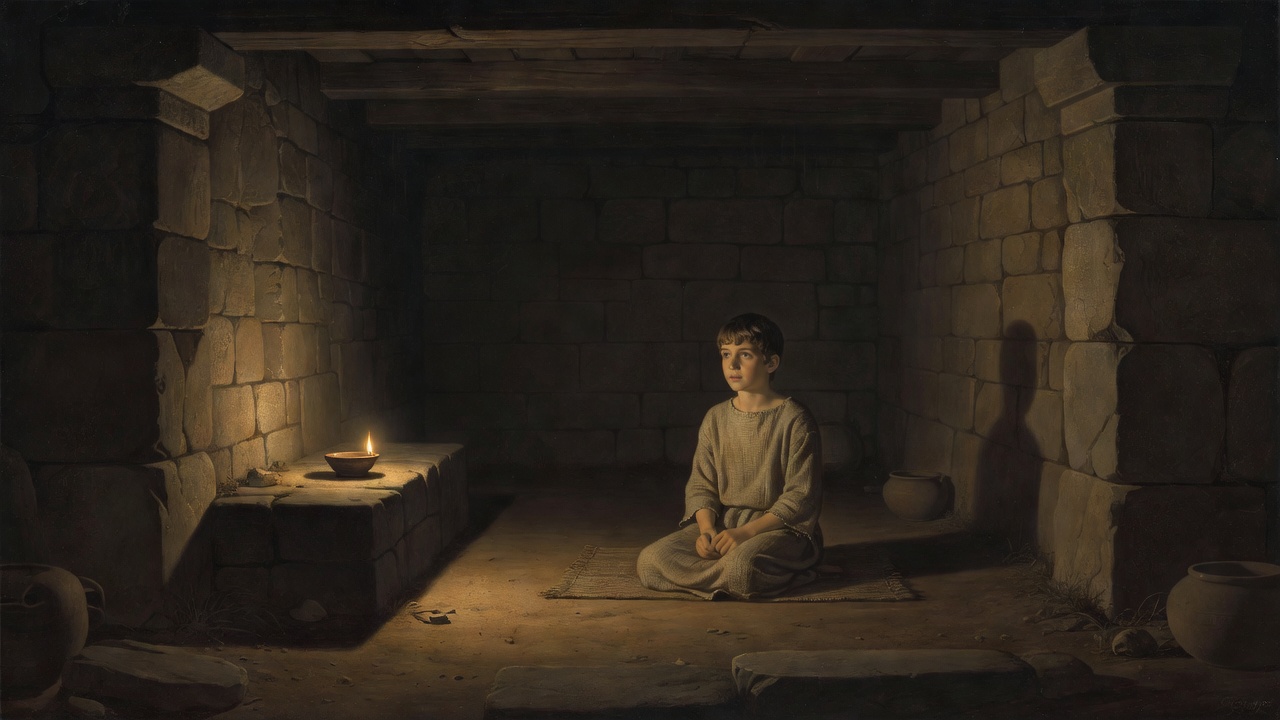
1Alò, Samuel te sèvi SENYÈ a devan Éli. Yon pawòl soti nan SENYÈ a te ra nan jou sa yo, e vizyon yo pa t fèt souvan. 2Li te rive nan lè sa a ke pandan Éli te kouche nan plas li, (alò, vizyon li te kòmanse febli; li pa t kab wè byen), 3epi lanp Bondye a potko etenn e Samuel te kouche nan tanp SENYÈ a kote lach Bondye a te ye a, 4ke SENYÈ a te rele Samuel. Li te reponn: “Men mwen isit la!”
5Alò, li te kouri vè Éli e te di: “Men mwen, paske ou te rele m.”
Men Éli te di: “Mwen pa t rele ou. Ale kouche ankò.”
Konsa, li te retounen kouche. 6Senyè a te rele ankò: “Samuel!”
Konsa, Samuel te leve, li te ale vè Éli. Li te di: “Men mwen, paske ou te rele m.” Men li te reponn: “Mwen pa t rele ou, fis mwen, ale kouche ankò.” 7Alò, Samuel potko konnen SENYÈ a, ni pawòl SENYÈ a potko revele a li. 8Alò, SENYÈ a te rele Samuel ankò pou yon twazyèm fwa. Epi li te leve ale vè Éli. Li te di: “Men mwen, paske ou te rele mwen.”
Konsa, Éli te vin apèsi ke SENYÈ a t ap rele gason an. 9Epi Éli te di a Samuel: “Ale kouche e li va fèt ke si Li rele ou, ke ou va di: ‘Pale, SENYÈ a, paske sèvitè ou ap koute ou.’” Konsa, Samuel te ale kouche nan plas li. 10Alò SENYÈ a te vin kanpe e Li te rele tankou lòt fwa yo: “Samuel! Samuel!” Epi Samuel te di: “Pale, paske sèvitè ou ap koute ou.”
11SENYÈ a te di a Samuel: “Veye byen, Mwen prèt pou fè yon bagay an Israël k ap fè zòrèy tout moun an Israël vin toudi. 12Nan jou sa a, Mwen va pote kont Éli tout sa ke M te pale selon lakay li, soti nan kòmansman, jiska lafen. 13Paske Mwen te di li ke Mwen prèt pou jije lakay li pou tout tan pou inikite ke li te konnen yo. Akoz fis li yo te mennen yon madichon sou pwòp tèt yo, e li pa t repwoche yo. 14Pou sa, mwen te fè temwen anvè lakay Éli ke inikite lakay Éli p ap padone, ni avèk ofrann, ni avèk sakrifis.”
15Konsa, Samuel te kouche jis rive nan maten. Li te ouvri pòt lakay SENYÈ a. Men li te krent pou pale Éli vizyon an. 16Alò, Éli te rele Samuel e te di: “Samuel, fis mwen.”
Epi li te di: “Men mwen.”
17Li te di: “Ki pawòl ke Li te pale ou a? Souple, pa kache l pou mwen. Ke Bondye fè l konsa a ou menm, e menm plis osi, si ou kache yon bagay a mwen nan tout pawòl ke li te pale ou yo.”
18Konsa, Samuel te di li tout bagay. Li pa t kache anyen a li menm.
Epi li te di: “Li se SENYÈ a; kite Li fè sa ki sanble bon pou Li menm.”
19Konsa, Samuel te grandi, SENYÈ a te avèk li e Li pa t kite okenn nan pawòl li yo manke reyisi. 20Tout Israël soti nan Dan jis rive menm Beer-Schéba te konnen ke Samuel te konfime kòm yon pwofèt a SENYÈ a. 21Epi SENYÈ a te vin parèt ankò nan Silo, paske SENYÈ a te revele Li menm a Samuel nan Silo selon pawòl Bondye a.
Did you know?
The Calling of Samuel
- The sanctuary housing the ark of God was located at Shiloh, where the young Samuel ministered under the high priest Eli. The text notes that direct divine revelations and visions were rare in those days, prior to the Lord revealing Himself to Samuel at Shiloh.Sources: the Bible text itself · Shiloh · Eli
- Eli served as high priest and judged Israel for forty years, but his failure to sternly reprove his corrupt sons, Hophni and Phinehas, brought a divine sentence of judgment against his household. The priestly office remained in Eli's lineage until King Solomon later removed Abiathar and installed Zadok.Sources: Eli · the Bible text itself
- The phrase from Dan to Beersheba designates the entire territory of the Promised Land, from its northern boundary at Dan to its southern limit at Beersheba, a distance of about 144 miles. Its mention emphasizes that the whole nation recognized Samuel as an established prophet.Sources: Beersheba · the Bible text itself
Notes written with AI assistance from open sources (Theographic Bible Metadata, CC BY-SA 4.0; Easton’s Bible Dictionary, public domain) and reviewed before publishing.
Places in this chapter
- Dan · Today: Tel Dan · 33.249, 35.652 · verse 20
- Shiloh · Today: Khirbet Seilun · 32.056, 35.290 · verse 21
Only places identified with high confidence are shown (90% or more according to the scholarly sources compiled by OpenBible). Period map: DARE (Digital Atlas of the Roman Empire), CC BY 4.0; modern map: © OpenStreetMap contributors; places: OpenBible.info (CC BY 4.0).
Credits and license for this translation
Bib Sen An
The Holy Bible in Haitian Creole, 2023 update
copyright © 2017-2023 Ron Smith
Language: Kreyòl Ayisyen (Haitian)
Translation by: Ron Smith
Contributor: Felix Nixon
This translation is made available to you under the terms of the
Creative Commons Attribution Share-Alike license 4.0.
You have permission to share and redistribute this Bible translation in any format and to make reasonable revisions and adaptations of this translation, provided that:
You include the above copyright and source information.
If you make any changes to the text, you must indicate that you did so in a way that makes it clear that the original licensor is not necessarily endorsing your changes.
If you redistribute this text, you must distribute your contributions under the same license as the original.
Pictures included with Scriptures and other documents on this site are licensed just for use with those Scriptures and documents.
For other uses, please contact the respective copyright owners.
Note that in addition to the rules above, revising and adapting God's Word involves a great responsibility to be true to God's Word. See Revelation 22:18-19.
2026-06-11
Source: http://ebible.org/hatbsa/ · eBible.org