Zephaniah 1
Bib La · Tap a verse to see its cross-references.
About this book
About Zephaniah
- Easton's Bible Dictionary (1897) presents Zephaniah, whose name it explains as "Jehovah has concealed" or "Jehovah of darkness," as the son of Cushi and great-grandson of Hezekiah, and as the ninth of the minor prophets. It dates his prophecy to the reign of Josiah, king of Judah (641–610 B.C.), and says he was contemporary with Jeremiah, with whom he had much in common.Sources: Easton: Zephaniah · Zephaniah · Cushi
- Amon, Josiah's father, restored idolatry in Judah, and Easton reads Zephaniah 1:4 and 3:4, 11 as referring to that reign. The same dictionary links Zephaniah 1:4–6 with the worship of Baal and Zephaniah 1:5 with Malcham, described as the national idol of the Ammonites. Josiah, who came to the throne at eight, is presented as later acting against the idolatry that prevailed.Sources: Amon · Josiah · Baal · Malcham
- Easton's Bible Dictionary outlines the book as an introduction announcing judgment on the world and on Israel because of their transgressions (1:1–6), a description of the judgment (1:7–18), an exhortation to seek God while there is still time (2:1–3), judgment on other peoples (2:4–15), what it calls the hopeless misery of Jerusalem (3:1–7), and a promise of salvation (3:8–20).Sources: Easton: Zephaniah
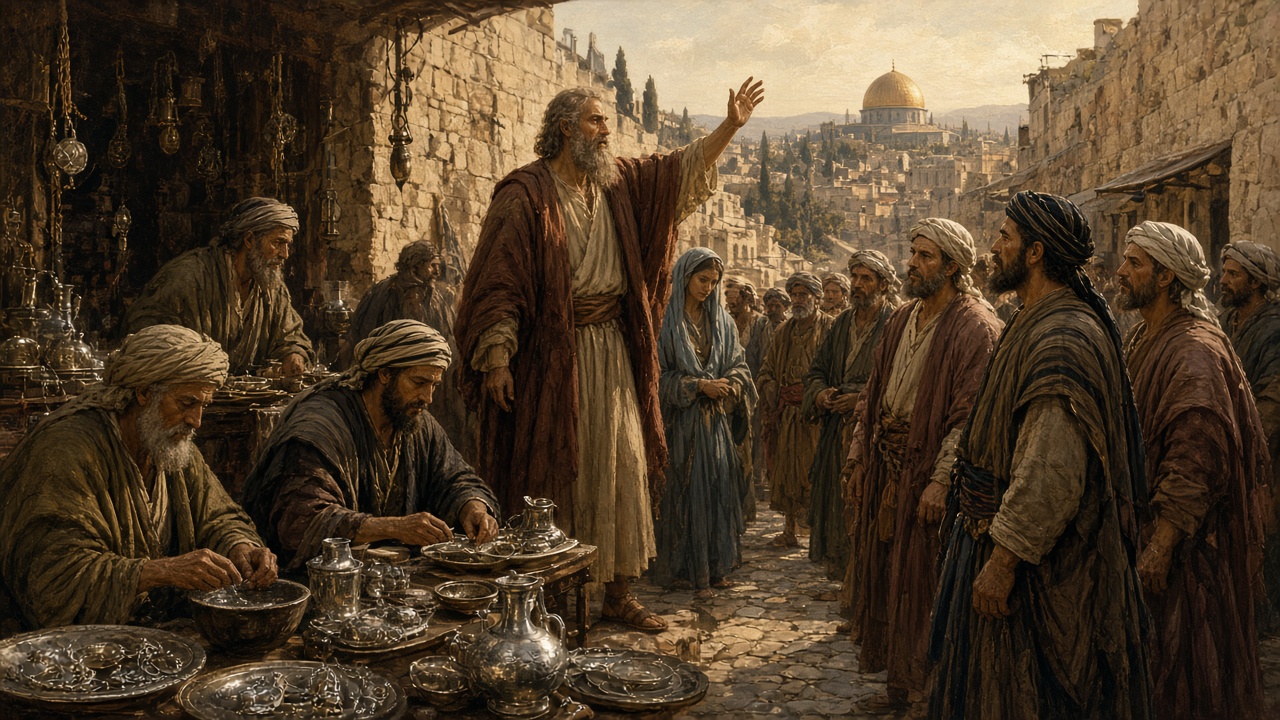
- Zephaniah 1:11 names the Mortar, a place in or near Jerusalem inhabited by silver merchants. It has been conjectured that this was the Phoenician quarter of the city, where traders of that nation lived.Sources: Mortar
Notes written with AI assistance from open sources (Theographic Bible Metadata, CC BY-SA 4.0; Easton’s Bible Dictionary, public domain) and reviewed before publishing.
1Men mesaj Seyè a te bay Sofoni sou rèy Jozyas, pitit Amon an, ki te wa peyi Jida. Sofoni te pitit Kouchi. Kouchi te pitit Gedalya. Gedalya sa a te pitit Amarya ki li menm te pitit wa Ezekyas. 2Seyè a di konsa: -Mwen pral detwi dènye bagay sou latè. 3Mwen pral detwi tout moun, tout bèt, tout zwezo nan syèl la ak tout pwason nan lanmè, mechan yo ansanm ak tou sa k'ap fè yo tonbe nan peche. Mwen pral detwi tout moun, mwen p'ap kite yonn sou latè. Se mwen menm, Seyè a, ki di sa. 4Mwen pral kraze moun peyi Jida yo ansanm ak moun ki rete lavil Jerizalèm yo anba men m'. Mwen pral disparèt dènye kras zidòl Baal nan peyi a. Pesonn p'ap janm chonje prèt k'ap sèvi l' yo ankò. 5Mwen pral disparèt dènye moun k'ap moute sou teras anwo kay pou adore solèy, lalin ak zetwal nan syèl la. M'ap detwi moun k'ap pran non mwen mete ansanm ak non zidòl Milkòm lan pou fè sèman. 6M'ap detwi tout moun ki vire do ban mwen, ki pa koute pawòl mwen yo, ki pa vin mande m' konsèy ankò. 7Jou pou Seyè a vin jije a pa lwen rive! Se pou tout moun pe bouch yo devan Seyè a. Seyè a ap pare pou li fè gwo sèvis pou touye bèt. Li chwazi moun l'ap envite yo. 8Jou gwo sèvis ofrann bèt sa a, m'ap pini tout gwo chèf yo, tout pitit wa yo ansanm ak tout moun k'ap kopye sou moun lòt nasyon yo. Se Seyè a menm ki di sa. 9M'ap pini tout moun k'ap fè sèvis tankou moun lòt nasyon yo. Wi, jou sa a, m'ap pini tout moun k'ap vòlò, k'ap touye moun pou yo ka plen tanp zidòl yo ak sa yo pran. 10Se mwen menm Seyè a k'ap pale toujou. Jou sa a n'a tande gwo rèl bò Pòtay Pwason nan lavil Jerizalèm. N'a tande moun ap plenn byen fò nan katye nèf lavil la. N'a tande yon gwo deblozay pete sou ti mòn yo. 11Nou menm ki rete anba lavil, rele byen fò paske tout moun ki t'ap fè trafik yo pral mouri. Wi, yo pral disparèt tout moun ki t'ap fè lajan sou tèt moun nan kòmès. 12Lè sa a, men sa k'ap rive. M'ap limen lanp pou m' fouye lavil Jerizalèm. M'ap pini tout moun ki chita chita yo tou dousman, epi k'ap di nan kè yo: Bondye p'ap fè anyen. 13Se sa yo kwè! Y'ap piye tout richès yo, y'ap kraze tout kay yo. Y'ap bati kay, men yo p'ap menm gen tan antre ladan yo. Y'ap plante pye rezen, men yo p'ap menm gen tan pran fre diven an. 14Wi, gwo jou Seyè a pa lwen rive. Sa pral yon gwo jou vre. Li pa lwen rive. L'ap rive byen vit. Jou sa a, sa pral rèd nèt! Ata sòlda ki pi vanyan yo pral rele anmwe. 15Jou sa a pral yon jou dechennen, yon jou lafliksyon ak kè sere, yon jou kraze brize, yon jou k'ap fè nwè kou lank, yon jou van ak gwo nwaj nwa ap plen syèl la. 16Yon jou twonpèt ap kònen, sòlda ap rele pou yo gen kouray pou y' al atake lavil ki gen gwo miray ranpa ak fò byen wo nan chak kwen pou pwoteje yo. 17Seyè a te di ankò: -Mwen pral manyen ak lèzòm! Yo pral tatonnen tankou avèg, paske yo te peche kont Seyè a. San yo pral koule kou dlo, kadav yo pral pouri tankou fatra. 18Jou Seyè a pral move sou yo a, ni lajan yo ni lò yo p'ap ka sove yo. Kòlè li tankou yon dife k'ap boule tout tè a, paske yon sèl kou a, l'ap disparèt tout moun ki rete sou latè. L'ap fini ak yo.
Did you know?
The Day of the LORD and Judgment on Idolatry
- Zephaniah traces his lineage back four generations to Hezekiah, dating his prophetic ministry to the reign of King Josiah of Judah. Josiah came to power after his father, King Amon, had restored idolatry across Judah before being assassinated by his own servants.Sources: the Bible text itself · Josiah · Amon · Hizkiah
- The chapter denounces religious syncretism in Jerusalem, where people bowed on rooftops to the host of heaven and combined their devotion to the LORD with oaths to Baal and Malcham, the national idol of the Ammonites.Sources: the Bible text itself · Baal · Malcham
- The prophecy specifies landmarks in Jerusalem that would experience turmoil, including the Fish Gate and the Mortar (or Hollow), a district inhabited by merchants who weighed out silver.Sources: the Bible text itself · Fish Gate · Mortar
Notes written with AI assistance from open sources (Theographic Bible Metadata, CC BY-SA 4.0; Easton’s Bible Dictionary, public domain) and reviewed before publishing.
Places in this chapter
- Jerusalem · 31.777, 35.234 · verses 4, 12
- Fish Gate · Today: in Jerusalem · 31.777, 35.234 · verse 10
- Second Quarter · Today: in Jerusalem · 31.777, 35.234 · verse 10
- Canaan · 32.767, 35.333 · verse 11
- Mortar · Today: in Jerusalem · 31.777, 35.234 · verse 11
Only places identified with high confidence are shown (90% or more according to the scholarly sources compiled by OpenBible). Period map: DARE (Digital Atlas of the Roman Empire), CC BY 4.0; modern map: © OpenStreetMap contributors; places: OpenBible.info (CC BY 4.0).
Credits and license for this translation
Bib La
The Holy Bible in Haitian Creole
Public Domain
Language: Kreyòl Ayisyen (Haitian)
In the Public Domain due to publication without copyright notice in 1985, and without subsequent registration within 5 years.
2020-03-10
Source: http://ebible.org/hat/ · eBible.org