Proverbs 27
The Orthodox Jewish Bible · Tap a verse to see its cross-references.
Do Not Boast about Tomorrow
1Boast not thyself of yom makhar (tomorrow),
for thou hast no da'as of what a yom may bring forth.
2Let another praise thee, and not thine own peh (mouth);
a nokhri (stranger), and not thine own sfatayim (lips).
3An even (stone) is heavy, and the chol (sand) weighty;
but a foolʼs wrath is heavier than them both.
4Chemah (anger) is cruel, and fury is a torrent,
but who is able to stand before kinah (jealousy, envy)?
5Open tovah tokhakhat (good, constructive reproof)
is better than secret ahavah.
6Ne'emanim (faithful) are the wounds of an ohev (friend);
but deceitful the neshikot (kisses) of an enemy.
7The full nefesh trampleth a honeycomb,
but to the hungry nefesh every mar (bitter thing) is sweet.
8As a tzippor that wandereth from her ken (nest),
so is an ish that wandereth from his makom (place, home).
9Shemen and ketoret rejoice the lev;
so doth the sweet discourse of a re'a (friend) from an atzat nefesh (a counselling of the soul).
10Thine own re'a (friend),
and the re'a avicha, forsake not;
neither go into thy brotherʼs bais in the yom of thy calamity;
for better is a shakhen (neighbor) that is near than a brother far off.
11Beni (my son), be chacham, and make my lev glad,
that I may answer my accusers.
12A prudent man foreseeth ra'ah, and hideth himself;
but the naïve ones trudge on, and are punished.
13Take his beged (garment) that is collateral for a zar;
seize the pledge given for surety for a nokhriyah (strange woman, foreign woman, seductress).
14He that maketh a bracha on his re'a (friend)
with a kol gadol (loud voice), rising early in the boker,
it shall be counted a kelalah to him.
15A continual dripping in a very rainy day
and a quarrelsome isha are alike;
16To restrain her is like restraining the ruach (wind),
and like grasping shemen in the right hand.
17Barzel (iron) sharpeneth barzel (iron);
so one ish sharpeneth another.
18He who is guard over the te'enah (fig tree) shall eat the p'ri (fruit) thereof,
so he that is shomer over his adon shall be honored.
19As mayim reflecteth the face,
so one lev ha'adam reflects another.
20Sheol and Avaddon are never full;
so the eynayim of adam are never satisfied.
21As the crucible is for kesef, and the furnace for zahav;
so is an ish tested by the praise he receives.
22Though thou shouldest grind a fool
in the makhtesh (mortar) among grain with the pestle,
yet will not his folly be removed from him.
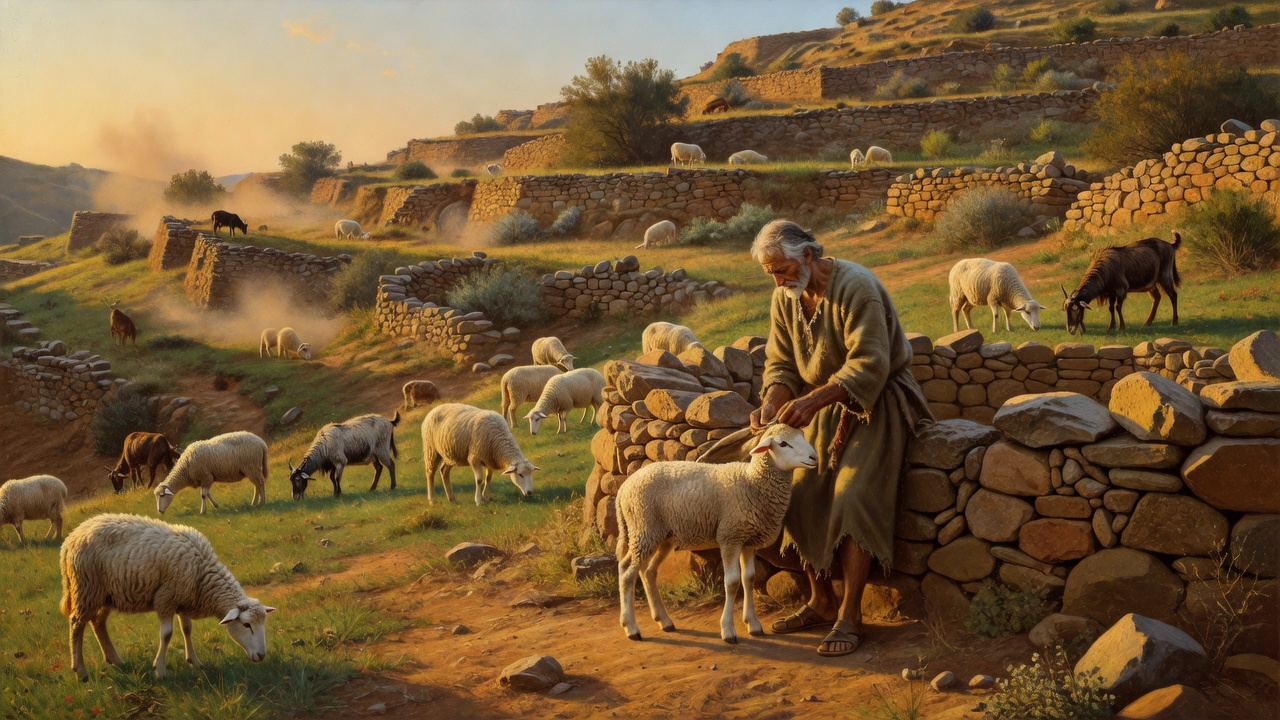
23Be thou diligent to know the condition of thy tzon,
and look well to thy adarim (flocks).
24For riches are not l'olam (forever);
and doth the nezer (crown) endure dor vador?
25The hay is removed, and the deshe (tender grass) showeth itself,
and herbs of the harim are gathered,
26The kevasim (lambs) are for thy clothing,
and the goats are the purchase price of the sadeh.
27And thou shalt have cholov of izzim (goats) enough for thy lechem,
for the lechem of thy bais,
and for the nourishment of thy na'arot (servant girls).
Did you know?
Friendship, Prudence, and Daily Diligence
- Proverbs 27 places a strong emphasis on authentic relationships, contrasting the deceitful kisses of an enemy with the faithful wounds of a friend. It famously describes constructive interpersonal interaction with the metaphor of iron sharpening iron, while also advising reliance on a nearby neighbor over a distant relative in times of crisis.Sources: the Bible text itself
- The chapter draws on practical illustrations from ancient daily crafts and domestic life, such as refining silver and gold in a crucible and furnace, grinding grain with a mortar and pestle, and observing one's reflection in water.Sources: the Bible text itself
- The closing section outlines the seasonal realities of an agrarian and pastoral economy. It urges careful oversight of flocks and herds, noting that wealth and political crowns are fleeting, while diligent care of livestock and land reliably provides food, goat milk, and wool for the household.Sources: the Bible text itself
Notes written with AI assistance from open sources (Theographic Bible Metadata, CC BY-SA 4.0; Easton’s Bible Dictionary, public domain) and reviewed before publishing.
Credits and license for this translation
The Orthodox Jewish Bible
The Orthodox Jewish Bible - Tanakh and Orthodox Jewish Brit Chadasha - The Holy Bible
copyright © 2002-2011, 2021, 2024 Artists for Israel International
Language: English
Contributor: Artists for Israel International
THE ORTHODOX JEWISH TANAKH
Artists For Israel Intl Inc.
This version also appears with the Orthodox Yiddish Triglot which presents the Hebrew Yiddish script in Latin script and an English word for word translation, available at afii.org/Torah
To donate PayPal.Me
This translation is made available to you under the terms of the
Creative Commons Attribution license 4.0.
You may share and redistribute this Bible translation or extracts from it in any format, provided that:
You include the above copyright and source information.
If you make any changes to the text, you must indicate that you did so in a way that makes it clear that the original licensor is not necessarily endorsing your changes.
Pictures included with Scriptures and other documents on this site are licensed just for use with those Scriptures and documents.
For other uses, please contact the respective copyright owners.
Note that in addition to the rules above, revising and adapting God's Word involves a great responsibility to be true to God's Word. See Revelation 22:18-19.
2026-01-06
Section headings adapted from the Berean Standard Bible (public domain); they are not part of this translation’s text.
Source: http://ebible.org/engojb/ · eBible.org