Ruth 1
Berean Standard Bible · Tap a verse to see its cross-references.
About this book
About Ruth
- The events are set in the days of the judges. A great famine led Elimelech, a man of the tribe of Judah and a kinsman of Boaz, to leave Bethlehem with his wife Naomi and their sons Mahlon and Chilion and settle in Moab, east of the Jordan and the Dead Sea. There Elimelech and both sons died.Sources: Elimelech · Moab · Mahlon · Chilion
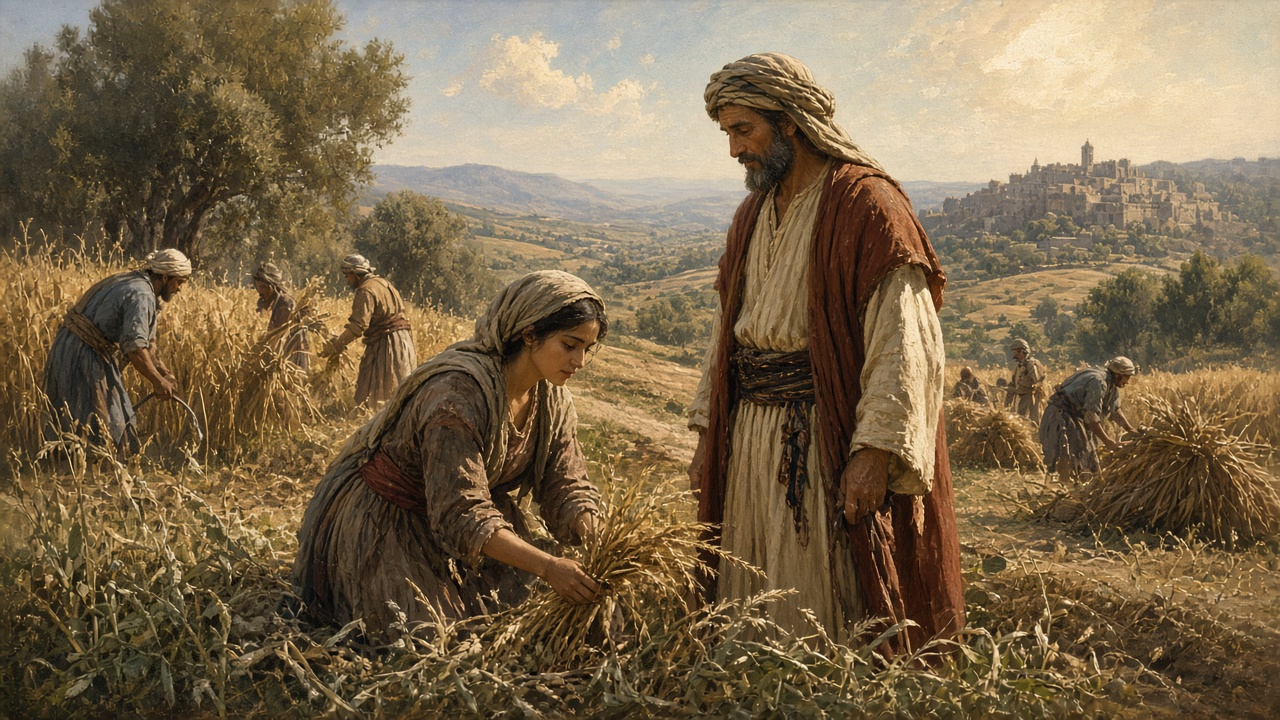
- Naomi then returned to Bethlehem with Ruth, a Moabite and the widow of Mahlon, who refused to leave her. Orpah, Chilion's widow, accompanied Naomi part of the way and then returned to Moab. In the valley east of the town, Ruth gleaned in the fields and was eventually married to Boaz, a wealthy relative.Sources: Easton: Ruth · Orpah · Bethlehem · Boaz
- Easton's Bible Dictionary (1897) says the story of the gleaner Ruth illustrates friendly relations between Boaz and his reapers, the land system, the way property was transferred, and the working of the Mosaic law for the relief of ruined families. By the levirate law, Boaz, a kinsman of Mahlon, took on the duty of marrying Ruth.Sources: Easton: Ruth · Boaz
- Ruth became the mother of Obed, the grandfather of David. The genealogy in Ruth 4:18-22 traces that line, and Matthew 1:5 includes Ruth, a Gentile, among the ancestors of Jesus. Easton also compares her with Tamar and Rahab, who likewise became ancestors of David.Sources: Easton: Ruth · Obed · Ruth
- Bethlehem, in the hill country of Judah, was originally called Ephrath; Ruth 1:2 calls it Bethlehem-Judah and its people Ephrathites. Easton's Bible Dictionary (1897) explains Ruth as meaning a friend, and Naomi as bitter or sad, a symbolic name she gave herself because of her misfortunes.Sources: Bethlehem · Ephrathah · Ruth · Naomi
Notes written with AI assistance from open sources (Theographic Bible Metadata, CC BY-SA 4.0; Easton’s Bible Dictionary, public domain) and reviewed before publishing.
Naomi Becomes a Widow
1In the days when the judges ruled, there was a famine in the land. And a certain man from Bethlehem in Judah, with his wife and two sons, went to reside in the land of Moab. 2The man’s name was Elimelech, his wife’s name was Naomi, and the names of his two sons were Mahlon and Chilion. They were Ephrathites from Bethlehem in Judah, and they entered the land of Moab and settled there.
3Then Naomi’s husband Elimelech died, and she was left with her two sons, 4who took Moabite women as their wives, one named Orpah and the other named Ruth.
And after they had lived in Moab about ten years, 5both Mahlon and Chilion also died, and Naomi was left without her two sons and without her husband.
Ruth’s Loyalty to Naomi
6When Naomi heard in Moab that the LORD had attended to His people by providing them with food, she and her daughters-in-law prepared to leave the land of Moab. 7Accompanied by her two daughters-in-law, she left the place where she had been living and set out on the road leading back to the land of Judah.
8Then Naomi said to her two daughters-in-law, “Go back, each of you to your mother’s home. May the LORD show you loving devotion, as you have shown to your dead and to me. 9May the LORD enable each of you to find rest in the home of your new husband.”
And she kissed them as they wept aloud 10and said, “Surely we will return with you to your people.”
11But Naomi replied, “Return home, my daughters. Why would you go with me? Are there still sons in my womb to become your husbands? 12Return home, my daughters. Go on, for I am too old to have another husband. Even if I thought there was hope for me to have a husband tonight and to bear sons, 13would you wait for them to grow up? Would you refrain from having husbands? No, my daughters, it grieves me very much for your sakes that the hand of the LORD has gone out against me.”
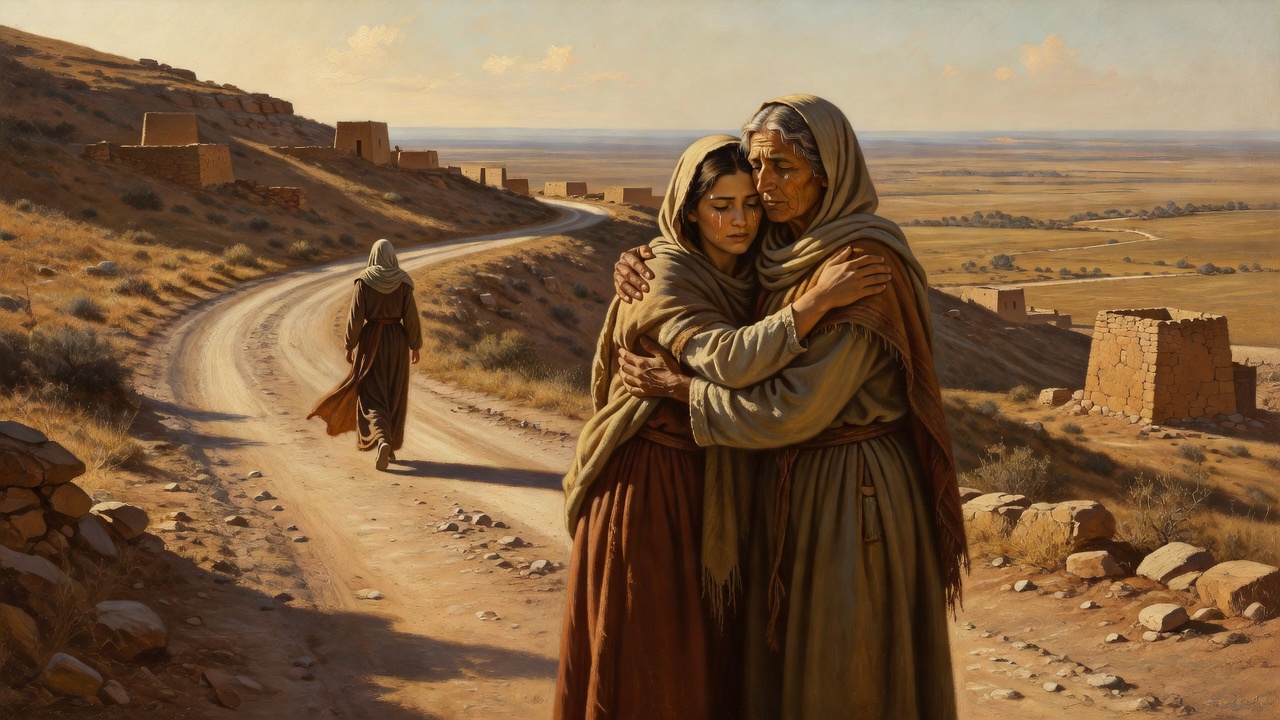
14Again they wept aloud, and Orpah kissed her mother-in-law goodbye, but Ruth clung to her.
15“Look,” said Naomi, “your sister-in-law has gone back to her people and her gods; follow her back home.”
16But Ruth replied:
“Do not urge me to leave you
or to turn from following you.
For wherever you go, I will go,
and wherever you live, I will live;
your people will be my people,
and your God will be my God.
17Where you die, I will die,
and there I will be buried.
May the LORD punish me,
and ever so severely,
if anything but death
separates you and me.”
18When Naomi saw that Ruth was determined to go with her, she stopped trying to persuade her.
The Return to Bethlehem
19So Naomi and Ruth traveled until they came to Bethlehem. When they entered Bethlehem, the whole city was stirred because of them, and the women of the city exclaimed, “Can this be Naomi?”
20“Do not call me Naomi,” she replied. “Call me Mara, because the Almighty has dealt quite bitterly with me. 21I went away full, but the LORD has brought me back empty. Why call me Naomi? After all, the LORD has testified against me, and the Almighty has afflicted me.”
22So Naomi returned from the land of Moab with her daughter-in-law Ruth the Moabitess. And they arrived in Bethlehem at the beginning of the barley harvest.
Did you know?
Naomi and Ruth Return to Bethlehem
- In the days when the judges ruled, famine forced Elimelech and his family from Bethlehem in the hill country of Judah to migrate to the land of Moab, east of the Dead Sea. After the deaths of Elimelech and her two sons, Naomi decided to return to Bethlehem when she heard that food was once again available in Judah.Sources: the Bible text itself · Bethlehem · Moab · Elimelech
- While Orpah returned to her people and gods in Moab, Ruth clung to her mother-in-law and pledged loyalty to Naomi and her God. Ruth, a Moabite woman, traveled to Bethlehem and would later become an ancestor of King David.Sources: the Bible text itself · Ruth · Orpah
- Upon arriving in Bethlehem at the beginning of the barley harvest, Naomi asked the women of the city to call her Mara, meaning bitter, because she felt the Almighty had dealt bitterly with her. She had departed full with a husband and two sons, but returned empty after their deaths.Sources: the Bible text itself · Naomi
Notes written with AI assistance from open sources (Theographic Bible Metadata, CC BY-SA 4.0; Easton’s Bible Dictionary, public domain) and reviewed before publishing.
Places in this chapter
- Bethlehem · 31.704, 35.208 · verses 1, 2, 19, 22
- Moab · Today: Moab 1 · 31.181, 35.701 · verses 1, 2, 4, 6, 22
Only places identified with high confidence are shown (90% or more according to the scholarly sources compiled by OpenBible). Period map: DARE (Digital Atlas of the Roman Empire), CC BY 4.0; modern map: © OpenStreetMap contributors; places: OpenBible.info (CC BY 4.0).
Credits and license for this translation
Berean Standard Bible
The Holy Bible in English: Berean Standard Bible
Public Domain
Language: English
Contributor: BSB Publishing, LLC
2026-10-02
Source: http://ebible.org/engbsb/ · eBible.org