Philemon 1
Berean Standard Bible · Tap a verse to see its cross-references.
About this book
About Philemon
- Easton's Bible Dictionary (1897) presents the Letter to Philemon as written by Paul from Rome, at the same time as the letters to the Colossians and the Ephesians, and sent by Onesimus.Sources: Easton: Philemon, Epistle to
- It is addressed to Philemon, an inhabitant of Colosse described as a person of some note, whom Paul had brought to the gospel, and to the members of his family. Apphia, a Christian woman at Colosse, is supposed by some to have been his wife, and Archippus, called Paul's "fellow-soldier," is described as a member of the household, probably his son. Philemon is called a "fellow-labourer," a title that at least marks his part in spreading the gospel, and he held a prominent place in the Christian community for his piety and generosity.Sources: Easton: Philemon, Epistle to · Philemon · Apphia · Archippus
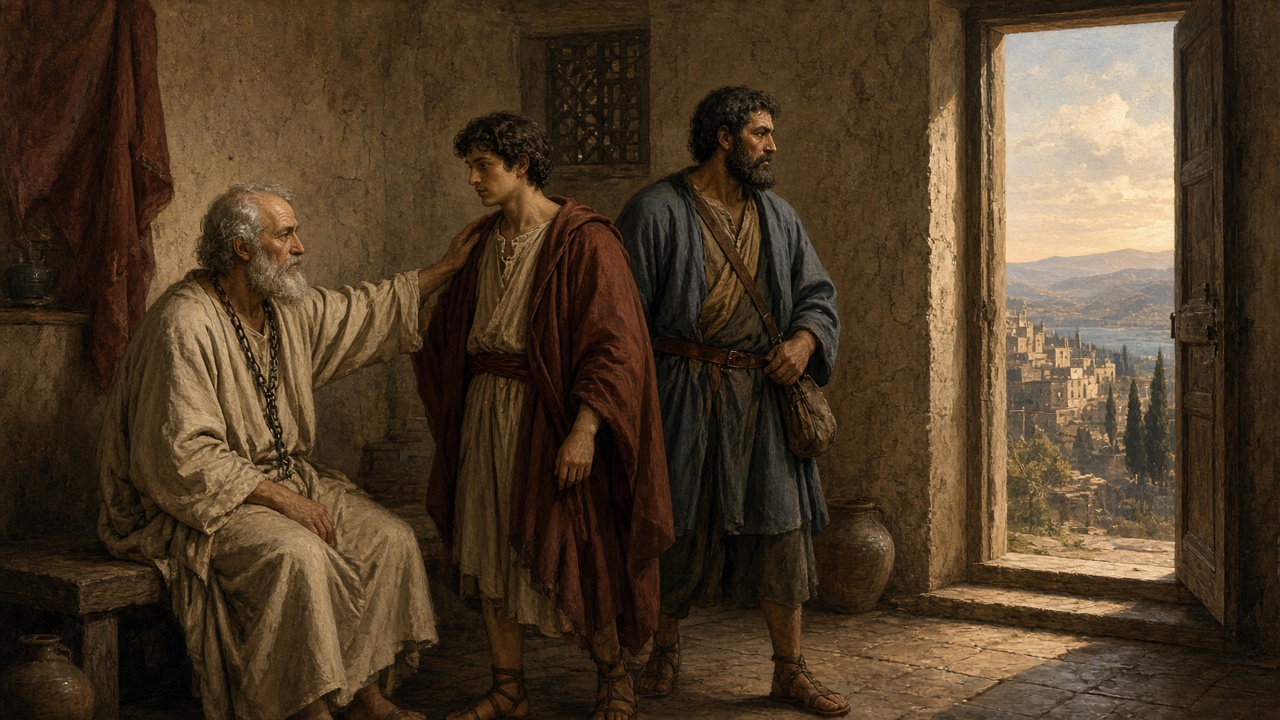
- The letter intercedes for Onesimus, whose name the dictionary renders "Useful": a slave who robbed his master Philemon at Colosse and fled to Rome, having deserted him and been "unprofitable" to him. There Paul found him and converted him, then sent him back with this letter. Paul asks that Philemon receive him as a "faithful and beloved brother," and offers to repay anything taken and to bear the wrong done.Sources: Easton: Philemon, Epistle to · Onesimus
- Easton calls this a strictly private letter, the only one of its kind preserved, and says that in it Paul throws off, as far as possible, his apostolic dignity and his fatherly authority over his converts, speaking simply as Christian to Christian. Onesimus was accompanied on his return by Tychicus, bearer of the letter to the Colossians. The same dictionary presents the fugitive's story as evidence that visitors were freely allowed to see Paul in his imprisonment at Rome, where Epaphras and Aristarchus are also named as his fellow-prisoners.Sources: Easton: Philemon, Epistle to · Onesimus · Epaphras · Aristarchus
Notes written with AI assistance from open sources (Theographic Bible Metadata, CC BY-SA 4.0; Easton’s Bible Dictionary, public domain) and reviewed before publishing.
Greetings from Paul and Timothy
1Paul, a prisoner of Christ Jesus, and Timothy our brother,
To Philemon our beloved fellow worker, 2to Apphia our sister, to Archippus our fellow soldier, and to the church that meets at your house:
3Grace and peace to you from God our Father and the Lord Jesus Christ.
Philemon’s Faith and Love
4I always thank my God, remembering you in my prayers, 5because I hear about your faith in the Lord Jesus and your love for all the saints. 6I pray that your partnership in the faith may become effective as you fully acknowledge every good thing that is ours in Christ. 7I take great joy and encouragement in your love, because you, brother, have refreshed the hearts of the saints.
Paul’s Appeal for Onesimus
8So although in Christ I am bold enough to order you to do what is proper, 9I prefer to appeal on the basis of love. For I, Paul, am now aged, and a prisoner of Christ Jesus as well.
10I appeal to you for my child Onesimus, whose father I became while I was in chains. 11Formerly he was useless to you, but now he has become useful both to you and to me. 12I am sending back to you him who is my very heart.
13I would have liked to keep him with me, so that on your behalf he could minister to me in my chains for the gospel. 14But I did not want to do anything without your consent, so that your goodness will not be out of compulsion, but by your own free will. 15For perhaps this is why he was separated from you for a while, so that you might have him back for good— 16no longer as a slave, but better than a slave, as a beloved brother. He is especially beloved to me, but even more so to you, both in person and in the Lord.
17So if you consider me a partner, receive him as you would receive me. 18But if he has wronged you in any way or owes you anything, charge it to my account. 19I, Paul, write this with my own hand. I will repay it—not to mention that you owe me your very self.
20Yes, brother, let me have some benefit from you in the Lord. Refresh my heart in Christ.
21Confident of your obedience, I write to you, knowing that you will do even more than I ask.
22In the meantime, prepare a guest room for me, because I hope that through your prayers I will be restored to you.
Additional Greetings
23Epaphras, my fellow prisoner in Christ Jesus, sends you greetings, 24as do Mark, Aristarchus, Demas, and Luke, my fellow workers.
25The grace of the Lord Jesus Christ be with your spirit.
Did you know?
Paul’s Appeal for Onesimus
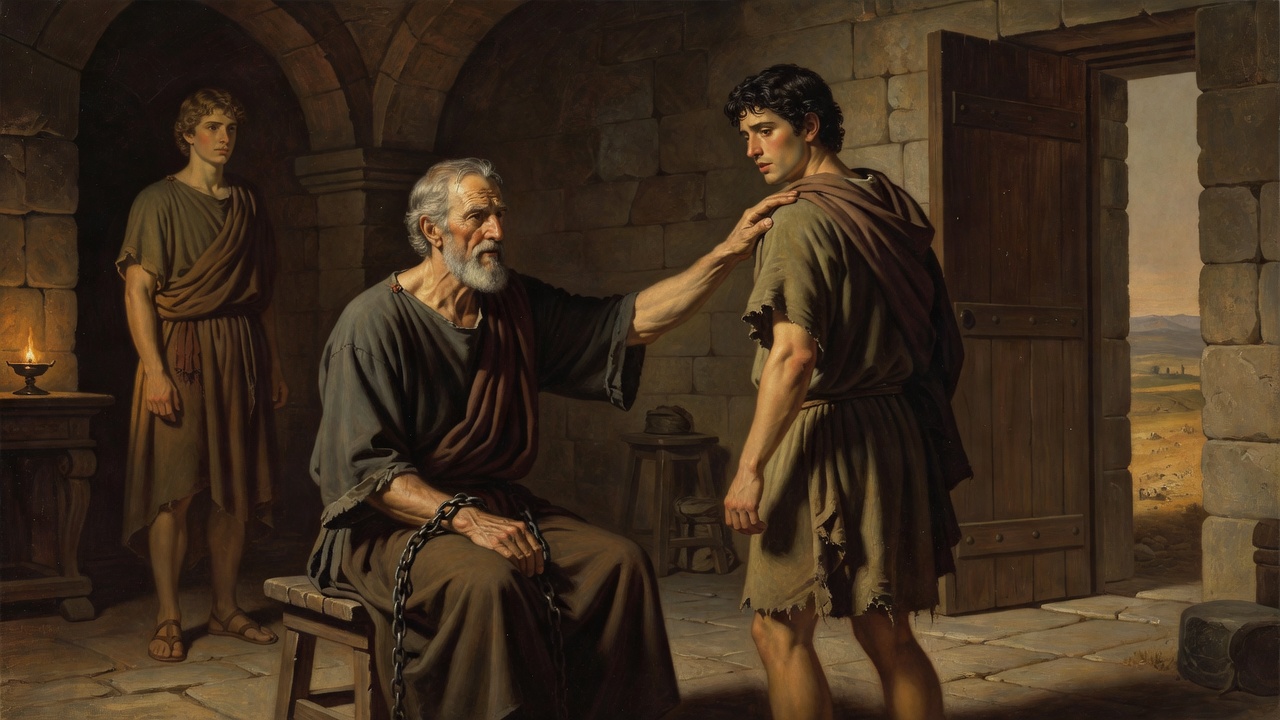
- Onesimus, whose name means Useful, was a slave of Philemon at Colosse. After robbing his master he fled to Rome, where Paul, then a prisoner, became his father in the faith and sent him back with this letter. Paul asks that he be received no longer as a slave but as a beloved brother, offers to repay anything owed, and, echoing a name that means Useful, says he was once useless but is now useful to both of them.Sources: Onesimus · Philemon · the Bible text itself
- Besides Philemon, whom Paul calls a beloved fellow worker, the letter greets Apphia, Archippus, and the church that meets in the house. Apphia was a Christian woman at Colosse, supposed by some to have been Philemon’s wife. Archippus, called a fellow soldier, belonged to Philemon’s family and was probably his son.Sources: Apphia · Archippus · Philemon · the Bible text itself
- Paul writes as an aged prisoner of Christ Jesus, still in chains, and says he is recording the promise of repayment in his own hand. Greetings come from Epaphras, his fellow prisoner, who was with him at Rome, and from Mark, Aristarchus, Demas, and Luke. Aristarchus is also described as Paul’s fellow prisoner at Rome, and Onesimus’s access to Paul shows the freedom visitors had to approach the prisoner.Sources: Epaphras · Aristarchus · Onesimus · the Bible text itself
Notes written with AI assistance from open sources (Theographic Bible Metadata, CC BY-SA 4.0; Easton’s Bible Dictionary, public domain) and reviewed before publishing.
Credits and license for this translation
Berean Standard Bible
The Holy Bible in English: Berean Standard Bible
Public Domain
Language: English
Contributor: BSB Publishing, LLC
2026-10-02
Source: http://ebible.org/engbsb/ · eBible.org