Genesis 15
Berean Standard Bible · Tap a verse to see its cross-references.
God’s Covenant with Abram
1After these events, the word of the LORD came to Abram in a vision:
“Do not be afraid, Abram.
I am your shield,
your very great reward.”
2But Abram replied, “O Lord GOD, what can You give me, since I remain childless, and the heir of my house is Eliezer of Damascus?” 3Abram continued, “Behold, You have given me no offspring, so a servant in my household will be my heir.”
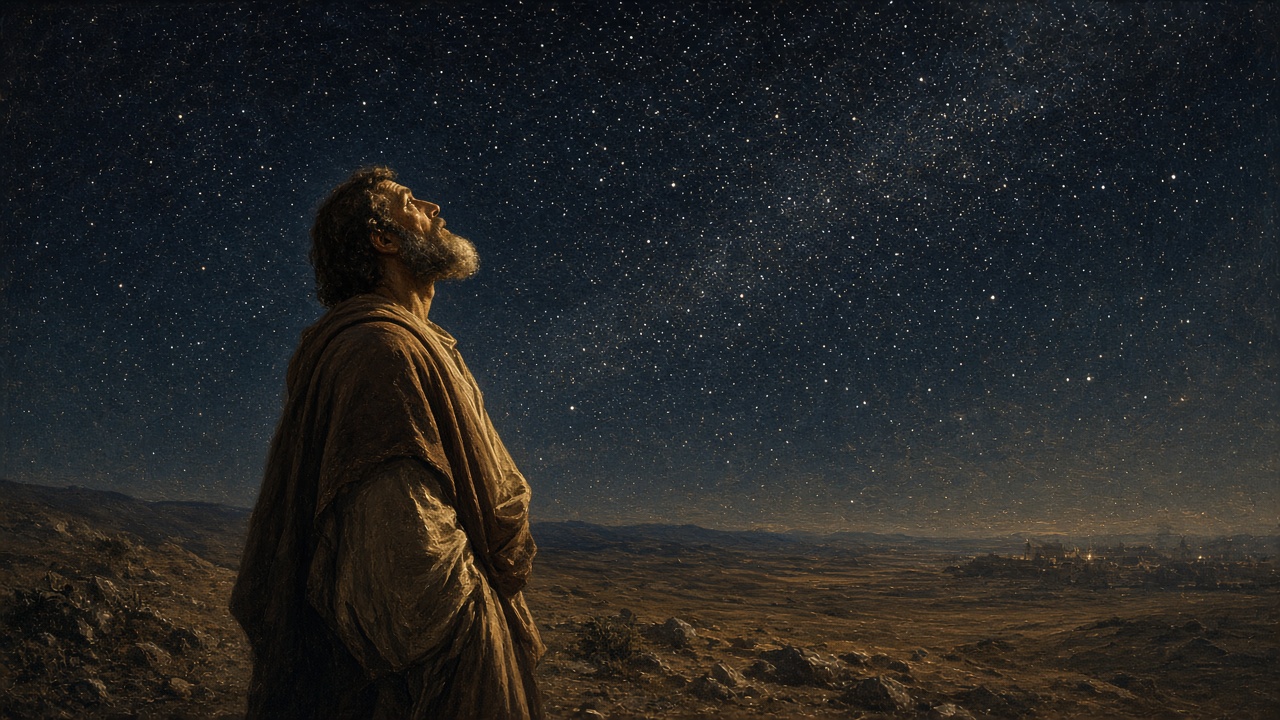
4Then the word of the LORD came to Abram, saying, “This one will not be your heir, but one who comes from your own body will be your heir.” 5And the LORD took him outside and said, “Now look to the heavens and count the stars, if you are able.” Then He told him, “So shall your offspring be.”
6Abram believed the LORD, and it was credited to him as righteousness.
7The LORD also told him, “I am the LORD, who brought you out of Ur of the Chaldeans to give you this land to possess.”
God Confirms His Promise
8But Abram replied, “Lord GOD, how can I know that I will possess it?”
9And the LORD said to him, “Bring Me a heifer, a goat, and a ram, each three years old, along with a turtledove and a young pigeon.”
10So Abram brought all these to Him, split each of them down the middle, and laid the halves opposite each other. The birds, however, he did not cut in half. 11And the birds of prey descended on the carcasses, but Abram drove them away. 12As the sun was setting, Abram fell into a deep sleep, and suddenly great terror and darkness overwhelmed him.
13Then the LORD said to Abram, “Know for certain that your descendants will be strangers in a land that is not their own, and they will be enslaved and mistreated four hundred years. 14But I will judge the nation they serve as slaves, and afterward they will depart with many possessions. 15You, however, will go to your fathers in peace and be buried at a ripe old age. 16In the fourth generation your descendants will return here, for the iniquity of the Amorites is not yet complete.”
17When the sun had set and darkness had fallen, behold, a smoking firepot and a flaming torch appeared and passed between the halves of the carcasses. 18On that day the LORD made a covenant with Abram, saying, “To your descendants I have given this land—from the river of Egypt to the great River Euphrates— 19the land of the Kenites, Kenizzites, Kadmonites, 20Hittites, Perizzites, Rephaites, 21Amorites, Canaanites, Girgashites, and Jebusites.”
Did you know?
Offspring and the Land of the Covenant
- Abram answered that he was still childless, so the heir of his house would be Eliezer of Damascus, a servant in his household. Easton's Bible Dictionary identifies Eliezer as the steward of Abraham’s house—the English Revised Version renders the word “possessor”—and says he was probably the servant later sent to find a wife for Isaac. The same dictionary places Damascus, the capital of Syria, about 133 miles north of Jerusalem, gives its modern name as Esh-Sham, “the East,” and notes that Scripture first mentions the city in connection with Abraham’s victory recorded in Genesis 14.Sources: the Bible text itself · Eliezer (Abraham's Steward) · Damascus
- The LORD told Abram that he had brought him out of Ur of the Chaldeans to give him this land. Easton's Bible Dictionary (1897) describes Ur as a city of the Chaldees, the largest city of Shinar or northern Chaldea, the principal commercial centre of the country and the centre of its political power, near the mouth of the Euphrates on its western bank, and gives its name as “light,” or “the moon city.” The same work says Abram had lived in Ur in his native country of Chaldea, then traveled with his father some 300 miles north to Haran.Sources: the Bible text itself · Ur of the Chaldees · Abraham
- On that day the LORD made a covenant with Abram, giving his descendants the land from the river of Egypt to the great River Euphrates. Easton's Bible Dictionary records the Hebrew name Perath and the Assyrian name Purat, and says the Assyrian name means “the stream” or “the great stream.” It also notes that the Bible generally calls the Euphrates simply “the river” or “the great river.”Sources: the Bible text itself · Euphrates
Notes written with AI assistance from open sources (Theographic Bible Metadata, CC BY-SA 4.0; Easton’s Bible Dictionary, public domain) and reviewed before publishing.
Places in this chapter
- Damascus · 33.511, 36.306 · verse 2
- Chaldea · 30.962, 46.104 · verse 7
- Egypt · 30.129, 31.308 · verse 18
- Euphrates · Today: Euphrates River · 31.004, 47.442 · verse 18
Only places identified with high confidence are shown (90% or more according to the scholarly sources compiled by OpenBible). Period map: DARE (Digital Atlas of the Roman Empire), CC BY 4.0; modern map: © OpenStreetMap contributors; places: OpenBible.info (CC BY 4.0).
Credits and license for this translation
Berean Standard Bible
The Holy Bible in English: Berean Standard Bible
Public Domain
Language: English
Contributor: BSB Publishing, LLC
2026-10-02
Source: http://ebible.org/engbsb/ · eBible.org